VI
VI


"Come over to my house to play."
The lush green of the mountains and the abundant mineral springs are two of Khansar's specialties that draw crowds of tourists. Friday, the weekend, is like Sunday in Vietnam, and people from all over the country flock here. Parking lots are packed, with cars overflowing onto both sides of the road.
Khansar's location on a mountain means its streets wind up and down slopes. Half mountain, half plain. Half city, half countryside.
Walking down the street, you suddenly come across a lush green barley field. Walking down the street, you suddenly find yourself climbing dozens of steps up a mountainside to reach another street. Walking down the street, you suddenly find a path leading to a water park overflowing with springs. Water is a special treat. For Iranians, just seeing water and playing in it is a joy.
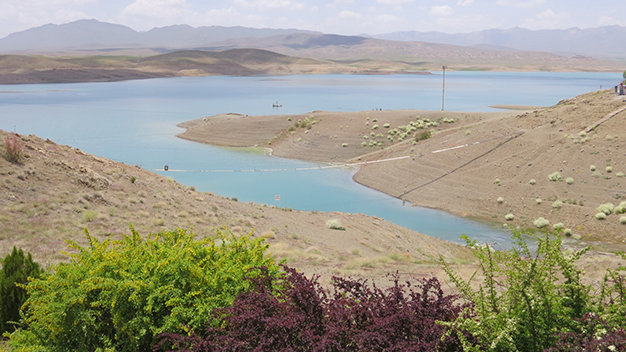
The mountain lake supplies water to five provinces in the region - Photo: HAT
At 3 p.m., in the spacious courtyard of the Zagros Hotel, while gazing up at the mountain behind the building, a few guys came up to introduce themselves. They spoke Farsi, I spoke English, and we quickly understood each other.
These guys are from Arak, about a hundred kilometers away. Today is their day off, so they've come here for a picnic. Where are they from? Vietnam. Vietnam? Come to my house, let's go tonight.
I remember on the way here, near Khansar, we decided to turn into a farm by the roadside. Lush greenery, crystal-clear water trickling down from the mountains. Loose earthen walls lined both sides of the garden path—a characteristic feature often seen in Persian tapestries.
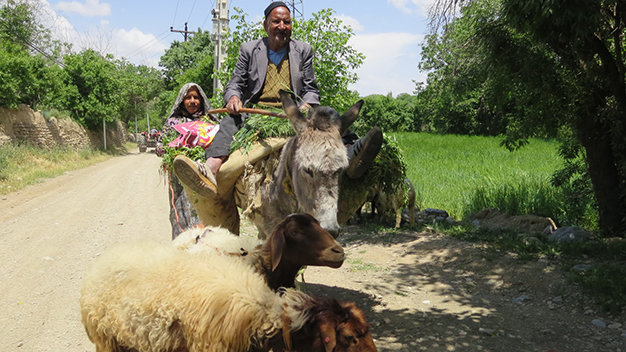

"Let's go home and have a drink of water" - Photo: Ho Anh Thai
Suddenly, there was the sound of bells. An old couple and their livestock approached from a distance. The old man sat on the back of a donkey laden with bundles of grass and vegetables. The old woman followed behind the donkey with several sheep.
We frantically snapped photos of the scene, as if it were a hundred years ago in Persia. We even asked the old man to stop his donkey so we could take more pictures. After we finished taking the photos and greeted him with smiles, the old man invited us in: "Let's go home and have some water."
That's Persian hospitality.
Hanging tulips, upside-down tulips, bell tulips
Actually, there's only one type of tulip. The flower is purplish-red; when it first blooms, it opens upwards normally, then after a while it closes downwards, and then opens upwards again before wilting.
The longest period is when the flowers droop downwards, resembling bells, clusters of bells hanging from the branches. Looking at these bell-like flowers, one can almost hear the tinkling of bells in the wind.
You call them hanging tulips, upside-down tulips, but I prefer to call them bell tulips. Well, whatever you call them is fine.
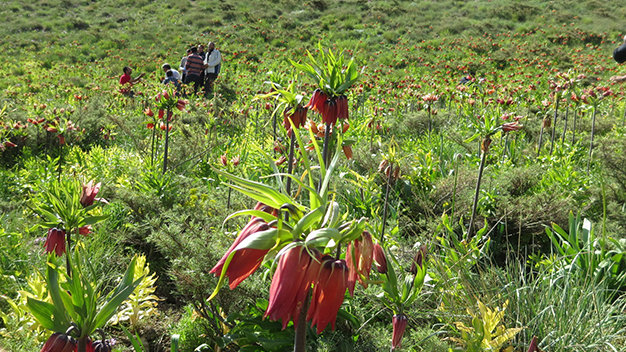
Climbing Mount Golestan to see bellflower tulips - Photo: HAT
The name Mount Golestan means flower garden or flower garden. The great ancient Persian poet Saadi has a collection of poems that have been translated into Vietnamese.Rose gardenIn its original Persian, the collection of poems was also titled Golestan. It was as if we were walking through Saadi's rose garden.
The name Khansar means "land of spring." It's best to visit in spring, or perhaps it's spring all year round. As mentioned above, this region has two specialties: plants and water. The plants produce flowers, the flowers provide honey for the bees, and the honey is considered the best in Persia.
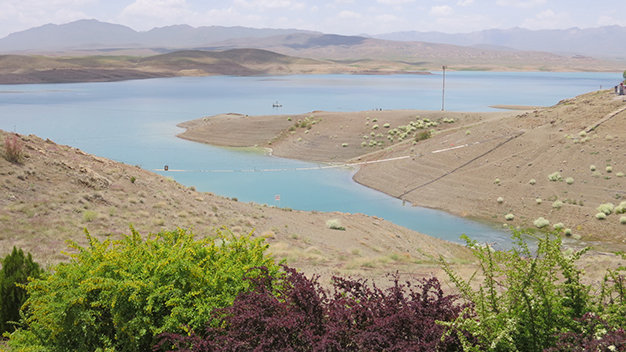
There is a special type of honey from an insect similar to bees, which is used to make a famous cake called "gaz," renowned throughout the region. Visitors always buy this cake to take home. Another water specialty is a large lake high in the mountains, with a dam built to supply water for five surrounding provinces.
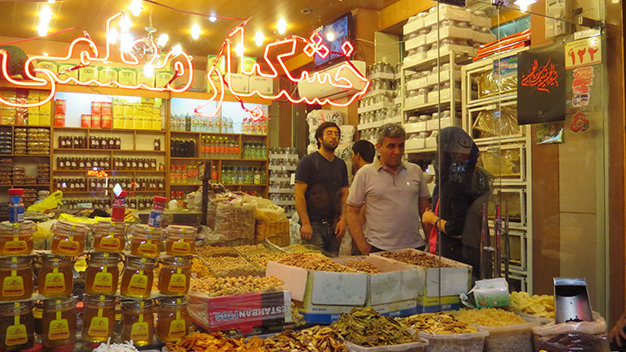
Buy Khansar specialties: honey and gas cakes - Photo: HAT
From above, the emerald green lake reflects the white clouds. Villas and resorts with bright red tiled roofs peek out from amidst the lush foliage, adding to the atmosphere of this springtime landscape.