VI
VI


Text and photos:Nguyen Chi Linh
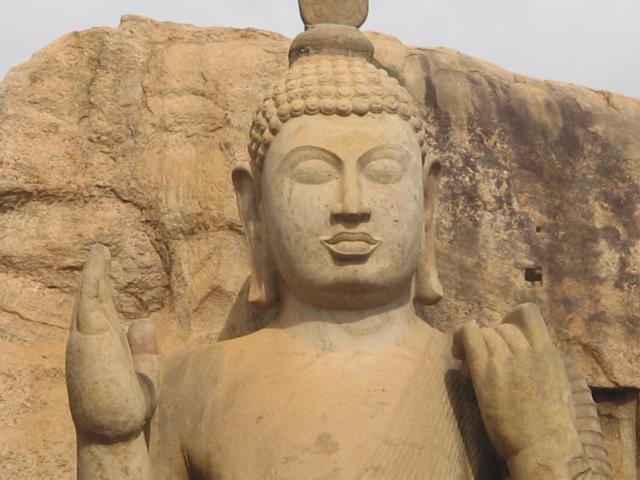
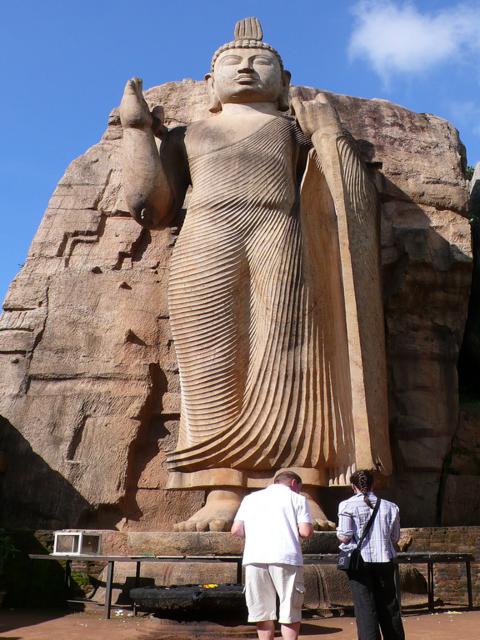
Ancient Aukana Buddha statue
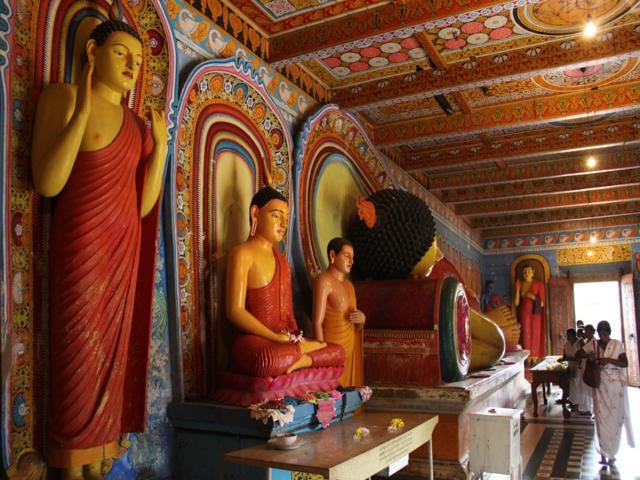
I took a bus from the new city center of Anuradhapura to Galnewa town, where the Kala Sela Saththu Patima temple houses the tallest ancient stone Buddha statue in Sri Lanka.
The pristine rainforests of this pearl-shaped country in the Indian Ocean offer a refreshing green hue that rushes by as the bus glides along. Kala Sela Pagoda came into view as the tuk-tuk reached the foot of the hill. Accompanying me on the winding steps was Amila and his family, a devout young man from the capital Colombo. Amila explained that in spring, he and his family try to visit all the most sacred temples in Sri Lanka to pray for blessings.
The Sri Lankan epic Mahavamsa recounts that, around the 5th century, a towering stone Buddha statue stood in a village called Aukana. The symmetrical statue, carved from a single massive block of stone, measured 11.58 meters in height, and including the pedestal, the entire statue reached 14.02 meters. This was the tallest Buddha statue in Sri Lanka and the second statue carved from a single massive block of stone in ancient South Asia (the first being in northern India, built by King Dharmasoka). Originally, the statue had a dome covering its head to protect it from rain and sun. However, the dome has deteriorated over time.
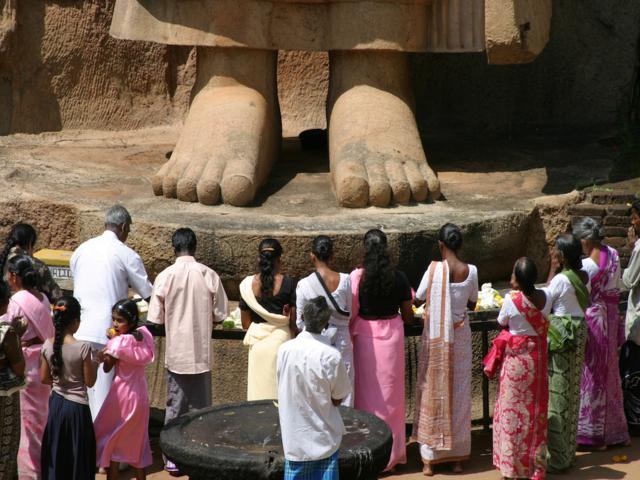
A sudden spring rain began to fall. Huddled under the temple eaves, I listened intently to the deep, resonant sound of the bells, seeking a sense of serenity, a place of pure spirituality, free from the calculations and struggles of life. Following the gesture of the elderly abbot Shehan, I looked up and sensed the mystical aura of the statue. After the rain, droplets of water trickled from the Buddha's head down his forehead, then to his nose. From the tip of his nose, they began to fall into the space between his toes.
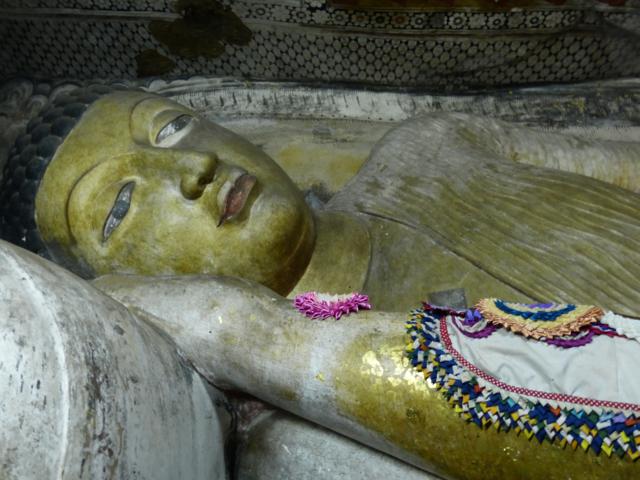
According to Venerable Shehan, another beautiful time to admire the Buddha statue is at sunset. When the last rays of the setting sun shine upon it, they combine with the color of the stone to give the viewer the feeling that the Buddha is radiating an "aura" to help Buddhists follow this aura to navigate through the "sea of suffering" of the world.

Explaining the history of the statue to me, the monk Shehan said there are many different theories. However, the most plausible is probably that the Muslims of Galwaduwagama village carved the Buddha statue from stone to give to their Buddhist brothers in the neighboring village of Nindagama to strengthen their loving and united relationship. They also intended to give it to King Dhatusena (who reigned from 459–477 AD) while he was a monk at Kala Sela Saththu Patima temple in Aukana village.
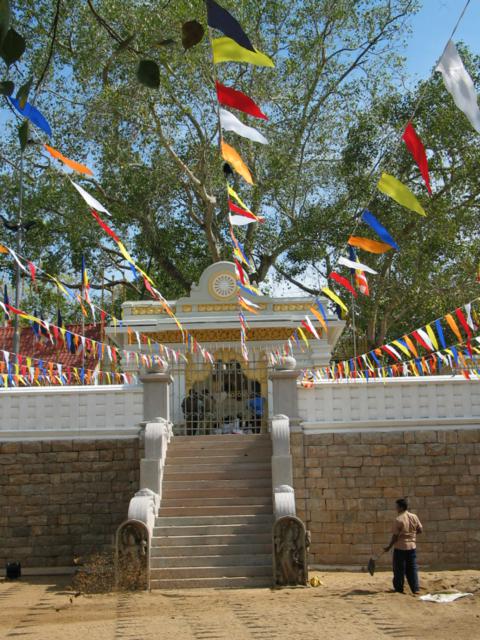
The Bodhi tree, over 2,000 years old, holds spiritual significance.
Anuradhapura was once the first Buddhist capital of Sri Lanka and a bustling commercial city in Asia during the ancient period from 500–250 BC. Today, Anuradhapura is divided into two parts, the old and new, with the remnants of its former golden age as a Buddhist capital still found in the old quarter.
I wandered into the royal palace, where a Bodhi tree, over 2,000 years old, is planted – a "spiritual treasure" of Anuradhapura, where Buddhists from all over the world come to worship. In front of the royal gardens, a large painting depicts the history of the Bodhi tree.
In 250 BC, Prince Devanampiya Tissa succeeded his father, King Mutasiva, as ruler of Sri Lanka. Due to his close relationship with Emperor Ashoka of India, the Indian king took a branch from the Bodhi tree where the Buddha attained enlightenment and presented it to King Devanampiya Tissa. This Bodhi tree was planted in the Mahameghavana garden, which King Mutasiva had previously built.
For some reason, the original Bodhi tree in Bodhgaya, India, died, so the Bodhi tree in Anuradhapura naturally became the original Bodhi tree. In the 19th century, the British took a branch from Anuradhapura and replanted it in the exact spot where the Bodhi tree had died in Bodhgaya. Because it houses a "treasure" of the Buddha, Anuradhapura is considered the second most spiritual city in Sri Lanka, after Kandy, where the Buddha's tooth relic is believed to be kept.
I bought a ticket to visit the Bodhi tree in the royal garden. The tree was surrounded by iron fences, and a pedestal had been built at its base, which from a distance looked more like a temple for worship than a tree-growing area. Bright, gilded iron bars were used by Buddhists to support the tree's massive, bending branches. They were designed like the scepters of the Anuradhapura dynasties, with the head of the scepter engraved with the emblem of King Devanampiya Tissa.
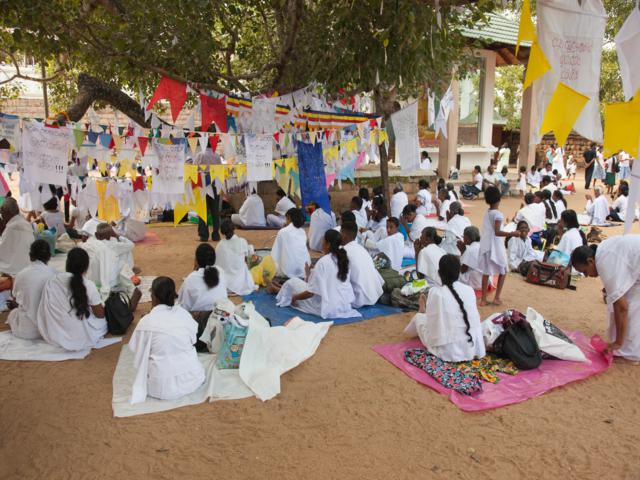
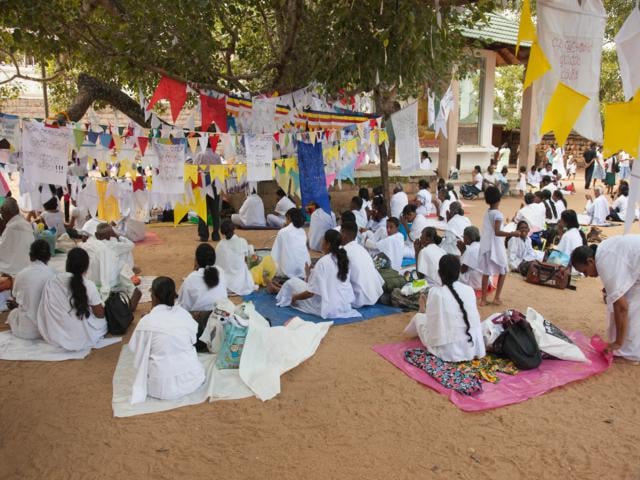
Beneath the large Bodhi tree stood a Buddhist temple, and outside, devotees attentively listened to the monks preaching. Although I didn't understand Shinhala, the local language, I joined the congregation in listening to the sermon. The melodious chanting of the scriptures, echoing continuously after each bell chime, brought me a sense of peace. Around the base of the Bodhi tree, people lined up in a circle to walk around it, and I didn't miss the opportunity because the Sri Lankan Buddhists had told me that walking around the tree would bring good fortune.
I wanted to find a young Bodhi tree to donate to a temple in Vietnam, as I had promised, but that was impossible now. Every Buddhist wants the chance to pick and cherish a fallen leaf. The guards wouldn't allow me to pick the leaves of the Bodhi tree. I walked around the royal gardens with the faint hope of finding young Bodhi trees growing in the mossy crevices where the wind had dispersed the seeds, but the walls surrounding the temple were spotlessly clean, without a trace of moss. I asked the guard on duty with a glimmer of hope. He pointed me to a nursery of young Bodhi trees, located next to the original tree and surrounded by iron fences. He told me, "That's a gift exchanged between Buddhist countries at the national level."
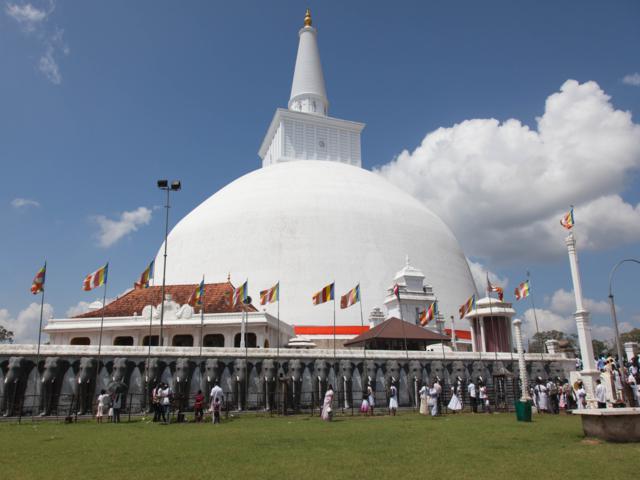
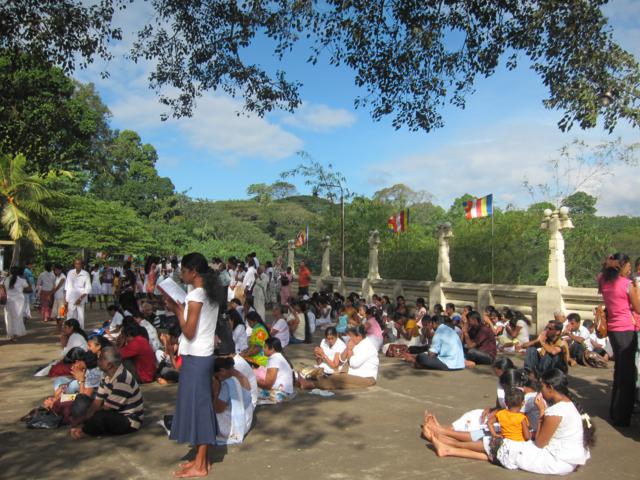
The sacred Ruwanweli Saya stupa, located about 200 meters from the Bodhi tree, was built in 140 BC and stands 103 meters tall. The white of the royal stupa blended with the golden light of the lamps, creating an even more mystical atmosphere. The surrounding square, approximately 290 meters wide, was filled with devout Buddhists praying and chanting. Amidst the lingering chanting, a Buddhist shared with me: “The ancient Buddhist civilization has deeply permeated our lives, even the young. It forms a very unique and distinctive characteristic of Sri Lanka compared to some neighboring South Asian countries.”
Listening to the evening bells brings peace of mind, reading a verse of scripture helps understand what to do and what not to do in daily life. During free time or on major national holidays, people flock to the temple to offer flowers and pray to Buddha for a better life…
During its spice trade, Buddhism from India entered Sri Lanka around the 3rd century BC, but it began to flourish and become the state religion of Sri Lanka around 250-210 BC under the devout king Devanampiya Tissa. Having evolved from Hinduism, most of the temple architecture in Sri Lanka features depictions of Apsara goddesses or Naga serpent deities in its patterns.
Although India is the birthplace of Buddhism, its architecture hasn't significantly influenced neighboring countries like Myanmar or Thailand because the majority of Indians follow Hinduism. However, along the cinnamon trade routes from port cities, the architecture of temples in Sri Lanka has influenced Theravada Buddhist countries. The image of the Ruwanweli Saya stupa shimmering in the sunset before me brought back memories of my days in Myanmar and the northern cities of Thailand.
The central tower symbolizes the cosmic mountain Meru, with its central peak representing the mountain deity Meru. The surrounding smaller towers are rings of mountains, tiered structures in the shape of the sea monster Macara, and the serpent Naga symbolizing the ocean. The image of the mountain deity also represents the Nirvana that monks envision during meditation.
As twilight descended, the sacred tower, illuminated by countless lights, stood out strikingly as darkness gradually spread. I walked along the cobblestone path back to the hotel with light steps. In the distance, the city of Aunradhapura was slowly sinking into golden lights, the deep, resonant sound of bells from the temples in the ancient capital still lingering…
Additional information:
1. Flights from Saigon or Hanoi to Sri Lanka are available with airlines such as Thai Airways, Malaysia Airlines, Singapore Airlines, and Air Asia.
2. From Colombo (the capital of Sri Lanka), visitors can take a high-quality train or bus to reach Anuradpuhara.
3. The currency of Sri Lanka is the Rupee (LKR). The exchange rate is 1 USD = 130 LKR.
4. With a 50 USD entrance ticket sold at museums, you can visit any of the attractions in Auradhapura city and also the seaside city of Galle in southern Sri Lanka.
5. Visit the archaeological site located next to the old Anuradpuhara area, including: the 120m high Jetavana tower (second only to the Egyptian pyramids in height in ancient times), the archaeological museum, the royal palace with many religious schools, and Lovamahapaya with 1,600 stacked stone pillars…
6. If you enjoy hiking, you can climb to explore the Mihintale rock formation.(350m high) located about 10km from the city center and Ritigala Mountain(765m high) located approximately 40km from the city center.
7. Rent a vehicle to go trekking in the forest and observe wildlife.