VI
VI


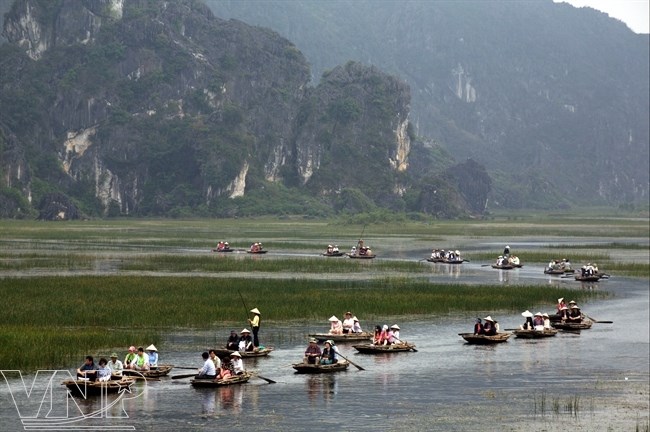
Sitting in small boats rowed by local people in Van Long (Gia Vien, Ninh Binh), while being guided through the history and culture of the area, is a fascinating experience when exploring this wetland nature reserve. Our first impression upon arriving in Van Long was hearing Mr. Nguyen Dinh Tan, the tour manager, introduce the tourist attractions in his hometown. He recounted the story of a tourist from France named Robest who was searching for a place mentioned in his father's memoir, a former soldier who fought in the Vietnam War.
Tourists from all over flock to Van Long to immerse themselves in the scenery of lush green mountains and clear blue waters.
In that memoir, there is a passage that reads: “September 24, 1943... On the march in Northern Vietnam, there was a strange wetland area. In autumn, birds flocked here in droves. Every evening, troops of monkeys and gibbons came down from the mountains to drink water and forage, as if it were a place untouched by human footsteps...”
Robest arrived in Gia Vien in the fall of 2011, carrying excerpts from his memoir, and asked the locals for their opinions. After being introduced to and visiting Van Long for a day, Robest confirmed that this was indeed the mysterious land where his ancestors had been stationed during their military campaigns. Robest's story was only for informational purposes regarding Van Long, but it piqued our curiosity and prompted us to explore further.
The Van Long Wetland Nature Reserve covers more than 3,500 hectares, surrounded by a concrete dike system over 20km long. Around the reserve are villages characteristic of the Northern Delta, places that foreign tourists love to explore by ox cart or bicycle, enjoying the peaceful atmosphere of the countryside.
Alternatively, if visitors wish to explore the landscape of Van Long Nature Reserve, their only option is to travel by small boat, rowed and guided by local people, along the single waterway from Van Long wharf into the reserve.
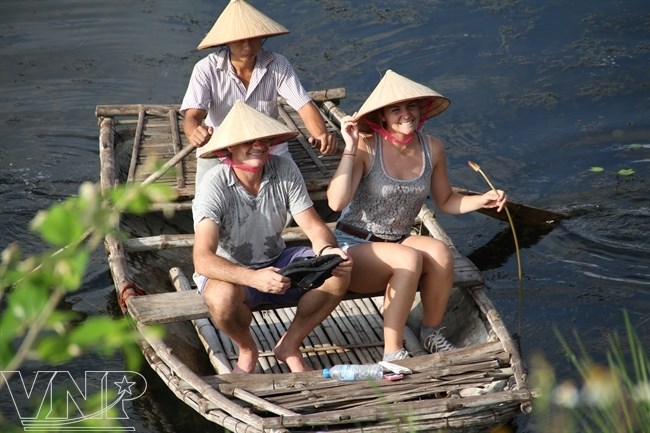
Foreign tourists enjoy the novel experience of riding in small boats on the turquoise waters.

The traditional bamboo boats of the local people here are very versatile. Previously, these boats were used for transportation and fishing in the wetlands, but since Van Long developed into an ecotourism area, about 400 of them are now used to transport tourists. At a price of 75,000 VND per person, this service provides a significant source of income for the local residents.
Our journey, as described by our boatwoman Thuy Lan, would take us north of the Van Long Wetland Reserve, then the boat would follow the foothills eastward.
The small boat took us through a tiny creek towards the foot of the mountain. The surrounding reeds and rushes were lush green, and looking down into the water, we could see layers of vibrant green algae and schools of fish swimming among the water.
Our boat weaved through the reeds, catching the cool breeze blowing in from the east, stirring the peaceful landscape. In the distance, the fishing boats of the local people cast their reflections on the water; even a small fish surfacing to gasp for air would create ripples that spread across the area.
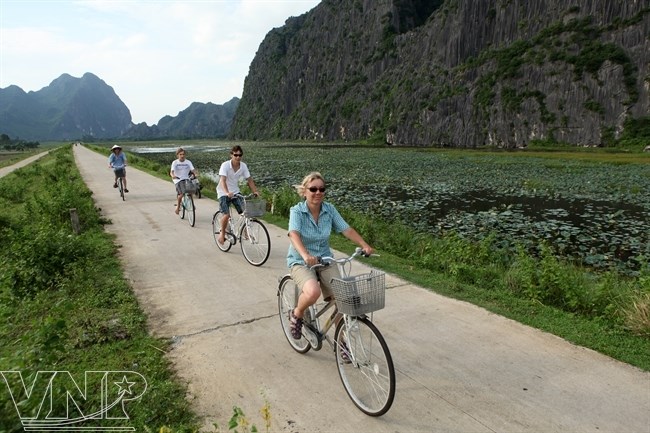
Or you could freely roam around by bicycle.
As a professional tour guide, Thuy Lan told us the legend of the highest mountain here. Long ago, a fairy visiting the mortal world passed by this mountain peak. Seeing the picturesque scenery, she stopped to admire it and fell in love with a poor young man living on the mountain, diligently studying. Their love story, a clash between the fairy and the mortal world, was punished by heaven, transforming them into two mountains named Nghiên Mountain and Cô Tiên Mountain, standing close together but forever unable to become husband and wife.
On our next leg of the journey, we crossed mountains with names associated with interesting legends, such as Cat Scratch Mountain, Sticky Rice Mountain, Bookcase Mountain, and Table Stone Mountain... The most exciting part was when we arrived at the heron island area at sunset. This is a flooded forest area nestled amidst reeds, a gathering place for migratory birds that come to roost in the winter.
At this time of year, many migratory birds from the North, such as Bonelli's eagles, grey herons, great egrets, kingfishers, grey herons, white egrets, and bitterns, gather and fill the sky, creating a fascinating scene of rivers, clouds, and flying birds.
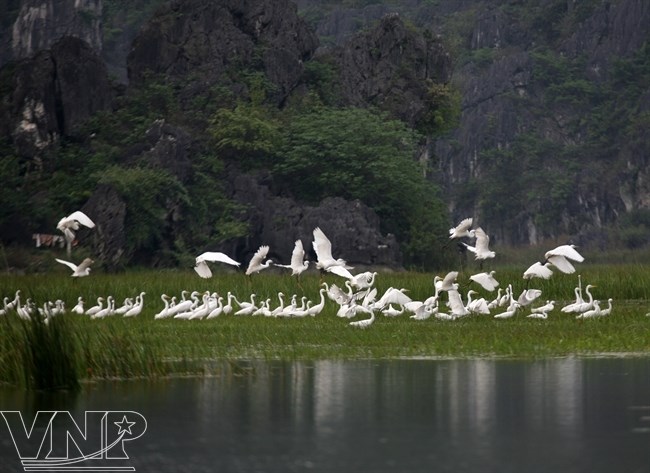
In autumn, flocks of white egrets fly gracefully over the reeds growing in the flooded swamps.
As the afternoon sun faded behind the towering limestone mountains, Thuy Lan informed us that we might encounter langurs descending from the mountains to the lagoon to drink water and forage. We spotted a large langur perched precariously on a mountaintop in a ravine. Upon seeing our boat, the langur climbed deeper into the dense foliage.
According to Thuy Lan's experience, on humid, foggy days, you can encounter a troop of more than a dozen langurs coming down from the mountains. If they encounter tourists in boats, the langurs will scatter and call out to each other as they head back up the mountain.
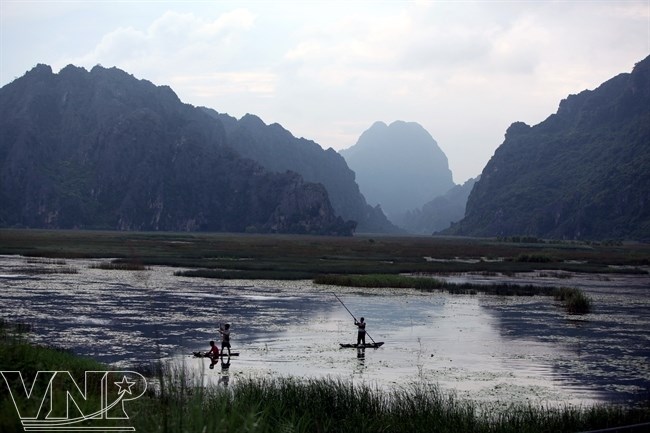
As evening falls, the sky and waters of Van Long are tinged with a melancholic mist.
As the day drew to a close, the sky was filled with hazy clouds, and in the distance, the calls of cranes and the rustling of reeds evoked the serene sounds of a peaceful landscape.