VI
VI


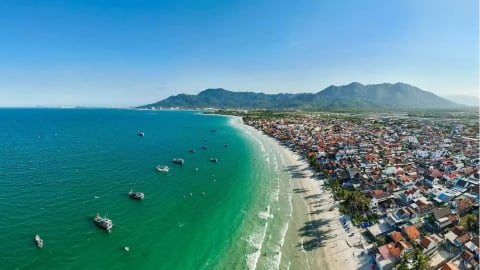
Ly Son Island, also known as Cu Lao Re, is an island district of Quang Ngai province. Ly Son has three communes: An Vinh and An Hai (located on the main island) and An Binh (on the smaller island). The main island of Ly Son was formed by five (inactive) volcanoes, covering an area of over 10 square kilometers with a population of more than 20,000 people.
Ly Son Island boasts a rich and long-standing cultural history. Archaeological sites reveal the Sa Huynh culture, which appeared on Ly Son Island over 2,500 years ago and lasted until the first century AD. Vietnamese people began settling on Ly Son Island in the 16th century, initially from the An Hai and An Vinh communes near the Sa Ky estuary in Quang Ngai province, later establishing the An Hai and An Vinh communes on Ly Son Island.
Ly Son is the homeland of the Hoang Sa Fleet. It was here, since the time of the Nguyen lords of Dang Trong, that the Hoang Sa Fleet was established and operated, and its soldiers braved the stormy seas of the East Sea to assert Vietnam's sovereignty over the Hoang Sa and Truong Sa archipelagos.
Today, this small and beautiful island boasts dozens of relics related to the Hoang Sa Fleet, serving as clear and compelling evidence that Hoang Sa and Truong Sa belong to Vietnam.
.jpg_0.jpg "LySon-(01).jpg_0.jpg")
Ly Son Island was formed by five volcanoes: Thoi Loi Mountain, Hon Soi Mountain, Gieng Tien Mountain, Hon Tai Mountain, and Hon Vung Mountain. Of these, Gieng Tien Mountain and Thoi Loi Mountain are the two largest.
.jpg_1.jpg "LySon-(2).jpg_1.jpg")
Panoramic view of the Gieng Tien volcanic crater – An Vinh commune
.jpg_2.jpg "LySon-(03).jpg_2.jpg")
"To Vo Gate" on the western coast of An Vinh commune - a remnant left by a volcanic eruption.
.jpg_3.jpg "LySon-(04).jpg_3.jpg")
The lighthouse is located on the eastern side of the island, in An Hai commune.

.jpg_4.jpg "LySon-(05).jpg_4.jpg")
A view of Ly Son Island from the lighthouse.
.jpg_5.jpg "LySon-(6).jpg_5.jpg")
The rice fields of An Hai commune as seen from Thoi Loi mountain.
.jpg_6.jpg "LySon-(07).jpg_6.jpg")
Am Linh Temple - a shrine dedicated to the soldiers who served in the Paracel Islands. This is a National Historical Monument.
.jpg_7.jpg "LySon-(08).jpg_7.jpg")
The wind-blown graves of soldiers from the Paracel Islands in front of the Am Linh Temple.
.jpg_8.jpg "LySon-(09).jpg_8.jpg")
The tomb of the Hoàng Sa commander Phạm Quang Ảnh (during the reign of Emperor Gia Long of the Nguyễn dynasty) is located in An Vĩnh commune.
.jpg_9.jpg "LySon-(a).jpg_9.jpg")
An Vinh communal house, built in the late 18th century, has undergone several renovations. The current communal house was renovated in 2009. An Vinh communal house is the site of the Khao Le The Linh Hoang Sa ceremony, where soldiers depart for their missions in the Hoang Sa Islands. An Vinh communal house is a National Historical Monument.
.jpg_10.jpg "LySon-(b).jpg_10.jpg")
The An Hai (Ly Hai) communal house was built in 1820 during the reign of Emperor Minh Mang of the Nguyen Dynasty. The An Hai communal house is the site of the Hoang Sa soldiers' memorial ceremony, commemorating the soldiers who lost their lives while on duty in the Hoang Sa sea. The An Hai communal house is a National Historical Monument.
.jpg_11.jpg "LySon-(c).jpg_11.jpg")
The Hoang Sa and Bac Hai Fleet Exhibition House is a replica of traditional architecture with a roof and decorations in the Nguyen Dynasty style; completed in January 2010. It displays artifacts and documents recreating the activities of the Hoang Sa and Bac Hai Fleet; along with artifacts, documents, and images related to the Hoang Sa Fleet's hometown in Ly Son Island District, Tinh Ky Commune - Son Tinh District, and Binh Chau Commune - Binh Son District, and images and documents related to Vietnam's sovereignty over the Hoang Sa and Truong Sa archipelagos.
.jpg_12.jpg "LySon-(d).jpg_12.jpg")
A model of a fishing boat used by the Hoang Sa Fleet (restored by artisan Vo Hien Dat - An Vinh commune, Ly Son district).
.jpg_13.jpg "LySon-(e).jpg_13.jpg")
Memorial tablets of the commanders and heroes of the Hoang Sa Team (restored artifacts)
.jpg_14.jpg "LySon-(f).jpg_14.jpg")
The Hoang Sa Team Monument is located in front of the Hoang Sa Team and Bac Hai Management Exhibition House. The monument depicts a group of three people: the central figure is the Commander (the leader of a group of three boats that sailed to Hoang Sa at once), wearing a court official's robe and holding a sovereignty plaque inscribed with the four characters "Van Ly Hoang Sa" (meaning "Ten Thousand Miles of Hoang Sa"); on either side are two militiamen carrying spears and nets. The sculptor is Ha Tri Dung. The work was completed in September 2009. The monument is a symbol of Vietnam's sovereignty over the Hoang Sa archipelago.