VI
VI


Anyone can enter the culture.
Located at 4 Nguyen Trung Truc Street (Hanoi), Engels Cafe opens up a different timeline. Just stepping through the door, one feels as if they've traveled back in time, transported to a "miniature cultural museum" hidden within an old French house built in 1940.
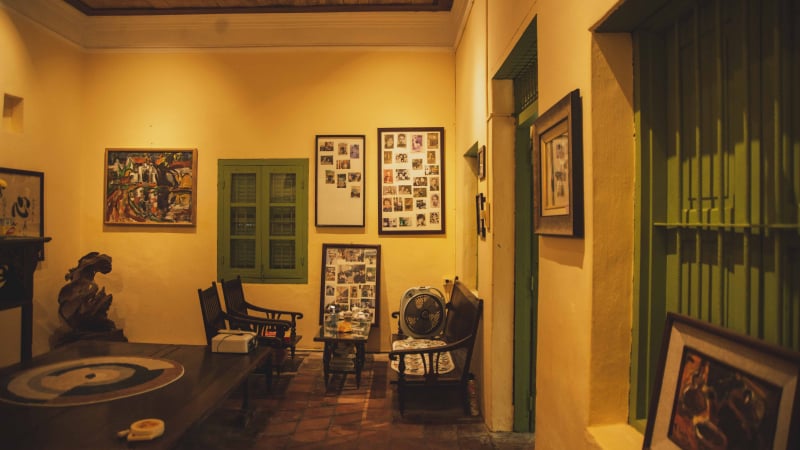
Quiet and unassuming, Engels is completely separate from the bustling city outside with its tranquil atmosphere, steeped in culture and history. Old paintings, exposed brick walls, wooden staircases, soft yellow lighting… all create the feeling of visiting an art collector's private space rather than a typical café.

The Engels café is inspired by the name of the theorist and philosopher Friedrich Engels.

The "old" charm of the modern era, subtly infused with Western elegance.
The owner, Lan Anh, after more than 10 years of working in an office with a long and stressful schedule, decided to leave that routine to pursue her passion. After switching to remote work, she had more time for herself and boldly opened a restaurant despite having no prior experience in the F&B industry.
Initially, her idea was to open a mini gallery showcasing antiques and art, but Lan Anh quickly realized that a café would offer a better opportunity for interaction with visitors. "I want people to feel like they're visiting a familiar, accessible, and relatable cultural space when they walk in. There's no need to pretend to love poetry or art; this place is designed for anyone to step in and enjoy," the owner shared.

A blend of traditional Vietnamese and Western colors.

From religion, jewelry, and clothing to drinks, and even philosophical and humanistic aspects… everything is skillfully interwoven.
The cafe's name is inspired by the theorist and philosopher Friedrich Engels – a friend of Karl Marx, who belonged to the capitalist class but dedicated his life to studying communism and humanistic values. According to Ms. Lan Anh, it's an interesting "connecting point" that links philosophy, ideology, religion, and life, making it easy to remember for both Vietnamese and international customers. Engels attracts a large number of young people, especially students, who come to find creative inspiration from artistic materials, while culture lovers consider it a familiar meeting place for dialogue.

"Vietnamese culture needs a common ground," the owner said. "From religion, jewelry, clothing, drinks… to ideology and humanism." Engels thus becomes a place where many elements that make up Vietnamese identity intersect, recounted in a gentle, non-dogmatic way.


Each element appears in small amounts, just enough to pique curiosity and make the viewer pause to "feel" it for longer.

The well-preserved ancient books are carefully displayed.
A space that is old-fashioned, elegant, and Western in style.
What sets Engels apart from the countless other vintage-style cafes in Hanoi is its blend of old-world charm and Western influence. It's not a typical Vietnamese village setting, but rather evokes a colonial era, a modern period, meticulously restored and preserved. On the wooden shelves, tea tables, and corners, you'll find bronze, ceramics, statues, paintings, and antique books – arranged simply but purposefully. Each material appears in small amounts, just enough to pique curiosity and encourage viewers to linger and appreciate it.
Engels' true appeal lies in the diverse cultural treasure that Ms. Lan Anh has quietly accumulated over more than a decade out of passion. The cafe's space is like a flow of memories, where each artifact, from bronze and ceramics to statues and paintings, tells the story of the skillful hands of Vietnamese artisans from the 12th and 13th centuries. There you'll find Dao people's ancestral paintings, ancient books written in classical Chinese that are still intact and respectfully displayed, and even worn-out pages cut and pressed into coasters, continuing a new life cycle…

The Dao people's ancestral paintings remain intact, a collection rarely found in northern Vietnam today.


Ms. Lan Anh also connects with elderly artisans in the highlands, bringing unique, non-mass-produced handcrafted products closer to tourists right in Engels. Even rarer is the set of 12 intact Dao ethnic group altar paintings, a collection difficult to find in Northern Vietnam today. Even broken pieces of pottery are "elevated" by applying gold-plated edges in the Japanese kintsugi style, transforming them into symbols of cherished heritage. "Even though they're broken, holding them still makes me proud because the technique and artistic eye of our ancestors reached such a high level," Ms. Lan Anh said.
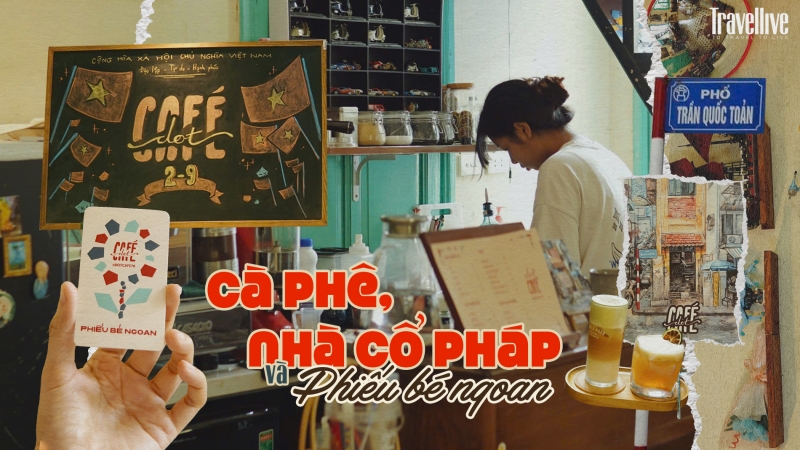
The menu at Engels is also unique, combining traditional Vietnamese drinks and snacks. Diners feel transported back to Hanoi in the 1940s, where each cup of iced coffee or egg coffee carries a story of the capital's culture and history. Accompanying pastries like Hue-style pressed cakes or sticky rice cakes evoke nostalgic flavors… Each sip of coffee or cup of tea at Engels is not just a beverage, but a small journey into the past, where history meets culture.


The worn-out pages of the book are cut and pressed into coasters, continuing a new life cycle…
In recent years, the wave of celebrating Vietnamese traditional culture through music and art programs has become a great source of inspiration, prompting Lan Anh to open her shop. For her, this is a small but practical way to contribute to sharing and preserving the beauty of the nation. Despite the increasing difficulty and scarcity of antiques, and the challenge of ensuring their integrity, she perseveres in transforming Engels into her own dream "office."
Amidst rapidly changing trends, Engels chooses a slower pace. The owner believes that "culture cannot be rushed." And perhaps that's what makes this place a special stop; not just for drinking coffee, but for touching time, history, and cultural stories that are still whispered.


Engels's work goes beyond mere exhibition; it also sparks curiosity and encourages dialogue about Vietnamese culture.