VI
VI


In the heart of the Italian capital, amidst masterpieces like the magnificent Baroque Trevi Fountain, the majestic Pantheon, and bustling ancient squares, the Colosseum still stands tall as one of the greatest historical witnesses.
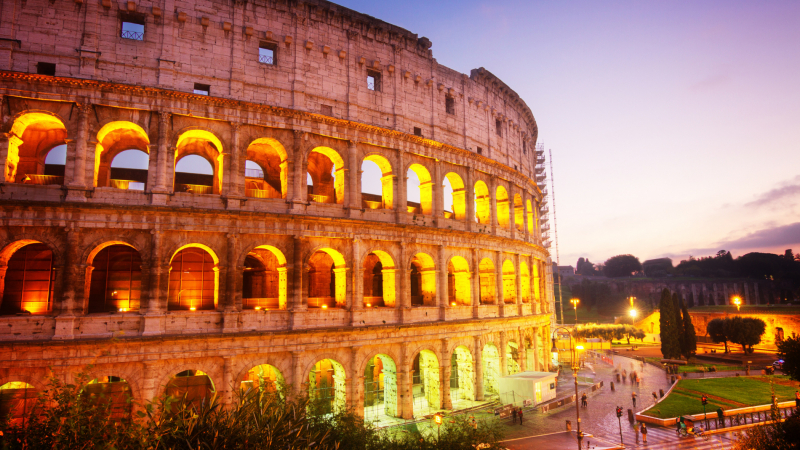

For anyone passionate about travel, a trip to Rome or exploring Italy would never be complete without standing before this monument. It is not only a witness to the golden age and peak of power of the ancient Roman Empire, but also an enduring symbol of the passage of time, where the past and present miraculously intertwine.
The first impression visitors have upon encountering this wonder is not simply the colossal stone walls or the immense scale of its sturdy architecture, but rather an intangible yet powerful feeling: time seems to slow down.
Amidst a modern, dynamic city with a constant flow of international tourists, this nearly 2,000-year-old structure still stands as a proud reminder of a glorious historical period, a place that laid the foundation and profoundly influenced the entire Western civilization.

Having withstood nearly 2,000 years of historical upheaval, the Colosseum still stands tall in the heart of Rome.
From the monumental achievements of the Roman Empire to timeless global icons.
Begun around 70 AD during the reign of Emperor Vespasian and completed in 80 AD under the reign of Emperor Titus, it once held the position of the largest amphitheater of the Roman Empire.
With an estimated capacity of 50,000 to 80,000 spectators, the structure was optimally designed to serve large-scale public events and legendary gladiatorial contests, clearly reflecting the affluent social life and the role of the entertainment industry in ancient civilizations. The presence of this architecture also affirms the superior organizational capabilities, masterful construction techniques, and grand expansionist ambitions of an empire that once reigned supreme over many territories.

Today, looking at the remaining structural elements and arches, many tourists and researchers still ask themselves: how could a structure built nearly two millennia ago, with rudimentary tools, have survived to this day?

Construction techniques that stand the test of time, spanning millennia.
The answer lies in the timeless, advanced construction techniques of the ancient Romans, their exclusive use of concrete and natural limestone materials, combined with rigorous restoration and preservation efforts spanning centuries. Despite enduring a series of devastating earthquakes, the ravages of war, and countless historical upheavals, the structure remains a lasting symbol, defying the harsh laws of time.
The miracle doesn't lie on the ground.
For many, the most valuable and memorable experience at this site isn't the moment of gazing at the colossal facade from the outside, but rather when they descend and explore the underground structure beneath the arena floor – known as the Hypogeum system.
This complex network of tunnels, fortified underground spaces, and mechanical operating areas once played a core role in organizing gladiatorial contests. It served as a place to confine wild beasts, prepare weapons, and as a secret passage for gladiators before they emerged into the open, demonstrating the sophistication and pinnacle of ancient architectural engineering.

The complex network of underground tunnels once served as a prison for ferocious beasts.
It is these surviving structural elements that have made history more vibrant and accessible than ever before, instead of just dry words existing in books or museum display cases.
Standing amidst the time-worn stone corridors, listening to the echoes of a thousand years ago, your trip will no longer be just an ordinary sightseeing tour. It is a true journey back in time, allowing modern humans to visually observe how a great civilization once operated and flourished.
The great legacy of civilization has faded into the past.
One of Rome's most captivating features is that its history is not isolated within individual landmarks, but rather forms a closely interconnected heritage complex.
Just a few minutes' walk from the arena, visitors can easily continue their journey to the Roman Forum (Roman Market) – the most bustling political, religious, and economic center of the ancient nation. A little further is the legendary Palatine Hill, associated with the legend of the ancient city's creation.
Parts of the vaulted structure have collapsed over the years, and many valuable materials were dismantled and reused for other constructions during the Middle Ages and the Renaissance. However, the powerful allure that continues to attract millions of visitors each year lies not only in its age but also in its ability to awaken human consciousness.

It makes us realize that there are civilizations that, though long gone, still leave a profound mark on architecture, thought, and how we perceive the world today.
Ultimately, what resonated most deeply from the trip wasn't the glamorous check-in photos, but the moment when the soul connected with the story of a civilization that once helped change the course of human history.