VI
VI


What caught my attention right now was a very strange "curse" of the World Cup: In recent tournaments, any team that eliminated Japan in the final knockout round was subsequently defeated by the eventual champions. If that pattern continues this time, Norway's path ahead will suddenly resemble a Norse epic more than a simple football journey.

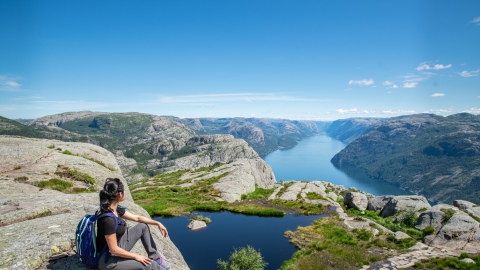
My first trip to Norway began in Oslo and ended on Trolltunga, the world-famous rock formation known by the challenging name: "The Devil's Tongue." It wasn't until many years later that I realized what I brought back from Norway wasn't just a photograph of myself standing amidst the clouds, but a different perspective on the limits of human potential.
Oslo, where mythology exists not just in stories.
Oslo didn't overwhelm me like many other European capitals. The city is so peaceful, tidy, and understated that it sometimes makes you forget it was once the home of famous Viking warriors.

The Storming Building, the seat of the Norwegian Parliament, in the capital city of Oslo.
I spent time strolling along Aker Brygge harbor, visiting Akershus Fortress, and then stepping into the Viking Ship Museum to see the wooden ships that have rested for over a thousand years. The Norwegians don't seem to place the past on a pedestal of reverence. They live with that past so naturally in their present lives, as if the Viking ships had never truly left these waters.
Norse mythology is no different. Odin, Thor, and Loki not only exist in the pages of ancient history, but also subtly appear in the names of mountains and waterfalls, in the stories children grow up with, and even in the way Norwegians interact with nature.
What is most memorable about these gods is not their power, but their fate. Even Odin knew Ragnarok would come, the end of the world that no god could escape. They knew they could fail, yet they still entered the final battle. Therefore, after each story, what remains is not victory, but courage.

The Norwegian National Theatre in Oslo

Oslo harbor opens up to a peaceful Norway by the sea.
In Oslo, that spirit is no longer present on Viking ships that crossed the seas, but quietly lives on in the way Norwegians treat nature, in their composure in the face of the unchangeable, and in the way they overcome challenges as a normal part of life. A few days later, I myself had to face a small challenge to understand why that spirit has remained intact in this land for thousands of years.

Trolltunga, where humans seek to push their own limits.
From the capital Oslo, I took an overnight train to Odda, a small town nestled in the mountains of western Norway, the gateway to Trolltunga. Almost all my plans changed the moment I arrived. The previous day's bad weather had forced many to turn back, and the forecast for the following day predicted heavy rain.
If I didn't leave that day, I would have had to give up on Trolltunga because my schedule wouldn't allow it. My backpack only contained a water bottle, two bananas, a chocolate bar, and a hiking stick I'd borrowed from the hostel. I wasn't sure if I was fully prepared for the journey, but sometimes you only truly know your limits after you've started walking.

The journey to Trolltunga challenges your legs and patience.

The higher you go, the more magnificent the scenery becomes.
The first two kilometers were quite easy. The green slopes, small streams, and fresh air made me think that all the warnings about Trolltunga had probably been exaggerated. But the higher we climbed, the stronger the wind became, the steeper the slopes grew, and each red T-marker along the way seemed further away than I had imagined.
There were times when I stopped thinking about that famous rock formation. I only thought about having to walk a few dozen meters more, then another few dozen meters. Each step was slower than the last, but if I stopped, I probably wouldn't have the courage to continue.
Strangely, amidst the exhaustion, I received so much motivation from complete strangers. Greetings, smiles, and encouraging nods halfway up the mountain made the journey much warmer. I met elderly people with gray hair steadily climbing, families with young children, and even innocent dogs running on the rocky slopes. No one tried to overtake anyone else. Each person patiently walked at their own pace.

The red T-shaped marker, a familiar symbol guiding the way on Norwegian trekking routes.

There are 8 km left – a number that reminds us the finish line is just ahead.
It wasn't until I stood on Trolltunga, gazing at the rocky outcrop reaching towards the sky and the deep blue lake below, that I understood why this place holds such a special allure. What truly stands out isn't the photo on the "Troll's Tongue," but the entire journey to get there. Nature remains, neither winning nor losing. Ultimately, the only one to overcome is oneself. Perhaps that's why Trolltunga is never just a place to conquer a rocky outcrop in the open air. It's a place where each person quietly overcomes another mountain, a mountain within themselves.
For me, years after leaving Norway, what remains is not the photograph on Trolltunga, nor the grandeur of the fjords or glaciers, but the feeling that I once set foot in a place where challenges were never seen as something to be avoided. They were simply a part of the journey of growing up.

Trolltunga, a rock formation over ten thousand years old, created during the Ice Age, where every step becomes a part of a memory.

Suspended between heaven and earth at Trolltunga, a symbol of Norway, this is a place where people come to challenge their own limits.
World Cup: When myths step onto the pitch.
After my trip to Norway, I no longer see their national football team as just a phenomenon of the 2026 World Cup. I see in them a continuation of a spirit that has been nurtured for a long time in the Nordic countries.
Norway has never been a world football powerhouse. With a population of just over five million and a relatively short World Cup history, Norwegian football, like Trolltunga, is not for those who give up easily. They always inspire a sense of readiness to face challenges with everything they have. They may not be the strongest team, but they command respect for their perseverance and resilience.
If the "curse" of this year's World Cup truly continues, Norway could go very far. But for me, what's more important isn't whether the curse is right or wrong. It's about how a nation that always faces challenges with its characteristic composure will continue its journey on the pitch. Because sometimes, legends aren't created by the strongest teams, but by those teams that make the world want to believe in the impossible once more.

Viking warriors are now only found in souvenirs, but their spirit is still present in the way Norwegians approach every challenge.
These days, the World Cup stands and the squares overflowing with fans, the Viking hats, the faces painted in the three colors of red, white, and blue, and the waves of cheering sweeping across the stadiums give me the feeling that Norse mythology never truly ends. It just changes battlefield, from ships sailing across the sea to a rectangular grass field.
If a new Nordic legend is truly to be written at this summer's World Cup, it will probably begin like every other legend: with a single step.