VI
VI


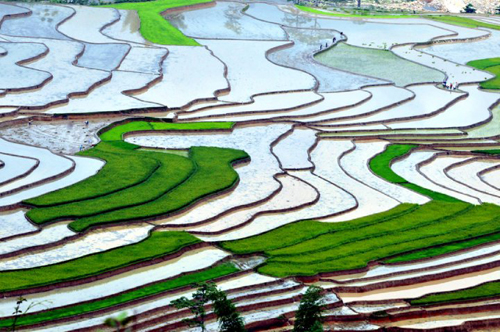
The ethnic minorities in the highlands of Yen Bai cultivate rice on the high mountain slopes. After spring, they wait until the rains come, when the terraced rice fields are flooded (known as the "water pouring season"), before they can begin planting the only rice crop of the year. The Thai people establish villages in the lowlands, growing upland rice in the Tu Le valley. Meanwhile, the Mong people, skilled at climbing mountains, have transformed the treacherous mountain slopes into stunning terraced rice fields. The skillful and diligent hands of the Dao, Mong, Ha Nhi, Giay, Tay, Xa Pho, Nung, and Pa Di people, generation after generation, have created these masterpieces.
 |
| The rice paddies shimmer with water under the sunlight. Photo: Vu Long. |
The only road to Mu Cang Chai is National Highway 32. From Hanoi, cross the Khe Pass to Yen Bai province, then follow this road through Nghia Lo straight to Mu Cang Chai. Before reaching the endless terraced rice fields, stop in Tu Le to enjoy fragrant sticky rice with free-range chicken, before crossing the winding Khau Pha Pass for nearly 20 km to reach Mu Cang Chai.
In the early morning, while the mist still lingered in the valley, the Hmong people, carrying baskets and hoes, led their buffaloes and loaded them with rice seeds to the fields. As the first rays of sunlight shone, bare feet followed the buffaloes as they plowed. The water shimmered, reflecting the deep blue sky and the dark brown rice paddies. The swaying shadows of Hmong women and their husbands, dressed in floral blouses, the husband ahead, the wife behind, undulating the slopes of the fields glistening with water. A simple hut was erected beside a dry field. Inside, a few odds and ends were left, a nearly empty water bottle, a meager meal wrapped in banana leaves, and a baby boy, only a few months old, sleeping soundly.

The terraced rice fields in the three communes of La Pán Tẩn, Chế Cu Nha, and Zế Xu Phình in Mù Căng Chải district, Yên Bái province, were recognized as a national historical site by the Ministry of Culture, Sports and Tourism on October 18, 2007. This is perhaps one of the most unique and special scenic spots in Vietnam. Spanning a radius of 20 km, the rice paddies are arranged between the mountainsides, gradually descending to the emerald green river below.
 |
| Reinforcing the embankment and smoothing out the steps. Photo: Vu Long. |
This region is at its most beautiful during two periods: May and June, when the rice paddies are flooded with water, and September and October, when a golden hue blankets the fertile fields. These are also the two times when Yen Bai, Sapa, and Y Ti - Bat Xat in the Northwest region welcome a large number of tourists and photographers eager to capture stunning images.
The harvest season is bustling with activity. Girls in their colorful dresses head to the fields, celebrating the start of a new planting season. From all the remote villages, families pour into the fields. Everyone lends a hand, building dams, reinforcing embankments, clearing weeds, plowing the fertile land, repairing the irrigation system—all filling the air with laughter, chatter, calls to one another, and the joyful shouts of children as they eagerly head to the fields to plant rice.
The colors of the water, the blue sky, and the red earth shimmer under the brilliant sunlight. The rainy season has its own unique beauty. With water, the Hmong people diligently repair the terraced rice fields, smooth out cracks, and clear the waterways down to each terrace. Then, a few months later, when autumn arrives, these fields are once again a stunning golden hue.
 |
| New rice harvest season. Photo: Vu Long. |