VI
VI


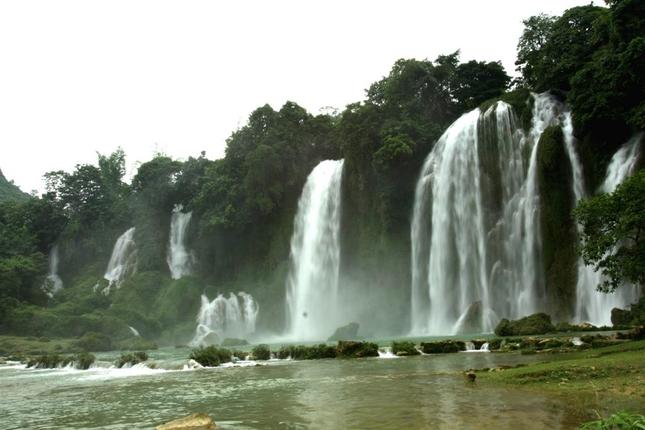
The morning mist still lingered, casting a hazy, ethereal glow over the valley. It was only 6 a.m., and we eagerly headed down to the waterfall. It was still very early, especially with the mist enveloping the entire landscape, making the valley appear dim. The houses along the road were still closed, with only the occasional bark of a few dogs. The roar of the waterfall echoed from afar. From the newly paved road, we could already see the enormous waterfall violently churning up white foam. The Quy Son River (also known as Quay Son), originally gentle, flows peacefully from China, winding through countless villages, providing abundant water for both Vietnam and China. The river cascades down from a height of over 35 meters along the border between the two countries, forming the famous Ban Gioc Waterfall. The main waterfall, the lower one, is located on the Chinese side, in Guangxi Province. The smaller, higher waterfall belongs to...Dam Thuy commune, Trung Khanh district, Cao Bang provinceWith a height of 53 meters and a width of 300 meters, the waterfall has three tiers consisting of many different large and small cascades. Large volumes of water pour down over many limestone steps, creating a white curtain of water spray.
In the spring, the waterfall cascades like gentle silk ribbons, creating a poetic and romantic scene amidst the natural beauty of Cao Bang. When summer arrives, the Quy Son River flows abundantly, and the waterfall truly displays its majestic and powerful beauty.The mist sprayed from the waterfall meets the sunlight, creating...therainbowSeven extremely unusual and fascinating colors.At the foot of the waterfall lies a wide river, its banks lined with meadows and patches of primeval forest. Water sprays from afar, as if in an endless rainforest downpour. The rice paddies are soaked, the plants are soaked, everything is soaked. The wooden and bamboo bridges spanning the river are soaked and slippery. The roar of the waterfall is like an orchestra of drums playing simultaneously. The green of the rice paddies and the forest, the white of the waterfall, the sunlight, and the rainbow create beautiful patches of light on the massive cascade.
We followed the slippery stone steps, climbing to the top. Standing high above, looking down at the waterfall and the river below, the entire natural landscape unfolded before our eyes. On the Vietnamese side were simple villages, rustic stilt houses, and unpretentious rice paddies. The waterfall on this side of the river was largely undeveloped for tourism, retaining its pristine beauty. Meanwhile, on the other side of the river, in neighboring Vietnam, Ban Gioc Waterfall had long been famous, attracting a large number of tourists every day. Houses and shops lined the riverbank, offering tourist services such as boats to the waterfall, food stalls, and souvenir shops.
Watching the crowds disembark from boats, enjoying the scenic views on the Quy Son River, one can't help but feel a pang of sadness that domestic tourism still hasn't found a way to fully exploit the enormous potential of Ban Gioc Waterfall. The waterfall continues its relentless roar amidst the lively atmosphere of laughter and conversation. We lingered at the bustling border market. The market has about 200 stalls run by Vietnamese people, mostly Tay and Nung ethnic minorities living in Co Muong village. Every morning, the villagers transport their goods to the market by tractor, and in the late afternoon, when the crowds thin out, they pack up and return home. Along with the Sunday market held right on the Quy Son River at the foot of the waterfall, this new market located on land offers visitors a deeper insight into the customs, traditions, and lifestyle of the local people.
Leaving Ban Gioc Waterfall well past noon, we returned to Cao Bang. We couldn't help but feel regret that our time in this northernmost region of Vietnam was so short, and we hadn't had the chance to fully appreciate the most magnificent scenery of Cao Bang's landscape as evening fell and night arrived. We heard that on sunny days, rafting down the Quy Son River could reveal a rainbow over the waterfall – a spectacular sight painted by nature.
A noisy summer downpour rumbled behind me. The road home was dimly visible through the rain. Somewhere, the shouts of children could be heard, bathing in the cool summer rain.
Additional information:

There are two routes you can choose to reach Ban Gioc Waterfall. Those who travel by motorbike can take the challenging Tra Linh – Tong Cot road to venture deeper into the rugged highlands. Meanwhile, the route over Ma Phuc Pass and through Quang Uyen is the preferred choice for those who enjoy exploring this famous pass.
Located 3km from Ban Gioc Waterfall is the beautiful Nguom Ngao Cave, a long cave nestled deep within the mountain, which you shouldn't miss.
Famous dishes of Cao Bang province include egg rolls, fried fish from the Gam River, and wild vegetable dishes. The largest hotel in Cao Bang province is the Bang Giang Hotel.
The best time to visit Ban Gioc Waterfall is in late spring and early summer, when the buckwheat fields are in full bloom, the scorching sun hasn't arrived yet, and the summer rains haven't turned the waterfall into a raging torrent of frothy water.


Lam Linh