VI
VI


The Hanoi-Lao Cai night train has long been a familiar route for tourists visiting Sa Pa. In recent years, the involvement of private companies in investing in and renovating old train carriages has reshaped the service towards accommodation to meet the high-end experience needs of international tourists – currently the main group of visitors on this route.

The Hanoi - Lao Cai night train before departure.
The imprint of the H'Mông ethnic group in "mobile hotels"
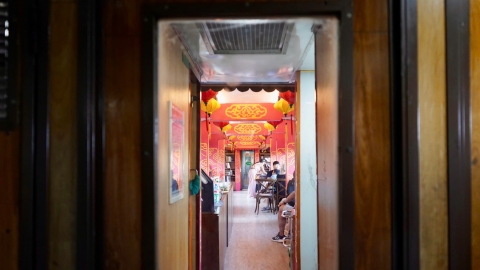
On the nearly 300-kilometer journey from Hanoi to Lao Cai, the train carriages have been redesigned to meet the standards of an overnight train experience for passengers. The interior uses wood materials, combined with handcrafted motifs inspired by the H'Mong ethnic group in the northern mountainous region. The muted color scheme aims to create a warm and relaxing atmosphere right from the moment of departure from Hanoi station.

The handcrafted decorative details on the ship are inspired by the traditional clothing and unique cultural features of the Hmong ethnic group.
Accommodation on board is divided into several classes; H'Mong suite (double bed) costs approximately US$386 per trip. Dzao suite twin (two single beds) is around US$265. Indigo berth (four-bed compartment) is US$65 per bed. According to the operator, ticket prices are calculated per cabin or per bed, depending on the class.

The H'Mong Suite boasts large panoramic windows, allowing passengers to fully enjoy the scenic mountain and forest views along the Hanoi - Lao Cai journey.

The space is spacious and furnished with additional sofas.

The Indigo class offers flexible options for groups of friends or families with its 4-berth compartment design.
Journey connecting the heritage of the North
The train usually departs from Hanoi station between 9:30 PM and 10:00 PM every night. After a journey of approximately 8 hours, the train is expected to arrive at Lao Cai station between 5:30 AM and 6:00 AM the following morning. This schedule allows passengers to arrive at the gateway to the highlands just as dawn breaks, ready for their journey to Sa Pa or nearby tourist destinations that same morning.


The windows along the corridor are designed to be large.

The group of international tourists enjoyed the moment the train slowly passed through the old quarters of Hanoi.

Passengers are served drinks and snacks in each cabin.

Along with mobile carts providing essential supplies and quick meals.
Currently, rail travel is experiencing a strong recovery thanks to investment efforts by businesses in specialized carriage systems. With a stable daily passenger volume, this train route demonstrates consistent appeal to both domestic and international tourists.


Personal hygiene facilities are optimally arranged, ensuring basic convenience.

Both Hanoi and Lao Cai train stations have lounge areas offering amenities such as drinks and restrooms.
However, despite the interior renovations, the train carriages still use the old structural frame, making it difficult to completely overcome some limitations. Since the original steel frame structure of the carriages could not be altered, the design team had to optimize every centimeter of space to accommodate sleeping berths, lighting systems, and personal amenities within the limited area.
An objective reality is that the "physical traces" of the railway industry, such as vibrations and mechanical noise, are still present during operation, especially at night. These factors differentiate it from traditional accommodation options, and this is a characteristic that is difficult to eliminate in this mode of transport.
Rail tourism - a sustainable vision
Beyond focusing solely on speed, the railway industry is exploring new avenues for development by emphasizing the passenger experience and diversifying its product offerings.
According to the long-term plan from the operating unit, the overnight train carriage model will continue to be expanded to other long-distance routes, including the Hanoi - Da Nang route, which is expected to be launched from July 2026. This is a step to expand the product on long-distance routes.


Mr. Nguyen Duc Tung, General Manager of Tonkin Heritage Express, said: “In the past year, the demand for rail travel among tourists has increased sharply, especially on the Hanoi - Lao Cai and Hanoi - Da Nang routes. This shift mainly stems from the recovery of international tourists and the trend of seeking safe and emotionally enriching journeys.”
According to Mr. Tung, many businesses have proactively upgraded their train carriages and standardized their services to meet market demands. Tourist train products are focusing on designs that reflect cultural characteristics and high-quality service.
The development of these products demonstrates the railway industry's efforts to diversify its offerings. However, the ability to maintain the appeal of this type of service still depends on infrastructure and operational quality.