VI
VI


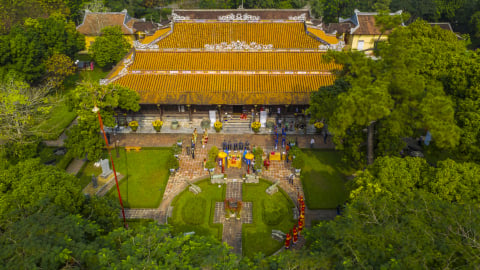
Dao Xa is an ancient land with a long-standing culture dating back approximately 1,800 years, belonging to the Khuat Dong Lieu region. Initially known as Lang Dau or Lang Da, it was later renamed Dao Xa village. Consequently, the communal house and temple in Dao Xa have also existed for a very long time. The Dao Xa temple, also known as the Tam Cong temple, worships three water deities, sons of Hung Hai Cong: Dat Cong Long Vuong, Man Cong Long Vuong, and Uyen Cong Long Vuong. In addition, the temple also worships Princess Trang Hoa, the wife of Hung Hai Cong, and Que Hoa, Princess Trang Hoa's servant. The communal house in Dao Xa worships Hung Hai Cong to express gratitude for the meritorious deeds of this saint who helped the people establish their land.
Legend has it that during the time of the Hung Kings, Hung Hai was appointed by his brother, King Hung, to govern the Tam Giang region (where three rivers meet: the Da River, the Hong River, and the Bua River), encompassing the districts of Dao Xa, Hung Hoa, and Tho Xuyen. On the 28th day of the first lunar month of that year, the couple traveled by boat from Tho Xuyen to Dao Xa, built a pavilion, and rested there for one night, living in harmony with heaven and earth. Later, they returned to Trang Hoa, where the couple conceived and gave birth to three sons named Dat Cong Long Vuong, Man Cong Long Vuong, and Uyen Cong Long Vuong. As soon as the children were born, Trang Hoa transformed. Hung Hai stayed behind to teach the people about water management and farming, and to raise his sons. He then entrusted the land to his three sons to govern while he returned to oversee the Nhi River region (present-day Hai Duong province).

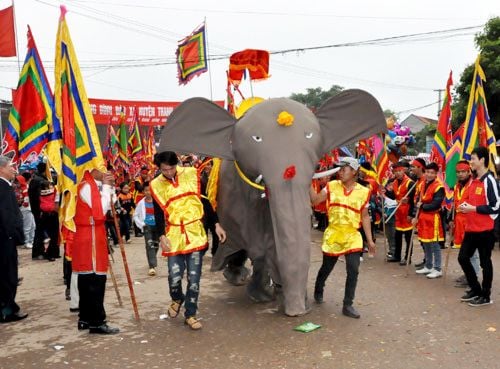
King Hung, recognizing his great contributions, rewarded him with two war elephants as means of transportation. Before parting ways and returning to the Nhi River, he led the elephants back to perform three farewell ceremonies. Hung Hai's departure was filled with affection and emotion. Later, following the principle of "drinking water, remembering the source," the people of Dao Xa village honored him as the village's tutelary deity, erected a temple there, and annually held ceremonies and traditional elephant processions.
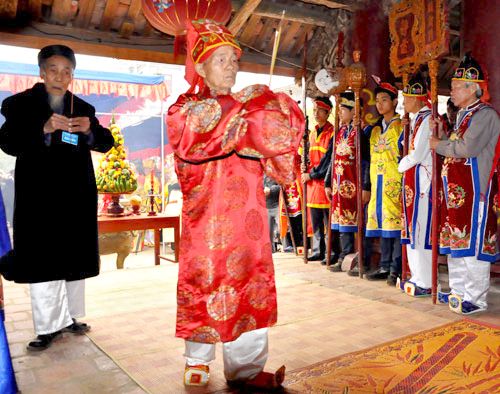
Every spring, Dao Xa village holds a three-day elephant procession festival from the 27th to the 29th of the first lunar month. This is a beautiful cultural and spiritual tradition, deeply imbued with humanistic values. At the same time, for each local resident, it is also an opportunity to offer incense and pay respects to their ancestors who contributed to the founding of the nation and the village, praying for blessings, good fortune, favorable weather, bountiful harvests, peace for the people, and prosperity for the country.
The festival consists of two parts: the ceremonial part and the festive part. The ceremonial part includes a procession of elephants, incense altars, royal treasures, ancestral tablets, and ceremonial chests, as well as offerings to the tutelary deity. The festive part features many folk games such as wrestling, chicken snatching, water fetching, rice pounding, and fire-making competitions. The entire festival focuses on honoring the origins, praising the merits of the gods and those who have contributed to the nation, and praying for national peace and prosperity, favorable weather, bountiful harvests, and a life of abundance and happiness.
In the warm spring atmosphere, local people and visitors from all over flocked to the festival, lighting incense sticks to honor their roots, and wholeheartedly contributing their efforts to help Dao Xa protect and preserve the precious ancient heritage of their homeland so that these tangible and intangible legacies will forever endure through time.