VI
VI


This is the journey of Tran Minh Phung, a young Vietnamese man with a special passion for unfamiliar and harsh lands. This time, he chose Mangystau – a desert in the heart of Kazakhstan – as his destination for a 21-day trip.
Amidst the barren rocky mountains, the ground stained a deep red, and the vast, lifeless expanse, Phung said he felt like he was walking on Mars. Throughout his nights camping in the Mangystau desert, as he gazed at the shimmering Milky Way against the pitch-black night sky, that saying kept echoing in his mind: "If your destination is the moon, then even if you get lost, you're still lost among the stars."


Step out of the photographs, step into the desert.
While casually browsing Instagram, I was stunned by photos of Mangystau – a surreal desert landscape in the heart of Kazakhstan. The scenery seemed to belong to another planet – Mars, where jagged stretches of rocky land and barren mountain ranges extended to the horizon. For a moment, I could only exclaim: “Is this place real, or just a product of imagination and some excessive color editing?”


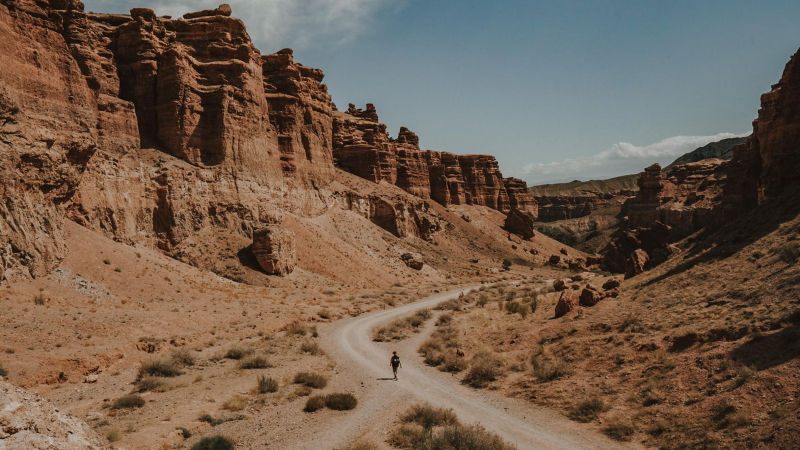
The Mangystan Desert possesses a surreal and desolate beauty, as if it belongs on another planet.
That question kept repeating in my head for days. Then, one evening at the end of last year, while everyone was busy preparing for Tet (Lunar New Year), I quietly booked a ticket, embarking on a journey that, I later realized, had changed me more than I could have imagined.
For 21 days, I crossed the frigid Mangystau Desert, traversed towering mountain ranges, and camped by the azure Lake Eshenkul amidst the vast steppe. I believe that no matter how many videos you watch or how many stories you hear, only when you actually step out there, touch the desert, smell the mountain wind, and hear the crackling of the campfire in the cold night, does everything truly come alive.


In the middle of the Mangystau desert, I found myself on another planet.
I woke up just as dawn was breaking over the desert. After a quick, simple breakfast, everyone quietly packed their belongings, but their eyes all shared a common direction – Bozzhira, considered the "heart" of Mangystau. The road leading there seemed to stretch endlessly across the arid landscape, a landscape of dust, wind, and rocky terrain extending to the horizon.


The Mangystau Desert is a desolate wasteland with endless stretches of dusty sand.
Kazakhstan possesses some of the world's largest oil reserves, largely located in Mangystau – arguably the most desolate region on the planet. If Kazakhstan is sparsely populated, Mangystau is even more isolated. It's jokingly said that here, you're more likely to encounter a camel or a scorpion than a human being. Amidst this vast expanse, the hills, ravines, and cliffs seem sculpted by the hand of time, possessing a beauty that is both wild and surreal.
Kyzylkup Hill, or as the locals affectionately call it, "tiramisu cake," appears with layers of red, yellow, and white soil stacked upon each other like multicolored cake layers. As the sun sets, the sunlight blankets the hill in a thin layer of honey, making the entire landscape seem to melt in a brilliant golden hue.

Kyzylkup Hill (also known as Tiramisu) with its overlapping colorful patterns.
Then Bozzhira appeared – a canyon so majestic and surreal that it felt like I had stepped onto another planet. Two colossal rock formations rose like white horns in the desert, surrounded by a vast valley of white chalk. When the sun rose, its light pierced through the dust, transforming the place into a breathtakingly vivid picture.
According to old stories, in the rocky crevices around here, hunters used to corner wild animals, causing them to panic and plunge into the abyss. That cruel practice is now just a memory, abandoned after the 1930s.
Bozzhira is considered a symbol of Kazakhstan, a natural wonder that, even after seeing it in photos a hundred times, cannot fully capture the awe-inspiring feeling of standing amidst it.

Bozzhira Gorge - one of the natural wonders and a symbol of Kazakhstan.
Not far away is Mount Bokty – “the sleeping horseman.” Its flat summit stands majestically in the desert, like a colossal sculpture carved from the earth. The people of Kazakhstan proudly call Bokty the soul of their country; its image is even printed on the 10,000 tenge banknote. Although I only spent three days in Mangystau, I was fortunate enough to witness firsthand the changing colors of the rock throughout the day.

Mount Bokty - an image featured on the 10,000 tenge banknote of Kazakhstan.
At the end of the journey, the Valley of the Sphere (Torysh) appeared in the cold wind. Hundreds of round stones lay scattered across the ground, as if someone had dropped giant meteorites from space. Locals call them "Koitas." Some jokingly say they are dinosaur eggs, others believe they are traces of extraterrestrial beings. Scientists, however, have yet to find a definitive explanation, only knowing that they have existed here for millions of years, silently in the desert.
I lay down in the middle of that valley, feeling as if I had just wandered into another world. The sky over Kazakhstan was a deep, boundless blue, and the wind whistled through the rocks like an echo of the universe. In that moment, I remembered a line from the movie Interstellar: "Father, I have completed my mission and returned. But I cannot find you and our vast Kazakh steppe; I can only land in a strange land…" And perhaps, Mangystau is that strange place, yet it makes me feel as if I have belonged there for a very long time.

The Valley of the Sphere (Torysh) gives you the feeling of being on the surface of the Moon.
In the middle of the Mangystau desert, life becomes "visible".
Mangystau is a land of extremes: scorching summers, freezing winters, and almost no rain throughout the year. If you want to avoid the heat, you should visit in spring (April-May) or autumn (September-October), when the climate is milder and gentle breezes blow across the rocky mountains. I went in late June, during the hottest days: midday temperatures exceeded 40 degrees Celsius, nights were bitterly cold, and early morning mist still clung to the gray rocks.
Some say that only by venturing into the desert alone can you truly appreciate its solitude. But Mangystau is not a place to take risks. Signals are virtually nonexistent, markers are erased by wind and sand, and getting disoriented is inevitable. I chose to go with a small group, hiring a local guide and a specialized Jeep. They took care of everything from drinking water and food to tents—seemingly small things, but essential for survival in this arid environment.

The moment of conquering Mangystau - "Mars" in the heart of Kazakhstan.
Four days without showering, my skin was tanned, my lips were dry and cracked, and I was exhausted from the sun and wind. But it was there, in the quiet solitude, as I gazed at the sky thick with falling stars atop Bozzhira, that I realized a feeling the city could not give me. Not about living slowly, but about living clearly with every breath, every drop of water, every step imprinted on the red earth.