VI
VI


Football fans are turning their attention to North America as the World Cup approaches. Among the three co-hosting nations, Mexico stands out as a destination with unique cultural appeal and a golden opportunity to boost its tourism economy.


Recently, Mexico's Minister of Tourism, Josefina Rodríguez, officially announced the government's strategic goal of enhancing the economic impact of the global football fan wave. Accordingly, this Latin American nation expects to increase the average spending per tourist by up to 48% during the world's biggest football event. This is not only an ambitious figure but also demonstrates Mexico's thorough preparation in maximizing the commercial value of this global sporting event.

The excitement surrounding the 2026 World Cup has begun to spread throughout Mexico.
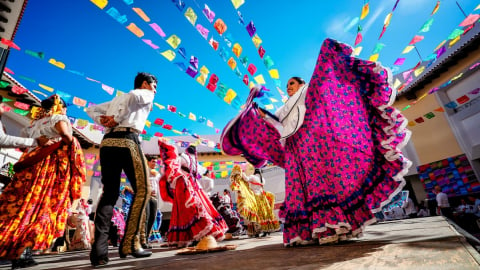
Currently, a festive atmosphere is already heating up in the central streets of Mexico City, where crowds of people and international tourists are flocking in to enjoy the pre-World Cup festivities. The excitement surrounding the tournament is clearly reflected in data from the hospitality industry. The three major cities chosen to host the exciting matches – Mexico City, Guadalajara, and Monterrey – have already recorded hotel booking rates reaching approximately 60%. This is an extremely positive sign for tourism managers and local businesses, especially with the tournament still nearly a month away from its official opening. Tourism representatives affirm that the characteristic hospitality of the local people, combined with Mexico's inherent competitive advantages in culture, nature, and history, will make it a unique and outstanding destination in the eyes of the international community.

Minister Josefina Rodríguez considers the 2026 World Cup a unique opportunity, but one that also comes with unprecedented peculiarities. It will be a relatively unusual World Cup due to the joint hosting by three countries: Mexico, the United States, and Canada. Instead of staying for extended periods in a single country as in traditional models, tourists will tend to move constantly back and forth across the borders of the co-hosting nations to follow their favorite teams.
To realize this challenging growth target, the Mexican government has proactively implemented a series of strategic infrastructure upgrade projects in the three host cities. Work ranges from modernizing the international airport system and constructing and renovating sports stadiums to urban beautification, all of which are being completed rapidly. The goal of these efforts is not only to serve the needs during the month-long tournament, but also to leave a lasting legacy for both the tourism industry and the national sports movement for decades to come. Notably, Mexico's transportation and travel network will receive a significant boost with 58 new tourist routes expected to open simultaneously from June onwards. Most of these routes have been meticulously planned and developed to anticipate and perfectly address the surge in travel demand from fans during the World Cup.

The Mexican government is investing in infrastructure to enhance the tourist experience.
Besides developing physical infrastructure, technology is also considered a core element in Mexico's strategy to reach global customers. The Minister of Tourism recently revealed plans to launch a mobile application called "Mexico Welcomes You" (Mexico Te Da la Bienvenida), a technology product developed in close collaboration with the Mexican Digital Transformation Agency. This intelligent digital tool promises to become an indispensable companion for tourists, integrating detailed information on 290 tour routes across all 32 states of the country. The application provides comprehensive suggestions ranging from local culinary delights and unique museums to magnificent archaeological sites, as well as flexible travel itineraries from 1 to 5 days. This solution optimizes the experience for football fans, whether they are watching a match live in the stadium or exploring cultural spaces outside the pitch.
According to estimates from the International Football Federation (FIFA), the upcoming 2026 World Cup has the potential to attract around 5 million tourists traveling between countries. Mexican officials believe this goal is entirely within their reach, as the Latin American nation has previously demonstrated its superior capacity to accommodate up to 14 million international visitors in a single peak month. The inherent appeal of Aztec and Mayan cultures, combined with large-scale media campaigns, is expected to create an unprecedented tourism boom.
To increase excitement and maintain a sustainable flow of tourists, a comprehensive tourism promotion strategy has been activated, highlighted by the campaign called "The Great Vacation" (La Gran Escapada). Taking place during the crucial period from June 18th to 29th, this campaign focuses on offering attractive travel packages and long-term booking incentives for tourists throughout the year. By integrating top-tier sporting events with smart travel promotion programs, Mexico aims not only to transform the 2026 World Cup into a mere football festival, but also to position the country as a leading global destination, continuing to attract international visitors even after the final whistle of the final match.