VI
VI


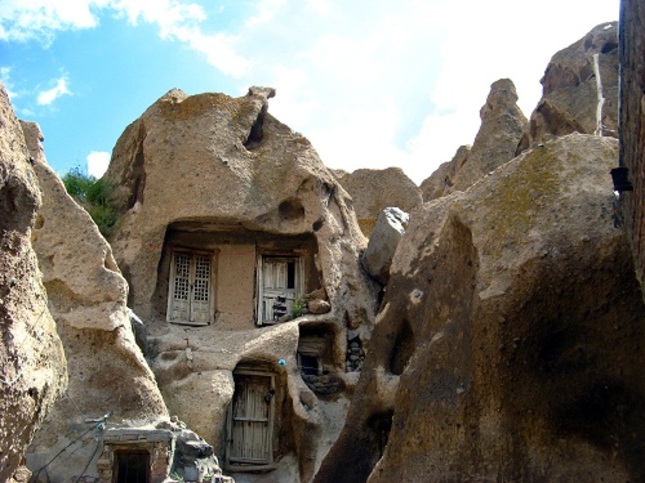
According to legend, the first people to settle in this village were soldiers participating in military operations nearly 800 years ago. These people stumbled upon the conical rock formations by chance and used them as camouflage and temporary shelters. However, archaeologists consider this place to be the beginning of the pre-Islamic period.


A vivid testament to human adaptation in this uniquely strange natural environment. The village sits on the northern slope of a valley in the low hills, at the foot of Mount Sahand. A river originating from the summit of Mount Sahand flows through the valley, and to the north of this river is a natural spring which, according to the locals, is a sacred spring with the power to cure kidney stones. The village's structure resembles something out of a fairy tale.


This is a unique village, with houses built inside cone-shaped caves. These cone-shaped caves were formed from volcanic ash from Sahand, compressed like rock and reshaped over hundreds of years. At first glance, the village gives the impression of a giant termite colony.


Scattered across a wide area are natural conical rock formations, carved and sculpted by humans into houses of similar shapes, some over 700 years old. These houses have 2-4 floors. The ground floor is for animals, the first and second floors serve as living space, while the top floor may be used for worship or storing unnecessary items.
Most houses face south to receive sunlight during the day. These houses all have windows with decorative glass. The houses here also have an excellent air circulation system, keeping them cool in the summer and warm in the winter.


The interiors of the houses are simply furnished, with a living area and a sleeping area dimly lit. The connecting corridors are relatively narrow. Because the houses here are similar in structure, tourists can easily get lost in the village. The paths leading to these houses are quite steep, and the steps are made of stone slabs. These serve as a shared pathway for both people and animals. Today, the houses in the village all have access to electricity, running water, and even modern sewage systems.


The main occupations of the people are agriculture and animal husbandry, but tourism seems to be booming here. The locals know how to make good use of the area where they live. They have built hotels and resorts right in the center of the village. These hotels are rebuilt based on traditional cave houses that have stood for centuries, to serve tourists. Although these hotels are quite old, they look very elegant and are fully equipped, comparable to modern hotels in Iranian cities.


The hotel's interior boasts luxurious furnishings.
Tourists from all over the world who visit the village of Kandovan are delighted with what they see. Besides the village's unique architecture and charming scenic spots, tourists flock here for another reason: to treat kidney stones at the village's famous natural mineral springs.
According to Tue Tam (Vietnam Post)