VI
VI


A life of luxury behind the walls of power.
Stepping into the Governor's Residence, it's easy to notice a living space completely different from what was found within the island's prison system. The spacious rooms with high ceilings, arched columns, and exquisitely carved wooden furniture reveal the comfortable life of the ruling class.

A panoramic view of the main facade of the Governor's Residence.

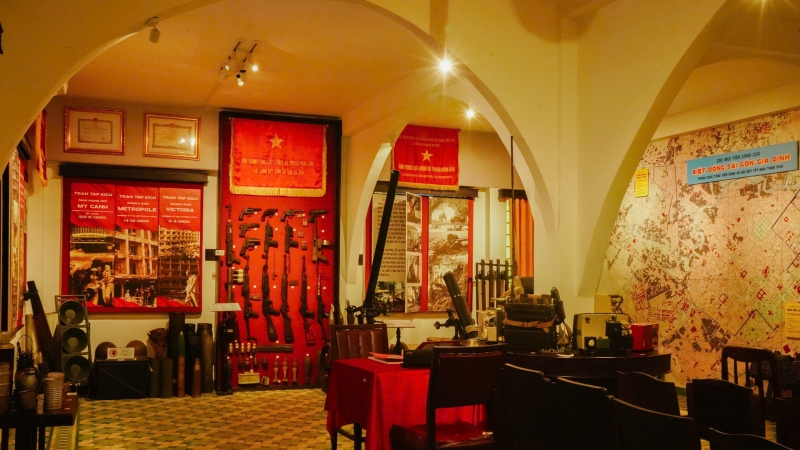

The billiard table was provided for the island lord's entertainment.
Right in the living room, a billiard table was placed in a prominent position, serving as entertainment for the island's ruler and officers. These seemingly ordinary pleasures took place in a place once known as "hell on earth."

A wine cabinet for use at the Island Lord's parties.

A bar is located in the main lobby to cater to the needs of the owner.
Not far away was the bar and wine cellar, situated right in the main hall. Imported bottles of wine and luxurious tableware were once used for parties and entertaining guests of the mansion's owner. Meetings, conversations, and entertainment took place in a quiet space, completely separate from the harsh reality of the prison just a few hundred meters away.

Bedroom space in the mansion
The island lord's bedroom also reveals a life of luxury and extravagance. The spacious room, with its large bed, curtains, and modern amenities, reflects the comfort enjoyed by those in power on the island. Meanwhile, many personal belongings of the island lord and his wife, such as clothing, handbags, and household items, are still preserved, suggesting a life befitting the upper class.

The exquisitely carved wooden tables and chairs in the reception room were once the venue for meetings, discussions, and welcoming officials. All of this created a living space imbued with an air of power and luxury.

The attire of the Island Lord and his wife.

The luxurious belongings of Lord Tăng Tư and his wife Phùng Thị Điểm.

An intricately carved reception table is displayed in the main room of the mansion.
Hell behind the luxury
However, not far from the Island Lord's Palace, a completely different world has existed for over a century.

Tiger cages during the resistance against the French.
While the island's rulers entertained themselves with billiards, drinks, and guests in spacious rooms, tens of thousands of prisoners lived in cramped, dark, and suffocating cells. Many cells were just small cubicles with iron bars above, offering almost no light or air circulation. In these confined spaces, sometimes only a few people were crammed together, but at other times dozens were locked in a single room. The suffocation, lack of air, and the brutal forms of repression under the prison regime caused many prisoners to become exhausted, and some even suffocated to death in those dark rooms.

The image depicts the harsh living conditions and meager food rations of prisoners during wartime.
Prisoners had to live in appalling sanitary conditions and endure meager rations consisting only of stale rice mixed with sand, rotten dried fish, or foul-smelling fermented fish sauce. Many contracted dysentery, became emaciated, and slowly died in the prison camps.

The rice mill was considered "hell within hell," as prisoners who worked there for just 1-3 months would become exhausted and die of tuberculosis.
Besides suffering from hunger and thirst, prisoners were forced into hard labor such as breaking stones, burning lime, carrying loads, or working in the prison kitchen. Any resistance could lead to brutal punishments: shackling, solitary confinement in dark rooms, or other severe forms of torture.

Stone quarrying is a typical form of forced labor in Con Dao, used to supply materials for construction projects there.

Phu Hai prison camp is where Phan Chu Trinh wrote his famous poem, "Breaking Stones at Con Lon".
The stark contrast between these two worlds exposed the brutal nature of the Con Dao prison regime. According to tour guide Pham Do Hoang Dung: “The brutal repression of the ruling regime could not subdue the political prisoners because their greatest weapon was their faith in the Party and revolutionary ideals. Though invisible, this was an unparalleled source of strength that forced the enemy to surrender in both the resistance wars against France and the United States.”

The garden surrounding the mansion features trees that are hundreds of years old.
Today, the system of historical sites in Con Dao is not only a collection of historical architectural structures but also a witness to two contrasting aspects of life that once existed side by side. The luxurious rooms, billiard tables, wine cabinets, and reception furniture sets remain, serving as a reminder of the stark contrast between power and suffering during a tragic period of history.