VI
VI


Each year, as the full moon of the first lunar month approaches, Cho Lon enters a different rhythm. The Nghinh Ong ceremony at Nghia An Assembly Hall is not only a ritual procession of Quan Thanh De Quan, but also a moment for the community to pause for a shared belief. Amidst the crowds, Hanh Hanh's perspective – a first-time participant – reveals many layers of meaning about the city's identity.
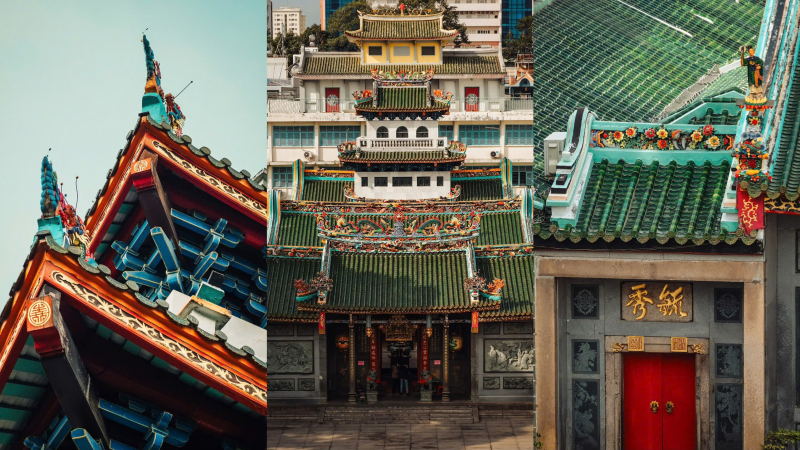
The first drumbeats echoed from the courtyard of Nghia An Assembly Hall at exactly 8 a.m., interrupting the traffic on Nguyen Trai Street. The wooden gates opened, and incense smoke filled the courtyard in front of the entrance. The lion and dragon dance troupe took their positions, and the statue of Quan Thanh De Quan was brought out amidst the rhythmic beating of gongs and drums.


Within minutes, the street in front of the assembly hall transformed into a sea of red. People lined both sides, holding incense sticks and raising their phones to record the moment of the procession of the deity. The Nghinh Ông ceremony officially began.


People gathered in front of the Assembly Hall to participate in the Nghinh Ong Quan Thanh De Quan (Guan Sheng Di Jun) procession festival.
Hanh Hanh arrived at 7 a.m. Knowing that some roads would be closed to traffic early, she proactively left an hour early to find a suitable spot. "There was no traffic on the way there, but the area in front of the Assembly Hall was already very crowded," Hanh recounted. People lined both sides of the gate, mostly Chinese people in traditional clothing, holding incense sticks, waiting for the moment to invite the deity to appear.
Contrary to concerns about crowds, the area in front of the assembly hall remained orderly. Spectators stood in rows along both sides of the road, making way for the procession. "Everyone was very civilized. Everyone gave each other enough space for the ceremony to proceed smoothly," Hanh said.


Rituals of belief and community memory
The Nghinh Ong ceremony at Nghia An Assembly Hall is essentially a procession of Quan Thanh De Quan, also known as Quan Cong – a deity revered by the Chinese community as a symbol of loyalty, integrity, and protection of merchants. Built by the Teochew community in the early 19th century, the assembly hall is one of the most important religious institutions of the Chinese community in Cholon.
In the community's consciousness, Guan Yu is not only a deified historical figure from the Three Kingdoms period, but also represents morality, trustworthiness, and protection in business. Therefore, the "Welcoming Guan Yu" ceremony, which involves parading Guan Yu around the area, signifies a prayer for blessings for the entire region, as a way of asking the deities to witness and bless the new year.


Statue of Guan Sheng Di Jun amidst the procession of people.
This ritual is part of the Lantern Festival – the full moon of the first lunar month, the most important occasion of the year for the Chinese. If the Lunar New Year marks the beginning, then the Lantern Festival is the time to complete the first cycle of rituals of the year, expressing wishes for peace, favorable weather, and smooth sailing in work.
The ceremony unfolded solemnly: drumming, incense offerings, and the procession of the statue of Quan Thánh Đế Quân (Guan Sheng Di Jun) onto a palanquin. When the main doors of the assembly hall opened, the crowd fell almost silent. The statue, clad in red and gold, was lifted and carried amidst the sounds of drums, gongs, lion dances, and the scent of incense wafting through the air.


The procession began moving through the central streets of Cholon. Hanh followed the Nguyen Trai - Tran Xuan Hoa axis, then to Tran Hung Dao - Phung Hung. Along the way, many families set up small altars in front of their houses to "welcome the deity." As the palanquin passed, they clasped their hands in prayer, entrusting their wishes for the new year.
"Walking amidst that crowd, I no longer felt like I was watching a festival, but rather stepping into a part of their collective memory," Hạnh said.


The procession stretched all the way to the gate of Nghia An Assembly Hall.
A different Cholon from an outsider's perspective.
What impressed Hanh was not just the scale of the procession, but the sense of community. The participants were mostly Chinese, but the festival was not closed off; anyone could stand and watch, follow along, or simply observe quietly.
After following the procession along the main streets, she returned to the area opposite the Assembly Hall to find a vantage point from above. From there, the entire stream of people appeared like a red silk ribbon winding through the old streets of Cholon. The closely packed rooftops, the Chinese-language signs, and the narrow alleys created a backdrop very different from the familiar image of modern Saigon.


"As someone from the North who moved to the South, I had heard a lot about Cholon, but only when I stood amidst the Nghinh Ong festival did I truly see that this place has its own unique cultural rhythm," she shared.
Having experienced no incidents throughout the morning, Hanh believes that arriving early is crucial for a complete experience. Some routes will have traffic restrictions before the ceremony begins, so if you plan to attend next year, you should proactively travel by motorbike or park early in the surrounding area. Dressing respectfully, maintaining order, and respecting the religious space are also essential, as this is primarily a spiritual ritual of the local community.


When religious beliefs blend into urban life
The Nghinh Ông Festival is not a tourist attraction but a vibrant religious ritual of a community that has been connected to Cholon for hundreds of years. Therefore, this experience offers a much more authentic feeling than festivals staged purely for sightseeing purposes.
For Hanh, this trip gave her the opportunity to see a different Saigon, where migrant communities still preserve their identities amidst rapid urbanization. In the hazy smoke of incense before the Nghia An Assembly Hall, traditions continue to be practiced, shared, and witnessed even by outsiders.


The palanquin carrying the statue of Quan Thánh Đế Quân (Guan Sheng Di Jun) returned to the assembly hall after its tour, marking the end of the ceremony.
As the procession returned to the assembly hall, the drumming gradually subsided. The crowd dispersed, traffic resumed, and Cholon returned to its normal rhythm. Shops reopened for business, and vehicles once again lined Nguyen Trai Street. But the echoes of the morning lingered, like a thin layer of memory covering the old streets.