VI
VI


In the past, Hanoi had calligraphers who wrote auspicious characters, but after a while, this beautiful image, full of cultural and spiritual significance, disappeared and is now being revived. However, the tradition of writing auspicious couplets in Cholon (Chinatown) has never vanished; it remains a beautiful tradition of Tet. Along Thap Muoi, Hai Thuong Lan Ong, and Nguyen Trai streets, next to the stalls selling calendars, are small tables adorned with red couplets. These calligraphers, writing auspicious characters, don't wear silk robes or turbans; they simply dress in their everyday clothes, setting up small tables surrounded by sheets of red paper already filled with characters.
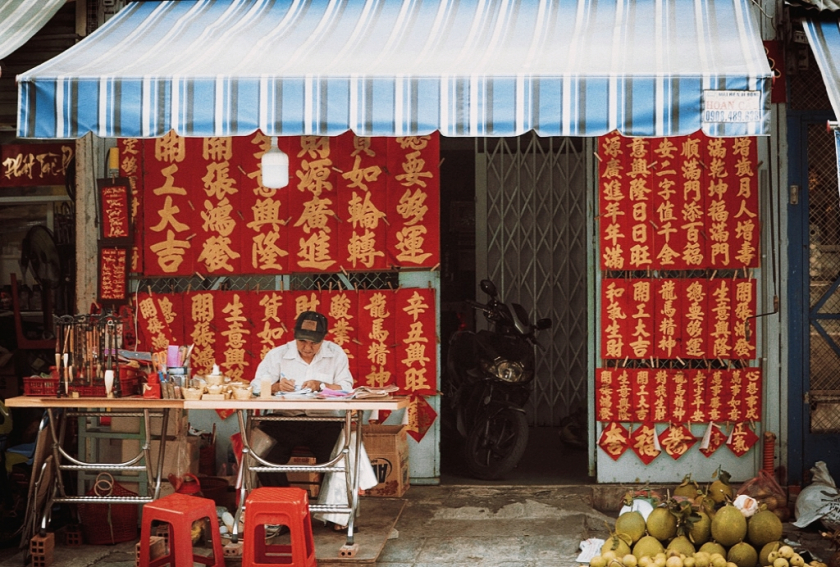
The calligraphers, dressed in their usual everyday clothes, set up a small table surrounded by sheets of red paper already filled with written characters.
Cholon is an area with a large Chinese population. These Chinese families came to the South to settle and have become deeply rooted, preserving their customs and traditions for generations. Every Lunar New Year, many families seek out and buy red couplets, calligraphy, and auspicious characters to hang in their homes to pray for peace and prosperity.
This Tet holiday, calligraphers still sit there, beside their red scrolls, writing each stroke with all their heart and soul, as a gift, a reminder of the beautiful tradition of their ancestors – the custom of requesting calligraphy during the spring festival. Buyers can choose the size of the paper, and the calligrapher will use a brush dipped in black or gold ink to write Chinese characters such as "Five Blessings Entering the Door," "Blessings, Prosperity, and Longevity," to be pasted on the front door, or simply the character "Blessing" on a piece of red paper to stick on watermelons for good luck. Characters like "Heart," "Patience," "Peace," "Auspiciousness," "Trust," and "Filial Piety" are respectfully written on the red scrolls by the calligraphers as decorative artwork, adding color and flavor to the Tet celebration.
These calligraphers have been dedicated to the art of writing for over 60 years.
Hai Thuong Lan Ong Street is the street with the highest concentration of calligraphers. At house number 213, the Chinese calligraphy stall of calligrapher Truong Kien Quoc is nestled among countless stalls selling Tet (Lunar New Year) goods. His regular customers often call him Mr. Sang, a kind and cheerful man of Cantonese origin. Few know that Mr. Sang started his calligraphy business at the young age of 13. As a child, he tutored students while selling calligraphy to save money for his education. Overcoming hardship and difficulties, the young boy has become a skilled calligrapher. For over 60 years, he has come here to write calligraphy for people every Tet.
The calligraphy profession is arduous, and at the age of 78, instead of staying home to celebrate the New Year, Mr. Sang is always busy with his paper until the night of the 30th of Tet (Lunar New Year's Eve), returning home at 2 AM on the 1st of Tet. Having lived his whole life in this profession, he has never stopped creating calligraphy. For Mr. Sang, the sacred symbol that always fills him with pride is the giant brush called Can Thien But. He believes that Can Thien But represents the nobility of the brush-wielding person; wherever the brush is seen, he is there writing.

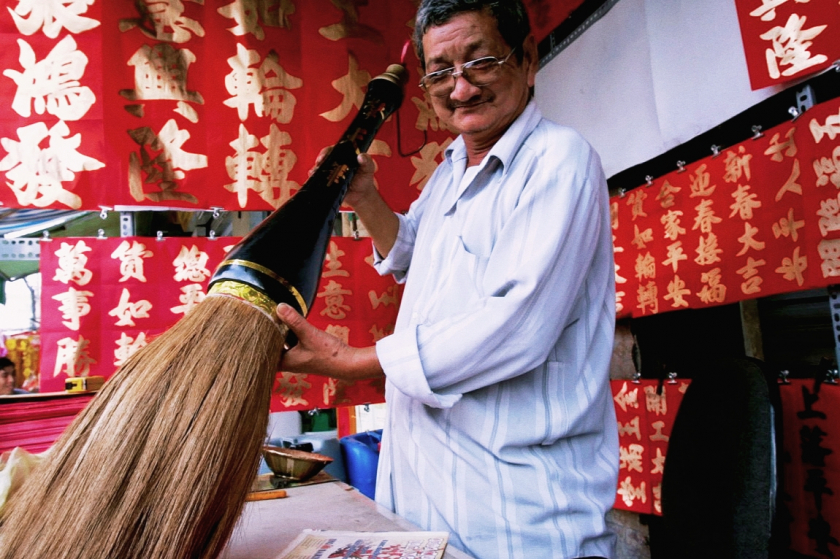
Calligrapher Truong Kien Quoc and the Can Thien Pen - representing the nobility of the calligrapher.
Another stall on Tran Quy Street (District 11) is the calligraphy shop of Mr. Huynh Tri Cau, 65 years old, who has been a calligraphy teacher in District 11 for many years. Every year in the twelfth lunar month, he sets up his tables and chairs, grinds yellow ink and red paper to write meaningful New Year's greetings and couplets for everyone.
Mr. Cau had a talent for beautiful handwriting from a young age. During his school years, he consistently ranked first or second in handwriting competitions. More than 50 years ago, as a student, he began practicing calligraphy like his father. His handwriting became increasingly refined, smooth, and distinctive, earning him the affection of the Chinese community in the Thiếc market area. Since then, over half a century and nearly 60 years have passed, and Mr. Cau's calligraphy shop has become a familiar destination for Saigon residents during the Lunar New Year.
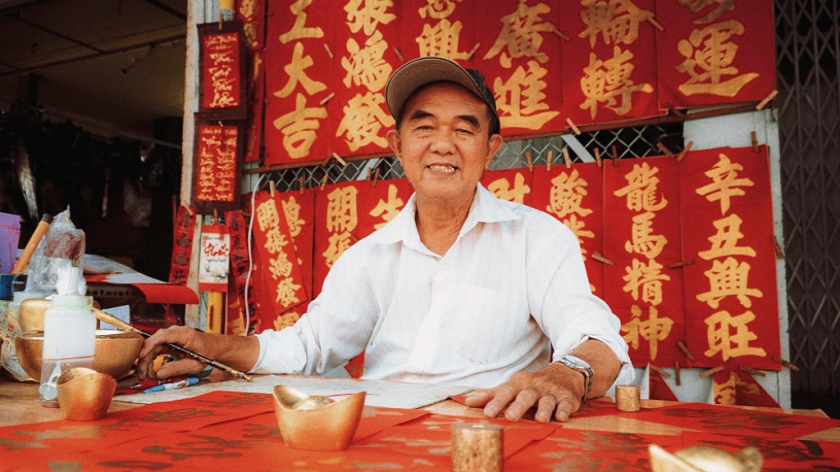
For over half a century, Mr. Cau's calligraphy shop has become a familiar address for Saigon residents every Tet holiday.
A family that has been writing New Year couplets for six decades is busy "giving out calligraphy" on the last day of the year.
In the days leading up to the Lunar New Year, the family of Ms. Luong Vien Du (residing in District 5, Ho Chi Minh City) is busy from morning till night writing hundreds of New Year couplets and good luck wishes for people preparing for the new year. For Ms. Vien Du's family, this is a side job, only done for one month of the year, with an average of 100 couplets of various kinds written each day. Ms. Luong Vien Du said: "Nowadays, there aren't many people writing couplets in the Cholon area anymore. My family is one of the rare ones that has passed down this craft through three generations."
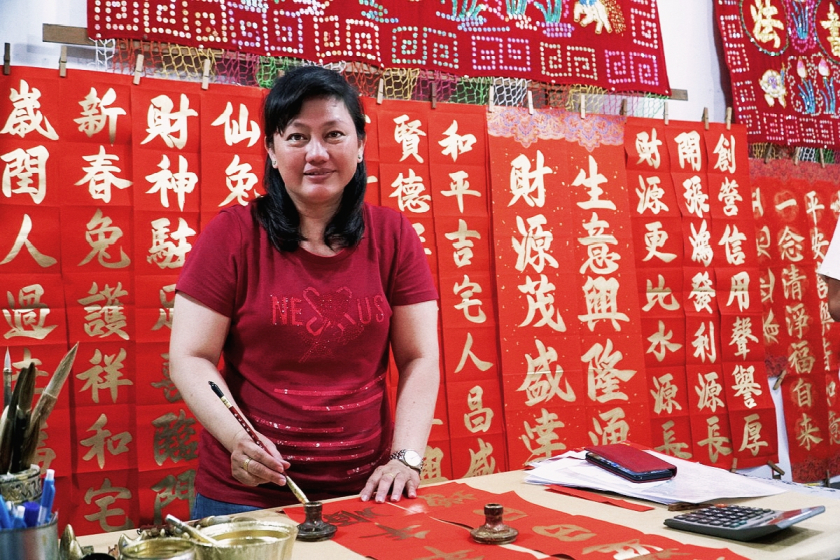
Ms. Luong Dien Du's family has been involved in the craft of writing couplets for over six decades.
"It's not simply about writing perfectly; in each stroke, I also convey my heartfelt wish for the recipient to always be happy and successful in the new year," added Ms. Luong Vien Du.
Mr. Luong Trieu Minh (33 years old, younger brother of Ms. Du) and other young family members have been practicing this craft since they were 15 years old. As a child, watching his father write, the flowing, graceful strokes fascinated him, and he gradually learned to do it himself. Nearly 20 years of writing, Mr. Minh considers the profession both a calling and a responsibility to preserve the beauty of ancient culture. Mr. Minh shared: “Chinese characters are already difficult, and writing couplets requires even more sharpness and meticulousness, so those who practice this craft must truly have perseverance and patience.”
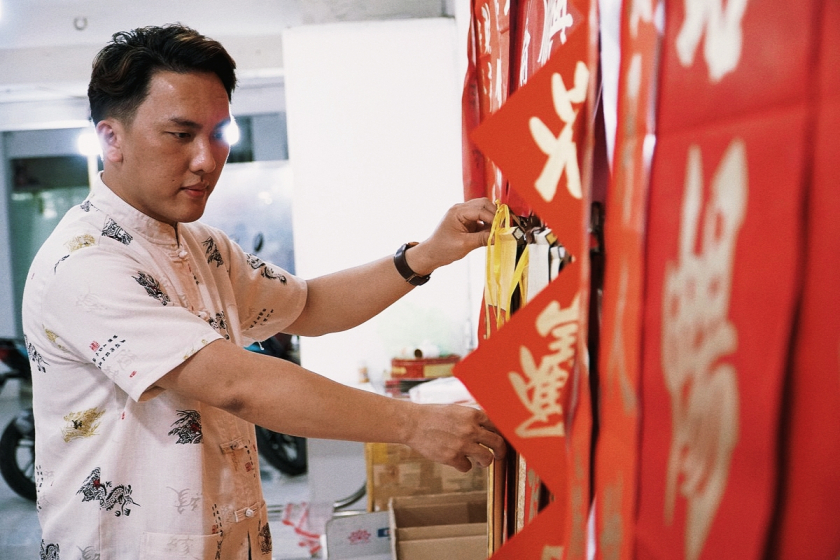
Luong Trieu Minh (33 years old, younger brother of Ms. Du) and other young family members have been in the profession since they were 15 years old.
From tradition to charitable couplet writing for over a decade.
Every year on the 22nd and 23rd of the 12th lunar month, Chinese calligraphers in Cho Lon gather to write calligraphy for charity. This year, at the Hai An Association Hall, the calligraphers created couplets with messages wishing a happy new year filled with good fortune. This is also the only time of year when calligraphy enthusiasts can meet all the famous calligraphers in the De Ngan (Cho Lon) calligraphy community, such as Truong Lo, Lam Han Thanh, Huynh Tung Ba, etc. This is also the 14th year the event has taken place.
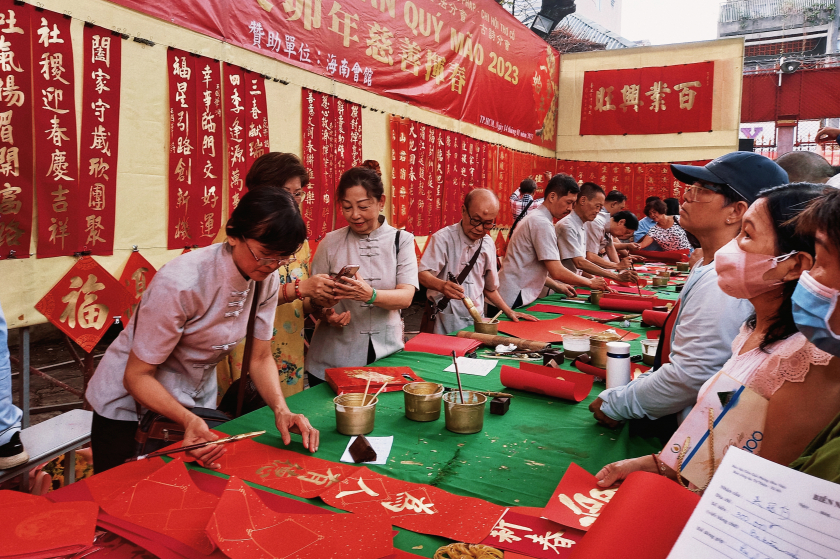
The charity calligraphy event in Cho Lon has been held consistently for 14 years.
Along one wall of the community hall's courtyard, couplets completed by famous calligraphers are hung for the public to admire; anyone who likes them can take them home, and voluntary donations to the organizers are encouraged.
Mr. Tran Quoc An (residing in District 3, Ho Chi Minh City), who has maintained the tradition of requesting calligraphy from his family for over 20 years, shared with Travellive: “The red couplets are both vibrant and preserve the cultural aspect year after year, preventing it from fading away. As always, I request the calligraphy ‘Peaceful Family,’ meaning I only wish for peace.”
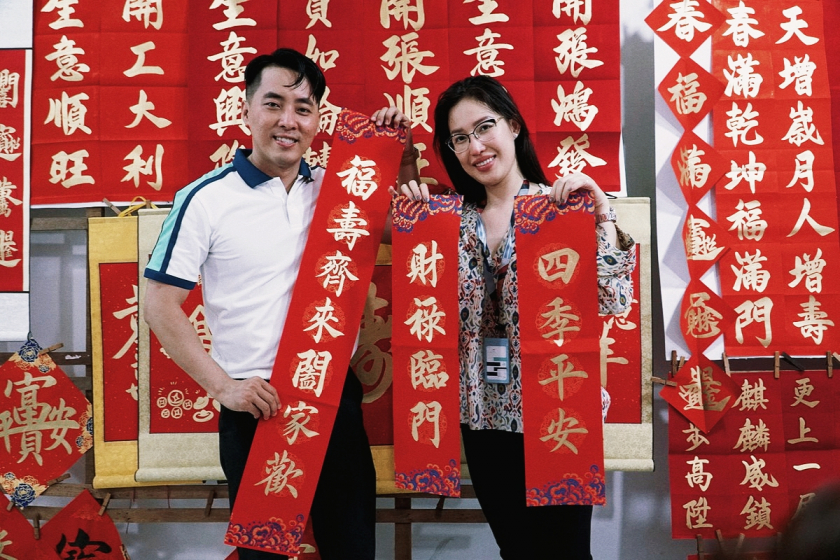
Mr. Tran Quoc An, residing in District 3, Ho Chi Minh City, still maintains the tradition of asking for blessings at the beginning of the year.
Nowadays, although printed New Year couplets and scrolls are quite beautiful, many people still prefer handwritten ones. This is because, although handwritten text may not be as sharp and polished as printed text, it has more soul and vibrancy.