VI
VI


Christianity arrived in Vietnam in the 16th century, carried by Portuguese merchant ships along the Southeast Asian coast. Around 1615, organized missionary activity began to take shape, primarily in the North. Remaining records show that the Nam Dinh – Ninh Binh region (formerly Nam Son) quickly became one of the first missionary centers, where parishes along the Red River and Day River formed and grew over generations.


This region has long been a bustling center of trade and cultural exchange. The presence of traditional craft villages specializing in stone, wood, pottery, and more has created a relatively open material and spiritual environment, making it easier for new religious beliefs to find a foothold. Over the centuries, despite religious persecution, wars, and large-scale migrations, the local religious community has maintained its faith with remarkable resilience.

No matter how rapidly social life develops, the church remains a steadfast spiritual anchor that has shaped Vietnam for over 400 years.

North Gate Church

Light and silence inside the North Gate Church
From the late 19th century, churches made of stone and teak wood began to appear, bearing the mark of a fusion between Western architecture and the spirit of East Asia. This was also the period when the Nam Dinh - Ninh Binh region shaped a very unique Catholic identity. Today, the two dioceses of Bui Chu and Phat Diem continue to be the cradle of the largest Catholic community in the North. "Holy Land," this designation reflects the combination of history, memory, and religious life that has been intertwined with this land for over four centuries.
At the end of the year, visiting some of the churches in this region, standing in the quiet sanctuary in the early morning or at dusk, one can easily spot a few people silently praying, hear the sounds of children playing in the courtyard… only then can one truly feel that no matter how rapidly social life develops, the church remains a solid spiritual anchor that has been shaped in Vietnam for over 400 years.


The So Kien Church was built in the classical European Gothic architectural style, harmoniously combined with local art.
Box: At the end of the year, visiting some of the churches in this region, standing in the quiet sanctuary in the early morning or at dusk, one can easily spot a few people silently praying, hear the sounds of children playing in the courtyard… only then can one truly feel that no matter how rapidly social life develops, the church remains a solid spiritual anchor that has been shaped in Vietnam for over 400 years.
A SONG OF STONE, LIM WOOD, AND WIND
Oral traditions from the early Catholic period in Northern Vietnam often mention churches built of bamboo and thatch, which could be quickly dismantled when needed. While difficult to fully verify, these anecdotes partly reflect the precariousness of the community at that time. In many coastal and riverside areas, bells were not dared to be hung, and crosses were sometimes carefully stored away in rooms; instead, only wooden gongs were used to signal prayer times. This image, though belonging to generational memory, shows a period when faith existed with caution.

Phu Cam Church, one of the largest and most representative Catholic structures in Hue.

Inside Phu Cam Church
By the end of the 19th century, as the social and political context allowed for the construction of more solid churches, cathedrals bearing European influences gradually emerged, featuring Gothic-style vaults, stained-glass windows with floral motifs, rigid structures, and tiled roofs reflecting colonial architectural styles. Many materials such as ardoise tiles, iron, steel, and stained glass were imported from France, creating an architectural appearance distinctly different from the Vietnamese countryside.

However, even during that period of intense cultural exchange, many Vietnamese priests proactively sought a localized approach, and Phat Diem Cathedral is the clearest example. The Phat Diem complex is a harmonious blend of laterite stone and ironwood, with curved roofs and wooden columns modeled after Vietnamese temple architecture, yet retaining the liturgical structure of the Latin Church. In the early morning light, these details appear both familiar and solemn; this fusional aesthetic has become a symbol of Vietnamese Catholicism, embraced, admired, and studied by architects both domestically and internationally.
In Kon Tum, wooden churches with the features of the Rông house combined with Bahnar patterns continued to expand the dialogue between indigenous architecture and the spirit of Western churches, easily found in Cam Ly Church or Mai Anh Church (Lam Dong). These experiments laid a solid foundation for a religious architectural style rich in identity. After 1954, when many parishioners from the North migrated to the South, churches were rebuilt with a simplified spirit: spacious, practical, prioritizing capacity in the context of war.

The dialogue between indigenous architecture and the spirit of Western churches can be easily found at Cam Ly Church in Lam Dong.
During the period 1975-1986, limited construction conditions led to the gradual deterioration of many churches, but religious activities continued under the restraint of a difficult era. From the 1990s onwards, with the opening up of the country, church architecture entered a new era. Concrete, glass, steel, and modern forms appeared in many places, reflecting the need to expand the community. Some chose minimalist geometric language; others drew inspiration from clasped hands, doves, or boats—each with its own story.
This architectural journey spanning over four centuries demonstrates the community's continuous adaptation between preservation and innovation, between memory and practical needs.

Bui Chu Cathedral in Nam Dinh, the main cathedral of the Bui Chu Diocese, is one of the oldest Catholic centers in Vietnam, notable for its classical European architecture and significant religious and historical value.
RELIGIOUS ARCHITECTURE IN NORTHERN VIETNAM: A RIVER THAT NEVER STOPS FLOWING
In the last two decades, the Nam Dinh - Ninh Binh region has witnessed significant changes. Ancient structures such as Phat Diem and Phu Nhai are still carefully preserved: individual roof tiles are replaced, foundations are reinforced, and moss-covered reliefs, over centuries, are cleaned. Every trace of time here is preserved as a shared memory of this coastal region and the delta.
Box: In the last two decades, the Nam Dinh - Ninh Binh region has witnessed significant changes. Ancient structures such as Phat Diem and Phu Nhai are still carefully preserved: individual roof tiles are replaced, foundations are reinforced, and moss-covered reliefs, over centuries, are cleaned. Every trace of time here is preserved as a shared memory of the coastal region and the delta.

Inside the ancient Phat Diem complex

Hai Dong ruined church
Meanwhile, many new parishes have had to expand or rebuild to meet the needs of their growing communities. Architectural blending is evident: curved roofs reminiscent of Vietnamese temples and pagodas juxtaposed with Gothic bell towers; lotus and chrysanthemum motifs carved in lim wood intermingle with Western patterns. Local materials such as Ninh Binh stone, Bat Trang bricks, and yin-yang tiles are more prevalent, helping new buildings integrate into their surroundings rather than stand out. In new urban areas, many parishes are embracing open architecture: glass walls, natural light, accessible entrances for people with disabilities, and spacious pilgrimage grounds. Religious life is more closely linked to community activities as churches become meeting places, venues for small events, children's activities, or catechism classes.
However, amidst the changes to meet the practical needs of the parishioners, the story of the old Bui Chu church remains a deep scar in people's memories. The more than 130-year-old Gothic structure, once considered one of the most beautiful cathedrals in Northern Vietnam, was demolished in 2019 due to the risk of deterioration and the need for a larger capacity. The new church is gradually being completed, modern and spacious, but in the memories of many, the void left by the old structure remains unfilled. This story illustrates the difficult dilemma between heritage and pastoral needs that religious architecture in Northern Vietnam always faces.

Nha Trang Mountain Church
THE CHURCH AND THE HOLY NIGHT ARE IMMENSELY MEMORABLE
Today, as one travels through this land, one easily perceives three layers of time coexisting: ancient churches bearing the marks of centuries, new cathedrals retaining their curved roofs and mahogany wood, and contemporary spaces bathed in light. All are present in a landscape that is both tranquil and dynamic. Churches are not merely places of worship; they are repositories of community memories. From baptisms and weddings to funerals, from evening bells to night prayers, religious life has permeated every moment of the people's daily lives.


So Kien Church in Ha Nam province is one of the largest and most important Catholic churches in northern Vietnam, and was once the administrative center of the early Vietnamese Catholic Church.
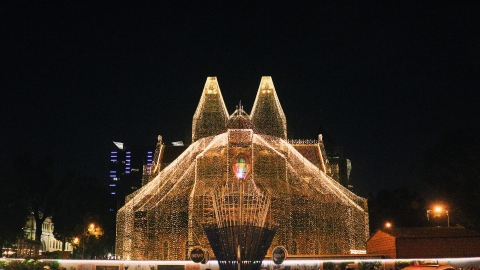
On Christmas Eve, that sense of togetherness is most evident. As decorative lights illuminate the arched roofs, the nativity scene is erected in the churchyard, and bells chime across the fields, the atmosphere becomes both warm and solemn. Whether it's the ancient Phát Diệm church, a new glass and steel church, or just a small chapel, each place transforms into a "Bethlehem" of its own community. Children wear Santa hats, the elderly lean on canes and quietly find their places, and the melodious strains of hymns resonate in the simple voices of the locals. In that moment, architecture ceases to be merely a matter of materials and becomes the shared heartbeat of the community, a continuity between generations of parishioners, and even non-Catholics.
And today, as Christmas approaches, the arched roofs and bell towers of this coastal region light up for the new holiday season, as they have done for the past four centuries—an unbroken, warm, and enduring tradition.

Mai Anh Church - the most famous church in Da Lat, Lam Dong.