VI
VI


Mai Linh (33 years old, from Thai Nguyen), currently works as an operator for Hippo Tour travel company. Although she has traveled to many places, this trip to Egypt was truly different. Mai Linh witnessed unique scenes she had never seen before in Islamic rituals. She also realized that the preconceptions about people, security, and culture there were completely different from her previous expectations.
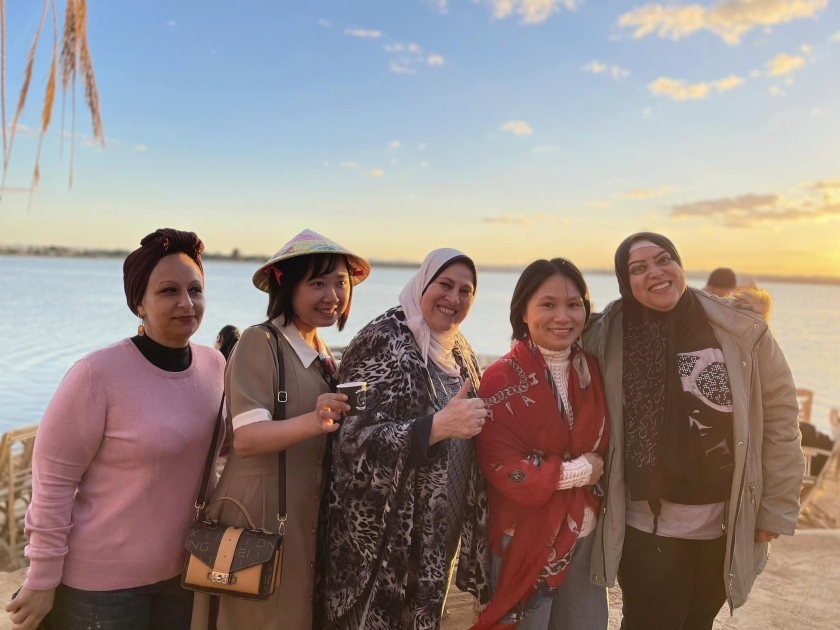
Mai Linh took photos with the local people.
Is it safe to travel to Egypt?
"Before going to Egypt, I felt it was a mysterious country and was very excited to explore it during Ramadan. But when I first arrived, things weren't as I imagined. Right in the city center, there were many police officers on the streets. I felt a little uneasy because I didn't understand what was happening," Mai Linh confided.
At that time, not only Mai Linh but also many of her companions couldn't hide their anxiety. But when they understood that the police presence was only to maintain order during the holy month, everyone breathed a sigh of relief. They felt more at ease and began their 11-day journey exploring Egypt during Ramadan.
Le Thai Binh (40 years old, Ho Chi Minh City), a tour guide with 15 years of experience currently working at Fit Tour, further shared: "Besides money, time, and health, luck is also an important factor in determining whether you can go to Egypt or not. The political situation in Egypt tends to be unstable. But in the past year, the political situation has become more stable, so I felt more at ease organizing the trip to Egypt."
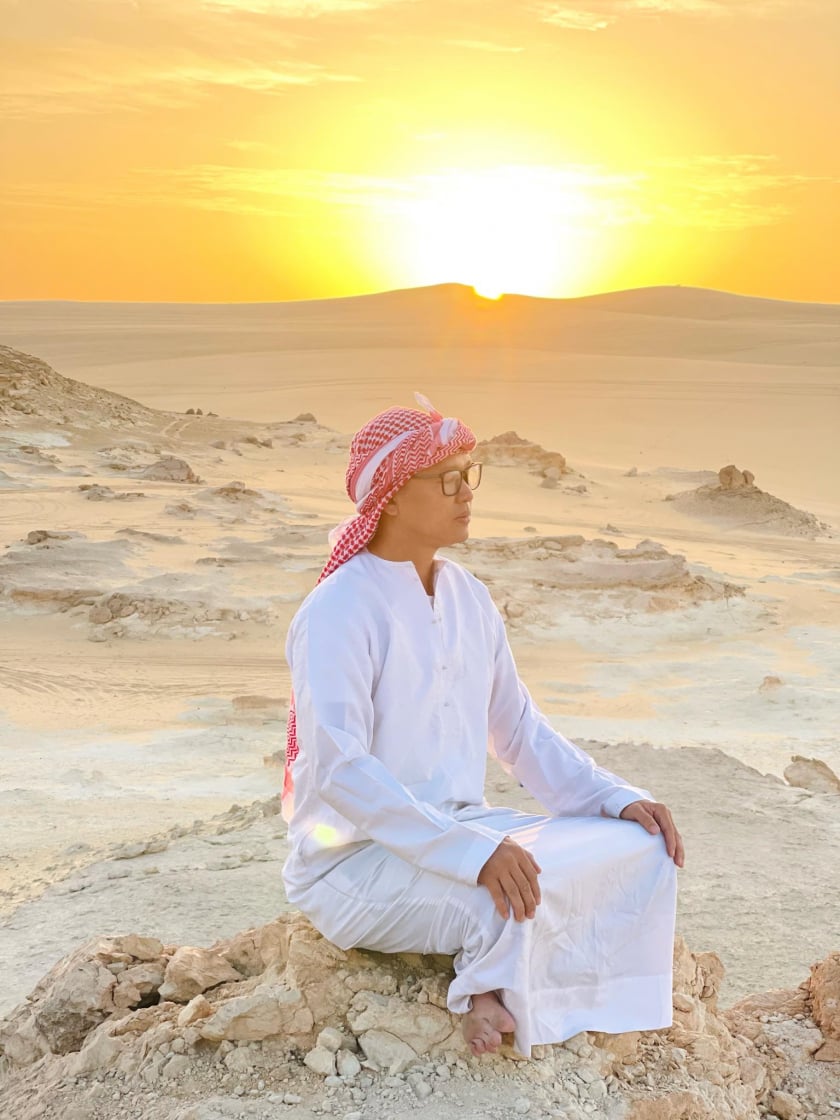
Le Thai Binh has 15 years of experience leading tours and also has a great love for Egypt.
Impressions of Muslim religious practices in Egypt
Fortunately, Mai Linh had the opportunity to visit Egypt during Ramadan, allowing her to witness and experience the essence of this holy month firsthand. She shared that she had previously studied in China and met international friends, so she had some basic knowledge of the festival. However, it was only in Egypt that she truly understood the importance and profound influence of this ritual on the people of a country where over 90% of the population is Muslim.
Mai Linh shared that Muslims here perform prayers five times a day. Therefore, she frequently encounters the sight of hundreds of thousands of people bowing down in unison during prayers and chanting the Quran. "Because over 90% of the population is Muslim, when they chant, the sound of the prayer resonates throughout the entire area – a deeply moving sound. They are devout and strictly adhere to the rule of not eating or drinking after sunrise and before sunset," she emphasized.
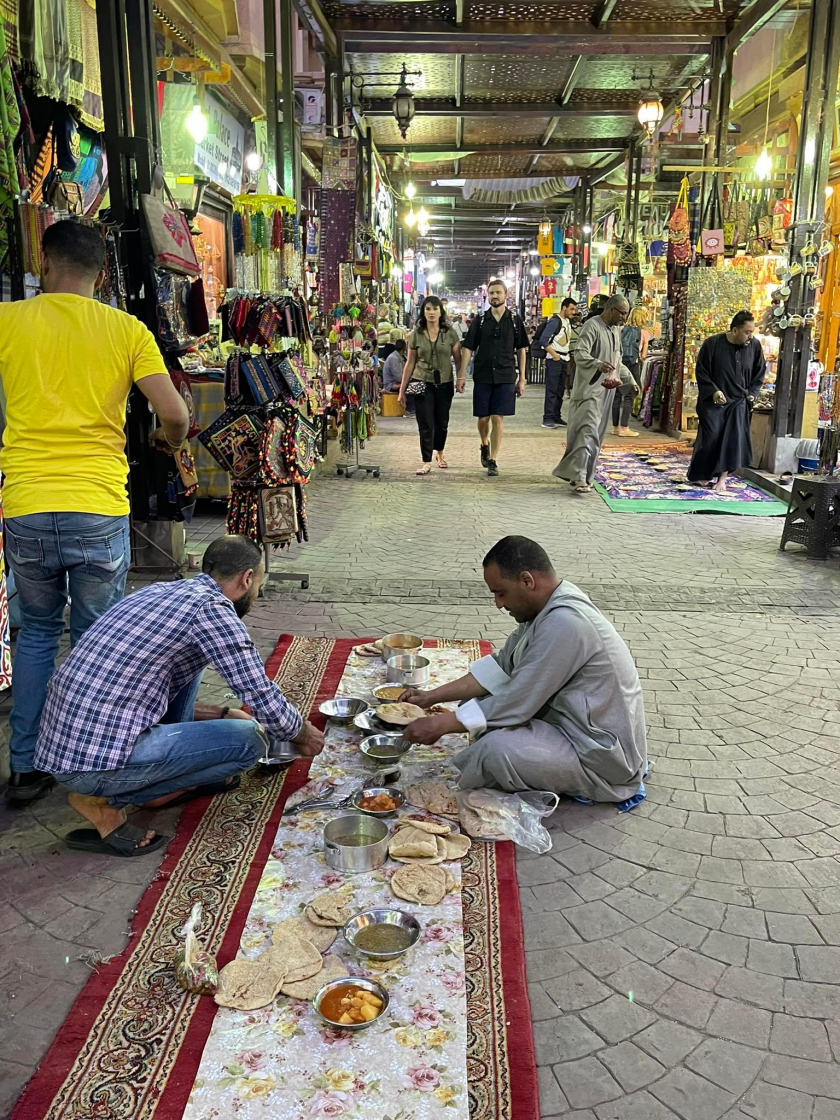
People eat and drink in the market after sunset.
Venturing into the markets, she began to see firsthand the lives of the people buying, selling, and working there. After sunset, they spread out mats, set out food and drinks, and joyfully danced to music, seemingly "enjoying" and recharging their energy after a day of fasting. Because they adhered so strictly to their fasting, it was easy to notice changes in their physical appearance. "Our local guide is also Muslim, so after several days of fasting, he looked completely different from when we first met," she gave as an example.

Of course, only Muslims are required to fast until sunset. Mai Linh herself still eats three plates of salad every day: "Imagine, three meals a day, one plate of salad at each meal. That's 33 plates of salad for 11 consecutive days." She also added that most of the food here has a distinctive flavor quite similar to Indian curry, with predominantly yellow and brown colors, and the dishes always have a thick, creamy consistency. Restaurants in Egypt during Ramadan have very few customers, mostly tourists. The main dishes in Egypt are lamb, chicken, and beef.
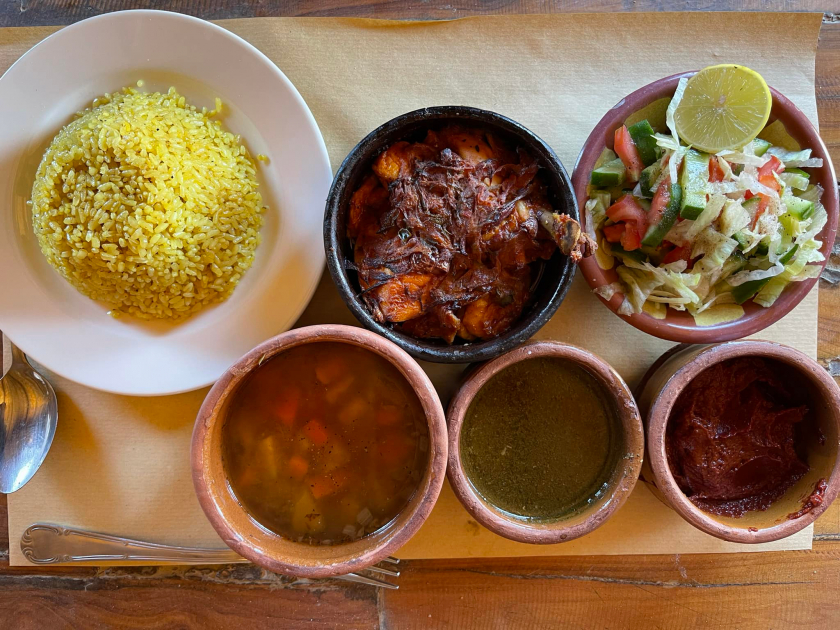
A meal of the day for the group.
When going to Egypt, is it absolutely necessary to visit the pyramids?
"Almost everyone who comes to Egypt hopes to visit the world wonder - the Pyramids - at least once. But it's a very crowded tourist spot, with countless people visiting, so I'm not really that excited," Mai Linh stated.
She found it even more exciting to travel 800 km along a desert-side highway to reach the Siwa oasis. There, she and her group visited the ancient town of Shati, experiencing a dip in the cool waters of the Salt Lake – once the bathing pool of Queen Cleopatra. Afterwards, she and her group toured the mineral pools and the Amoun Temple, and Mount El Dakrour. She emphasized the magnificent beauty of the temples in Egypt – a sight that no visitor should miss.
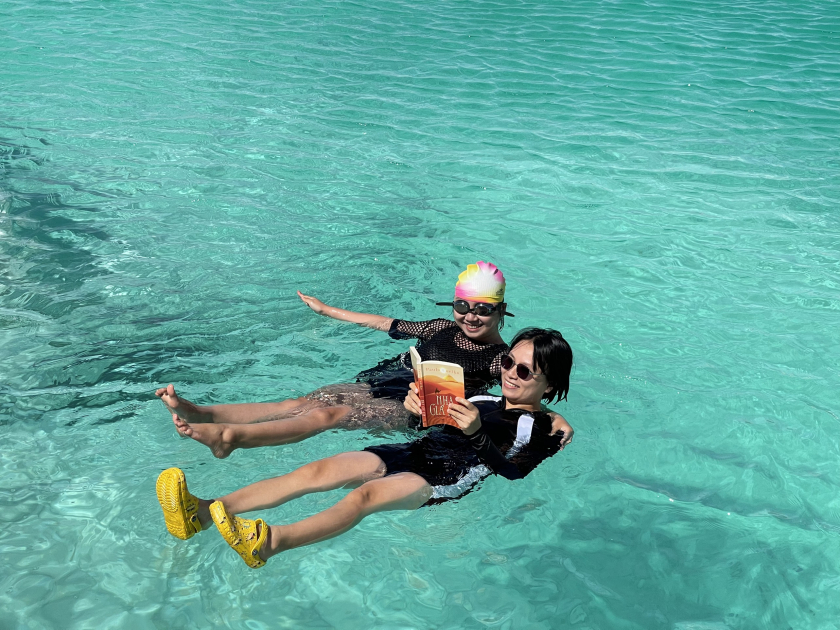
Mai Linh happily reads a book while soaking in the Salt Lake.
What haunted her after this trip was a day and a night in the Sahara, the world's largest desert. She had experienced walking on sand dunes before, but when she set foot here, she truly shuddered at the sheer size and terrifying harshness of the place. Adventuring on the roadless paths of the Sahara was an extreme sensation she had never experienced before.
After more than an hour of off-road driving on steep sand dunes, perched precariously on the "dinosaur's spine," the reward was well worth it, especially the breathtaking sunset. The vibrant scenery amidst the vast, arid desert as the sun gradually set in the west left everyone in awe. As night fell, she and her group spent the night in the Sahara – a once-in-a-lifetime experience she will surely never forget.
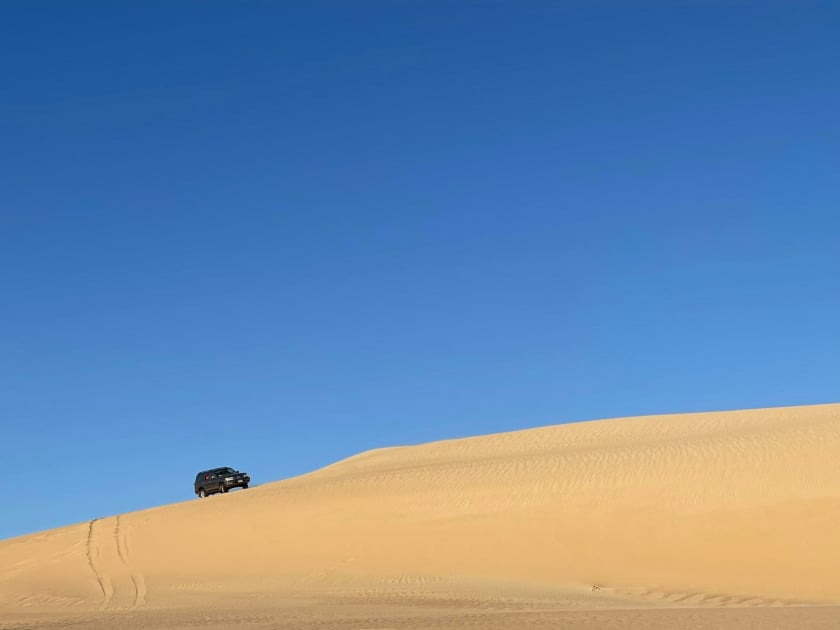
"Offroad" in the Sahara Desert.
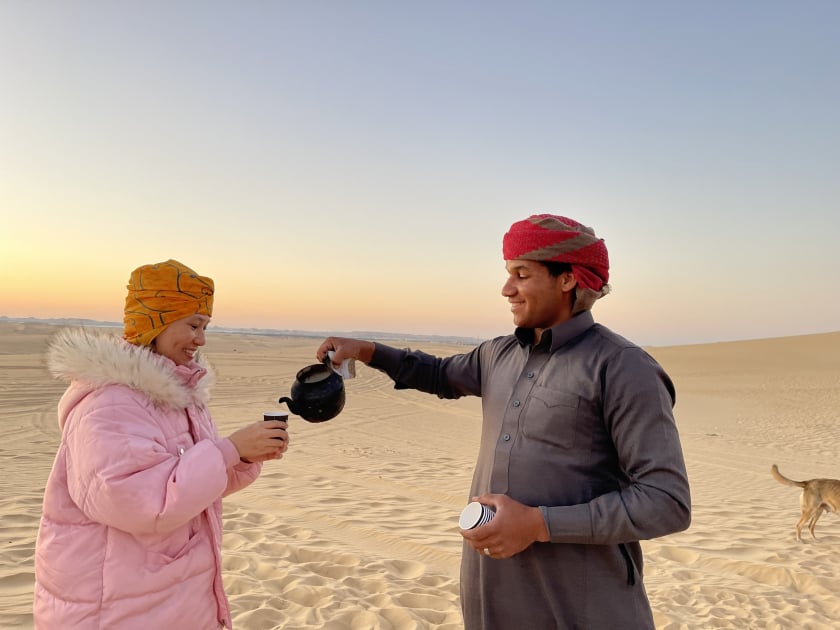
Enjoying mint tea with my Arab friend at sunset in the Sahara Desert.
Mai Linh added that because the area is right next to the Libyan border, any tour group entering or leaving must always report their presence. Each tour group is accompanied by a police officer to ensure their safety, so people don't need to worry too much about security when traveling here.
Egyptians are very different from what you might imagine!
"Before going on the tour, I had preconceived notions about the people in Arabia and Egypt. But only after coming here, meeting and interacting with them, did I truly feel the friendliness and loveliness of the people here," Mai Linh confided.
She cited an example: when she visited Alexandria on a weekend, many families and schoolchildren were at the amusement parks. Upon encountering a group of tourists, they approached, asked to take photos with them, and expressed great fondness for the Vietnamese people. Similarly, on the train from Cairo to Aswan, a train attendant came over to chat, then pulled out his phone to share interesting information about Ramadan with the entire group.
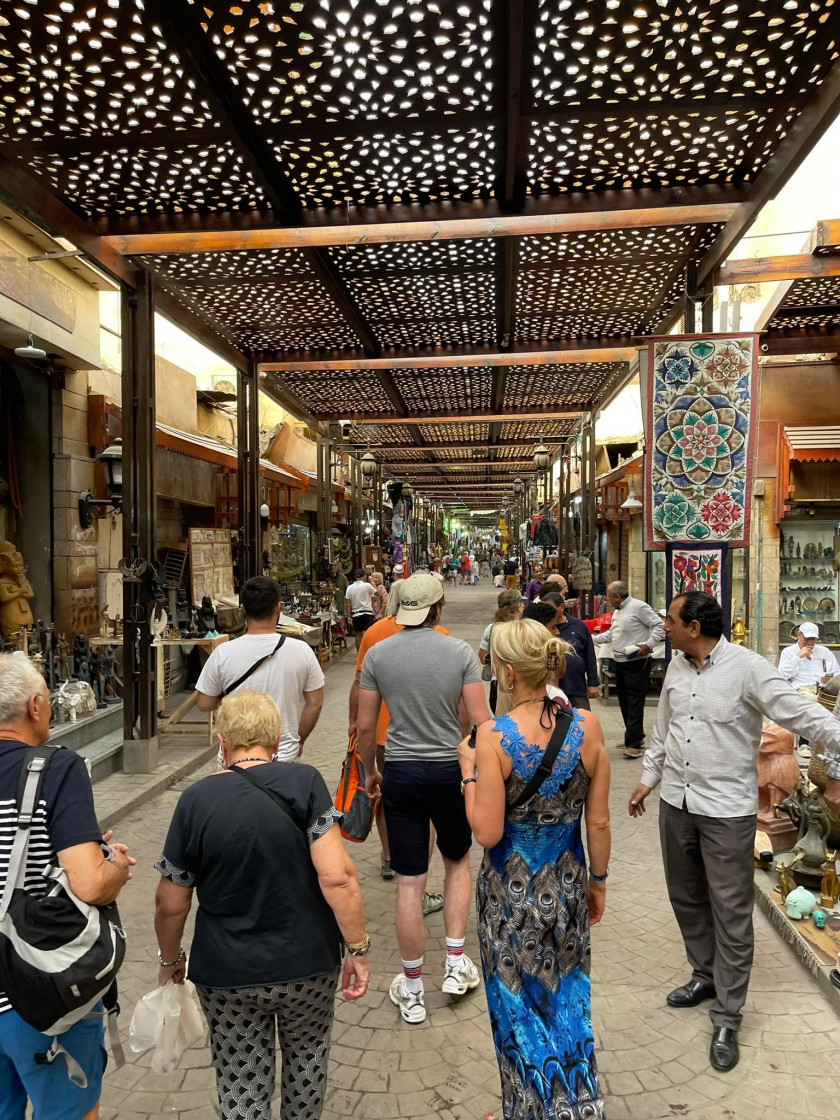
The salesperson was polite and gentle with the customers.
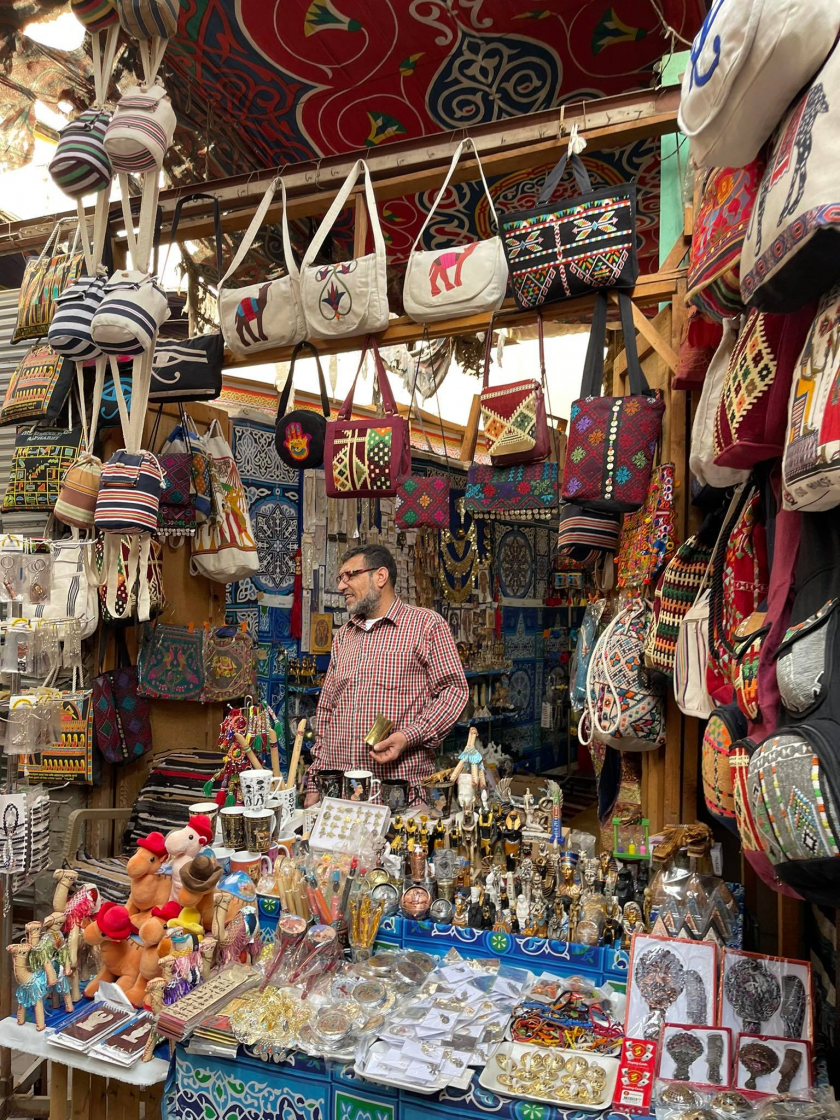
100% of the salespeople are men.
Mr. Thai Binh added: "When leading the group shopping at the markets, the vendors were very cheerful and gentle. They were extremely polite in approaching customers and gentle when customers haggled. What's special is that in these markets, 100% of the vendors are men. Women appearing in the markets are either tourists or local people wearing black scarves that completely cover their faces, except for their eyes."
Another unforgettable impression of the people here is that, while cruising on the Nile River, many children would "run" after them on surfboards to beg for money. In the middle of one of the world's largest rivers, she was sometimes frightened by the strong currents in some sections. Yet, the children persevered, singing and asking for money from tourists. Through this experience, she gained some understanding of the hardships and deprivations faced by the people living in the southern region of Egypt.
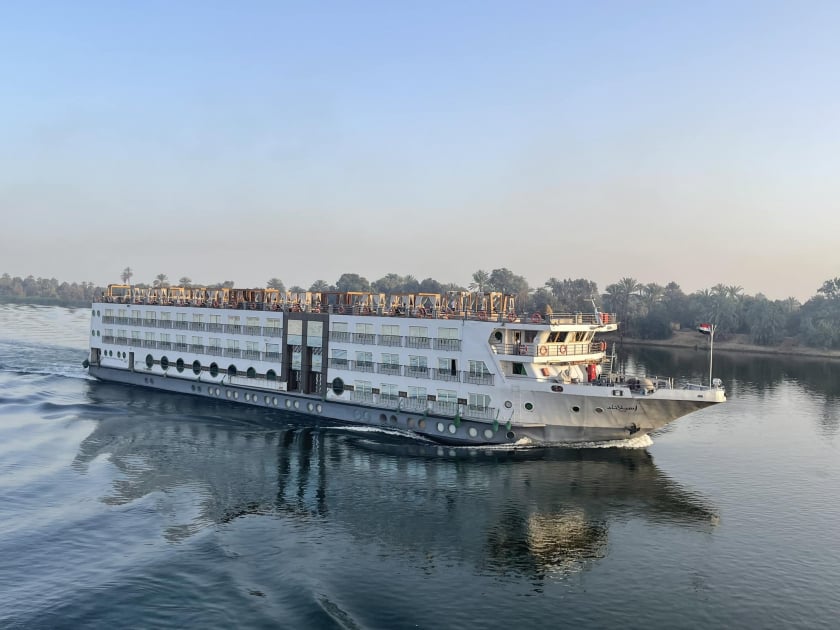
Take a cruise on the Nile River.
This was probably the most memorable trip of Mai Linh's life. She couldn't hide her happiness and pride at having the opportunity to visit this region. Mai Linh also praised the travel agency FIT TOUR for its professional, knowledgeable tour guide and excellent customer service. She was satisfied with the trip and felt it was well worth the money for such an experience.
"Everyone should go to Egypt at least once to see how amazing it is!", Mai Linh concluded.