
 VI
VI


Life between two worlds
In the Kunene region of northwestern Namibia in Southern Africa, the Himba community remains a separate pulse of modernity. As the world becomes increasingly flat due to globalization, the Himba choose to retain the earthy red color of their skin, keep the sacred fire burning in their villages, and maintain their semi-nomadic lifestyle passed down through generations.

The Himba people live off livestock farming, migrating with the monsoon season and utilizing scarce water sources in their arid lands. Their lives revolve around simple villages, where conical houses are constructed from mopane leaves and reinforced with a distinctive mud mixture, creating a sturdy structure resistant to the harshness of nature. Simple yet resilient, these structures reflect the very way the Himba people survive: adaptable, steadfast, and utterly connected to their environment.


Amidst the harsh red desert of Namibia, the Himba tribe perseveres in preserving their semi-nomadic identity.
Despite living in seclusion and remaining wary of outside influences to protect the purity of their faith, the Himba are known as one of the warmest tribes in Africa. They possess a stable, self-sufficient economy and a liberal mindset that is enough to amaze any traveler.
Otjize - A "coat" from Mother Earth
The beauty of the Himba people is an artistic arrangement from nature. Himba women cover themselves with otjize – a mixture of finely ground red stone mixed with herbs and butter. This special "cream" not only protects them from the harsh sun and insects, but also symbolizes grace. In one of the driest environments on Earth, where fresh water is a precious luxury, the Himba have a sophisticated "cleansing ritual" that doesn't require water. They steam themselves with dried herbs. The fragrant smoke rises, enveloping their bodies under a cloth covering, helping them sweat and cleanse their skin, keeping them looking fresh and healthy.


While men toil with their livestock in the pastures, and women attend to everything from firewood and water to childcare, the sacred fires in the village continue to burn as a link to their ancestors. However, this slow pace of life is facing new challenges.

The thick braids, covered in red earth and adorned with cowhide jewelry, reflect the status and stage of life of each Himba woman.
More and more Himba youths are leaving their villages in search of opportunities in the cities. Those who remain are burdened with a deep worry about the future: Will the red otjize and the soul of the tribe be preserved, or will they fade away in the whirlwind of the modern world?
At the heart of each village, the sacred okuruwo fire burns brightly, connecting the living with their ancestors. Amidst the whirlwind of globalization, the Himba people choose to preserve their identity as a rhythm of daily life. And then, as the sun sets over their earthen roofs, the red hue on the Himba women's skin glows in the firelight—a color both fragile in the face of time and enduring like the very land that gave birth to it.


More than just a skin protection therapy against the harsh Namibian desert sun, this shade of red is also a cultural symbol, a "statement" of unmistakable tradition.
The wilderness shapes the rhythm of life in Namibia.
Leaving the cultural boundaries of the Himba people, the journey opens up new horizons in Etosha National Park. There, vast expanses of white salt flats stretch like giant mirrors, reflecting the intense sunlight of the equatorial region. Gone is the hurried pace often found in "checklist" safaris; life in Etosha is slower and more practical, operating entirely on the instinct for survival.
Natural pools of water become the heart of life. Herds of elephants move toward the water source in quiet order; giraffes stretch gracefully in mid-air, while zebras remain vigilant but never chaotic. Standing before a perfectly functioning ecosystem that requires no human intervention, the traveler learns a lesson in humility: humans, after all, are merely transient guests in an eternal order.


Leaving the cultural boundaries of the Himba people, the journey opens up new horizons in Etosha National Park.
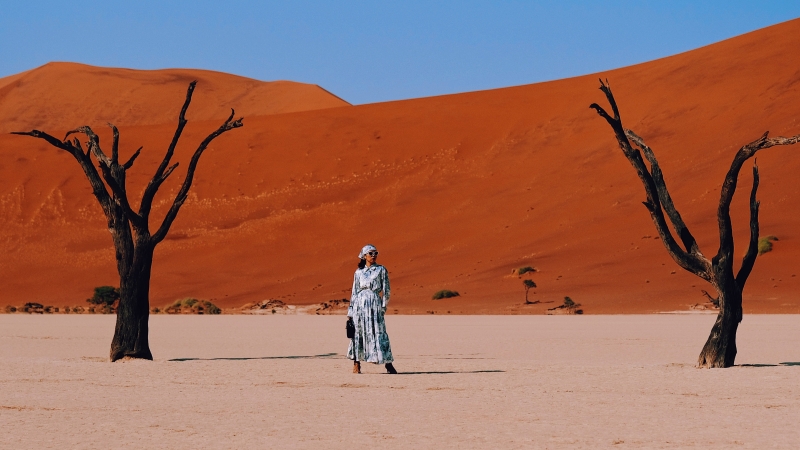
In the Namib Desert—one of the world's oldest deserts—the red sand dunes of Sossusvlei stand tall like giant sculptures of time. Strip away the noise, the hectic schedule, and the need for ostentation. A simple lodge in the desert or dinner under the stars creates a sense of self-fulfillment, replacing all flashy material possessions. Meanwhile, at Walvis Bay, the sight of flocks of flamingos standing still on the calm water serves as a gentle link, soothing the harsh sun and wind of the preceding desert journey.


Namibia's beauty lies not in its glitz and glamour, but in its vastness and tranquility.
Namibia doesn't try to impress with ostentation. It simply exists—vast, arid, and restrained. This restraint creates a rare depth, where the journey is no longer a conquest of landscapes, but a process of readjusting the inner rhythm of each traveler. Leaving Namibia, what remains isn't a list of destinations, but a feeling of "less": less noise, less pressure to be perfect, and less need to prove oneself. Namibia doesn't try to hold anyone back, but this land will linger in the traveler's mind for a long time, like a space large enough for each person to listen to themselves again, amidst the interplay of nature and local culture.


Namibia doesn't try to impress with ostentation. The land simply exists, vast, arid, and full of restraint.












