VI
VI


Phuoc Loc Tho is a collection of 22 ancient houses, large and small, each beautiful, possessing a rare antique charm. The owner of Phuoc Loc Tho invested time and money traveling throughout the country to collect and rebuild them in a harmoniously arranged space. The pathways within Phuoc Loc Tho are also a "wonder" for those who appreciate fine art. Winding paths paved with large rectangular blue stones, dotted with lush green grass, are flanked by bamboo groves, rows of rare and exotic plants, and scenic hills... like skillful and evocative brushstrokes. There are also paths paved with emerald green cement, and artistically designed cement bridges resembling wood spanning tranquil streams, making visitors feel as if they have wandered into a fairytale land. These ancient houses – traditional wooden houses – will tell visitors about the unique cultural heritage of the area.
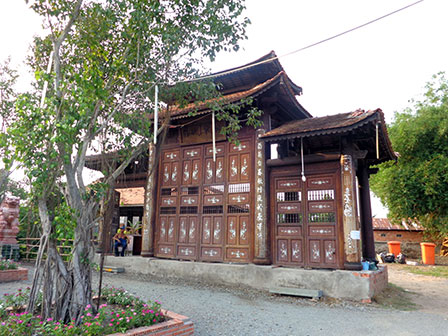

Cao Minh Sang, 36, son-in-law of the owner of Phuoc Loc Tho, said that each ancient house in Phuoc Loc Tho has a unique and interesting cultural characteristic. These include a Southern Vietnamese house with three bays and two wings; a Vietnamese stilt house reflecting a communal style; a Northern Vietnamese-style house with 104 columns and 1,000 intricate and sophisticated patterns in sets of two, three, four, five, six...; a five-bay, three-wing house from the Nguyen Dynasty that only the king was allowed to build; a Khmer stilt house from Tay Ninh; a Thai ethnic stilt house; and a small octagonal pavilion, also known as a Hue pavilion... All the houses are built with precious woods such as Cam Xe, Ca Chat, Redwood, Trac, and Dau... The wooden columns of the houses are wood carvings from the late 19th and early 20th centuries, harmoniously combining strength and grace, solidity and softness according to the philosophy of yin and yang. Most of the rafters, columns, beams, pillars, decorative panels, and ceilings are inlaid with mother-of-pearl and intricately carved with flowers, stories, and couplets in various patterns. The house with the most columns has 114, and the one with the fewest has 36, with an architectural style that is both unique and beautiful. Notably, there are six stilt houses in the style of the Central Highlands ethnic minorities, all built with high-quality wood, mostly collected from Dak Lak, Dak Nong, Gia Lai, and Quang Nam provinces.
Along with the vast collection of restored ancient houses is a collection of antiques displayed within them. For example, the octagonal pavilion, once the residence of high-ranking officials of the Nguyen dynasty, houses a set of three bronze statues of the same age, vividly depicting the Buddha, the Bodhisattva Avalokiteshvara, and the Bodhisattva Ksitigarbha. Each statue bears a seal. Another house houses a 300-year-old statue of the Buddha, made by the Khmer people. The interiors of these ancient houses are filled with rare and precious items, such as a large bed made from a single large piece of wood. "During the Nguyen dynasty, only emperors had such a single-piece bed. High-ranking officials had two-piece beds, while commoners had three or more. This single-piece bed was the royal bed of Emperor Bao Dai," Sang explained. Phuoc Loc Tho also houses another Nguyen Dynasty-era royal bed, gilded and lacquered, with carvings depicting border guarding, battles against foreign invaders, fishing, woodcutting, and farming, as well as the daily lives of the four classes: scholars, farmers, artisans, and merchants. There is also an antique mother-of-pearl cabinet that, when illuminated, emits a shimmering seven-color glow... Phuoc Loc Tho also preserves everyday items from various segments of Vietnamese society, from royalty, officials, landowners, and ordinary people, to spiritual and cultural artifacts of the Vietnamese people, made from various materials such as wood, iron, copper, and ceramics, with diverse ages and types. Among them are even antique items with a modern style from the early French colonial period, such as telephones, radios, gramophones, cameras, and lamps...
With such a vast and rare collection of ancient houses and artifacts, Phuoc Loc Tho Ancient Village Tourist Area was recognized by the Vietnam Book of Records as the place with the most ancient houses and the richest and most diverse patterns in Vietnam in 2010. In 2013, Phuoc Loc Tho was certified as one of the 100 most impressive destinations in Vietnam by UNESCO Vietnam.