VI
VI


From linen to a garment
In early March, the launching ceremony of the "Cooperative for Preserving the Traditional Costumes of the Mong Du Ethnic Group" was held in Lao Chai commune, organized by the Lao Chai Women's Union of Lao Cai province. The event was attended by local residents, representatives from the Lao Chai Women's Union, representatives from Ethnotek company, and the non-profit organization Tip Me – two organizations that have partnered in projects supporting ethnic minority communities in preserving their traditional handicrafts.


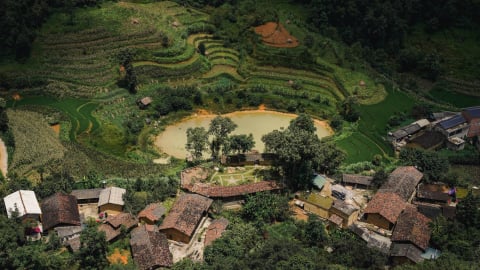
In the village, most people don't speak Vietnamese. Perhaps because of this, they rarely go out to work elsewhere, mainly sticking to the familiar Hmong occupations. This slows down the economic development of households and villages, but it helps preserve traditions naturally. Almost all girls are taught by their mothers how to plant trees, harvest fibers, weave cloth, and make brocade from a very young age.

Hmong Du (also known as Hmoob Dub or Black Hmong) are a subgroup of the Hmong ethnic group. They are known for their flax cultivation, weaving, and brocade making.


According to local accounts, we learned that in the past, the Hmong people used to weave their own cloth, but later they gradually bought cotton fabric from the Thai people or other industrial fabrics and embroidered them with patterns. Currently, only the Thai people still maintain the tradition of weaving cotton fabric, while linen weaving is still practiced in very few places. Therefore, the most valuable thing in Lao Chai commune is the complete preservation of the traditional process, from sowing flax seeds in small gardens to harvesting and weaving them into fabric.
I remember a conversation with Hnub, a Hmong fashion designer. She shared that every time she held a piece of brocade in her hands, she was reminded of her mother.“Women in the past often couldn't marry the men they loved, and life was difficult. They poured their sadness into every song, every stitch. Those involved often didn't fully realize the emotions they were conveying. But if you pause, you'll see that each piece of brocade is a story, a soul. In winter, they would gather around the fire, embroidering and telling stories; they would even embroider while tending buffaloes. Those patterns weren't just for decoration; they were also repositories of the sadness, dreams, and resilience of these women.”

The most valuable aspect of Lao Chai commune is the complete preservation of traditional processes, from sowing flax seeds in small gardens to harvesting and weaving them into fabric.
Indeed, in the memories of those who grew up in Lao Chai commune, the image of mothers and grandmothers sitting on the porch embroidering has become sacred and deeply ingrained in their genes, forever belonging to them and shaping who they are. When asked what the patterns on someone's sleeve meant, a young girl innocently replied:"I don't know. My grandmother and mother embroider like that, so I just follow their example."

Naturally, in each different region, the Hmong people have their own unique patterns, and fashion trends change from year to year. But they themselves cannot clearly explain it, and they don't need to. Particularly in Lao Chai commune, they use both hand-painting and beeswax printing techniques to create patterns. The clothing of Hmong Du women in Lao Chai is special compared to the clothing of other Hmong groups in the women's blouse. The blouse is simply made, close-fitting, and has short sleeves, similar to the blouse in the men's attire.


The traditional clothing of Hmong women in Lao Chai has a distinctive feature compared to the clothing of other Hmong groups, particularly in the women's blouse.
There's nothing but love.
We – visitors from afar – were given an incredibly warm welcome. The villagers organized a cultural performance with traditional acts such as playing the mouth organ, the flute, and singing. According to the stories, the melodies of the songs have been passed down through generations; each singer would adapt the lyrics to express their own thoughts. The songs that day carried the meaning of wishing peace and well-being to everyone. After the performance, the whole village celebrated with a feast of special dishes, rice wine, and joyful, warm congratulations.
As we were leaving, Va Thi Bau – a young woman from the Women's Association of Lao Chai commune – gave me a traditional Mong Du women's outfit. The form-fitting blouse, exquisitely hand-embroidered, must have taken a great deal of time to complete. Bau told me that she loves brocade and often sews clothes for herself and her siblings. To me, it was an incredibly precious gift, and I don't know how many words of thanks would suffice.


Bau also led us to a corner of the garden where the flax seeds sown not long ago had sprouted into vibrant green seedlings. In about three months, they will be taller than the roof, and the villagers will begin harvesting. The stems are bundled, dried, and then the fibers are extracted. Afterward, the flax fibers are soaked in water, pounded until soft, and spun into small spools of thread. These spools are then boiled and dyed with leaves or herbs to create natural colors. Once dry, they are placed on a loom and woven into coarse cloth.
Bau also promised that in September or October, Lao Chai commune would hold a big festival, showcasing the entire process of making brocade, and told us, "You must definitely come back!". Ms. Lo Thi Mo - head of the Women's Association - shared:“Previously, the women mainly worked from home, taking individual orders from customers they happened to come across. Recently, thanks to social media, some women have opened TikTok channels, and although they don't speak Vietnamese, they still introduce their products in Hmong, connecting with more people and selling better. Now, with the establishment of the Women's Association, the goal is to work in a standardized manner, share profits, develop the community economy, and preserve culture in a more systematic way.”


In the village, the people rarely speak Vietnamese, and are mainly involved in the traditional work of the H'Mông people.
Our group consisted mostly of foreigners from various countries. We divided into small groups, slowly observing each stage of the process: from stripping flax fibers, spinning yarn, weaving cloth, applying beeswax, washing, drying, to embroidering patterns. The stories shared by the locals couldn't fully reach us due to the language barrier. There were times when they talked amongst themselves and burst into laughter; we didn't understand anything, but we felt happy nonetheless.
Everyone cherishes and admires the weather-beaten, calloused yet incredibly skillful hands of the Hmong women who create these beautiful brocade fabrics. In every stitch, there is nothing but love for the land and sky, for the high mountain ranges that have sheltered generations of Hmong people, and for the traditions preserved through their daily labor, as familiar as breathing.


Life in Lao Chai commune is slow-paced, resulting in less developed economy, but in return, cultural values are preserved naturally.