VI
VI


The inner world "transforms" on lacquer paintings.
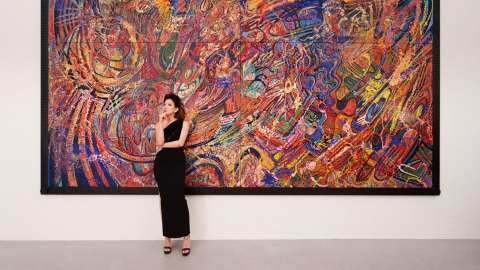
In the lacquer world of artist Pham Tra My, brilliance is not opposed to sadness, but rather coexists in a slow and patient rhythm. (Exhibition)Tropical DreamBringing together 37 lacquer paintings created by Pham Tra My between 2018 and 2025, the exhibition opens up an emotionally rich artistic space where tropical nature is no longer just scenery, but becomes a metaphor for the artist's inner life, memories, and silent dreams.


Tropical Dream unfolds a garden of emotions where nature, memories, and silent dreams are refined over time, sparkling yet profoundly deep.
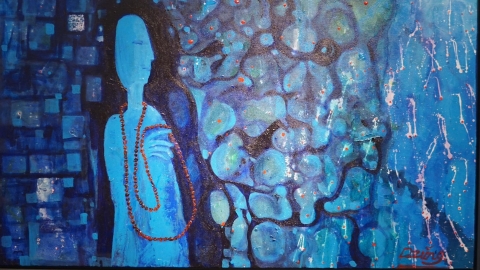
Tropical Dream (or Sad Tropical)It is an invitation to step into a garden of emotions preserved with slowness and patience. There, beauty, sadness, and faith in life coexist in a gentle, dreamy state, refined and distilled through layers of lacquer. The 37 works are like pieces of a unique world, where tropical trees and birds coexist with sadness and hope, not in opposition but in harmony, creating a vibrant yet tranquil space, inviting viewers to slow down and feel.


Pham Tra My's works reflect the inherent contradictions of emotion: vibrant yet potentially melancholic, overflowing yet not carefree, fleeting joy with a lingering aftertaste, both exhilarating and nostalgic.
In a conversation with Travellive, artist Pham Tra My shared that her journey into lacquer painting was a process of persistent training, where each day of artistic work contributed to self-improvement and the shaping of her painting language.“It’s the transformation of my thoughts into concrete forms on the canvas. Lacquer suits my personality: slow, patient, and meticulous. This is a medium that doesn’t allow for haste or mass production; it demands quiet, persistent work, along with a ‘slow but profound’ mindset.”

Lacquer painting is the medium in which Pham Tra My found herself: slow, patient, and meticulous.
The visual language of a tropical dream garden.
According to the artist, the exhibition's title embodies a romantic spirit without being melancholic; it's like a dream of soft, delicate femininity, expressed through restrained colors and emotions.
Sharing more about her relationship with lacquer, Pham Tra My considers this material a quiet companion that "tempers" both her emotions and her inner creative artistic strength.“With its slow pace, demanding considerable time and immense patience, only when the polishing process is complete do the color effects and spatial depth gradually emerge. Thanks to lacquer painting, I have cultivated patience, nurtured my creative inner strength, and fostered a persistent belief in the ability to unlock artistic depths. For me, brilliant things can also carry sadness, and sadness is not necessarily dark. My works, therefore, are both revealing and concealing; both suggestive and retaining a necessary silence.”


In a near-unconscious state, the artist randomly interweaves floral tones amidst the myriad shades of red and green from paint, eggshells, vermilion, silver, and gold.
Viewers recognize that Pham Tra My's dreamy gardens transcend the familiar colors of traditional lacquer painting and the classical compositions of painting (space not confined to perspective but expansive). Then, a feast of vibrant colors, seemingly simple yet elusive, unfolds.
At the opening of the exhibition, the President of the Vietnam Fine Arts Association - painter Luong Xuan Doan - remarked:"Pham Tra My has embraced a quiet life to pursue her art. It's a journey of self-consolation, of erasing inner anxieties, of rediscovering the natural rhythm of life – true to the quiet yet beautiful qualities of Vietnamese women. The garden in My's paintings is one of the most dreamy gardens in contemporary Vietnamese art today. My boldly walks alone, singing her own song amidst the contemporary Vietnamese art scene. That is the courage of Vietnamese women throughout the centuries; she dares to assert her individuality and continues on her path without fear. And who knows, in a few years, we might meet another Pham Tra My – continuing but not repeating, still with the spirit of daring to walk her own path."

According to the President of the Vietnam Fine Arts Association, painter Luong Xuan Doan, Pham Tra My's paintings open up a rare dreamlike garden of contemporary art, where resilient and strong Vietnamese women dare to walk alone, asserting their own artistic voice.

Brilliance can contain sadness, and sadness is not necessarily the opposite of brightness.
With the philosophy of "painting as a way to decorate the soul," art becomes a sanctuary for Phạm Trà My's emotions and silent dreams. Placing the natural world as her main theme, using vibrant and rich colors, each of her works is like an excerpt from a wild, endless tropical garden, where nature, humanity, and all living things intertwine in a simultaneous space. Her paintings don't follow a narrative sequence, nor do they clearly define the subject; instead, they lead the viewer into a quiet, vague, and endless stream of emotion.

My's artistic style gradually perfected through the process of mastering color shading, scraping, and smoothing out the forms.


Viewers recognize that Pham Tra My's dreamy gardens transcend the familiar colors of traditional lacquer painting.
According to artist Nguyen Ngoc Dan, Pham Tra My's painting style is highly decorative and ornate, reminiscent of Art Nouveau – a movement that emerged in Europe in the late 19th and early 20th centuries. However, transcending the spirit of Western aesthetics, My's paintings define a unique identity with vibrant colors, stylized forms, and soft lines, opening up a worldview deeply rooted in East Asian culture. In this space, water, clouds, birds, fish, and plants are present through graceful movements, sometimes revealing, sometimes concealing, as if whispering layers of emotion and inner secrets.
The symbolic approach in the female artist's paintings does not follow the vague or heavily metaphorical personal references found in Symbolist painters like Gustave Moreau, Pierre Puvis de Chavannes, or Odilon Redon. Instead, My's lacquer paintings leave their mark with a sense of ambiguity and indefiniteness in their form, with overlapping layers of shapes, one overlapping another, creating a multi-layered visual effect.


Tropical Dream (or Melancholy Tropical) is an invitation to step into a garden of emotions preserved by slowness and patience.
With its slow pace and demanding nature, lacquer becomes the ideal medium for Pham Tra My to create her dreamlike world. Her artistic style gradually takes shape and is perfected through mastering the use of color, scraping, and smoothing the surface. The soft, flowing lines, rich in whimsy, along with the metallic accents, black lacquer, reddish-brown, and gold leaf, not only evoke visual imagery but also emotion, creating a unique appeal for her works. On the foundation of traditional lacquer, Pham Tra My finds and affirms her own artistic identity."She paints to understand the flow of life, quietly but resolutely, constantly dreaming and full of creative energy, so that every moment of existence has a complete meaning. Therefore, Pham Tra My's sadness has form and her joy has meaning."Artist Nguyen Ngoc Dan commented.
The exhibition "Tropical Dreams" by artist Pham Tra My is open to the public free of charge until January 27, 2026, at the 2nd floor, Building B, Vietnam Fine Arts Museum, 66 Nguyen Thai Hoc Street, Ba Dinh District, Hanoi.


Against the backdrop of traditional lacquer painting, the female artist finds her true self.
Additional information:
Pham Tra My (born 1986, Hanoi) is an artist and a member of the Vietnam Fine Arts Association. She graduated from the Hanoi University of Industrial Fine Arts, majoring in Monumental Painting (2009). Over more than a decade, she has participated in numerous domestic and international exhibitions, including the Vietnam Fine Arts Exhibition, regional exhibitions of the Vietnam Fine Arts Association, and many group exhibitions in Hanoi and Taiwan. In 2026, Pham Tra My held a solo exhibition.Tropical Dream (Sad Tropical)At the Vietnam Fine Arts Museum, this marks a significant milestone in his creative journey.