VI
VI


A journey through Northern Mongolia – where the Taiga begins to breathe.
Leaving Ulaanbaatar, the capital of Mongolia, the road became increasingly deserted. Gray, snow-capped mountains unfolded, signaling the approach of Siberia's renowned Taiga coniferous forests. Our destination was Lake Khovsgol, one of the oldest freshwater lakes on the planet. From here, a one-and-a-half-hour boat ride would take us to the Russian border; in winter, the lake freezes over so completely that people can walk on the transparent ice. But this magnificent scenery wasn't what amazed me most. What left me speechless was the way the people here live and follow nature.

The snow-covered landscapes of Mongolia in winter.
Despite the language barrier, the Mongolian locals always understood what we needed with just a glance or a small gesture. They were born amidst nature, and it seems that their intuition – something that city dwellers have inadvertently lost – has never left them.

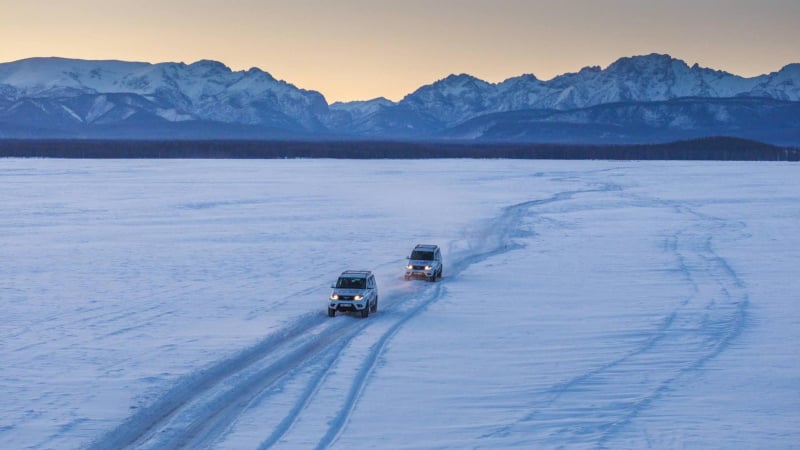


The gray, snow-capped mountain ranges unfold, signaling the approach of Siberia's renowned Taiga coniferous forests.
The Reindeer Tribe – The Last People Living Like in Legend
Deep within the Taiga forest live the last families who make a living by reindeer herding – one of the few tribes that still preserve the custom of taming these animals. Reindeer cannot live in warm places. The colder they are, the stronger they become. Therefore, their villages are always the most remote and difficult to access. Standing beside the reindeer herd in the mornings, listening to the gentle tinkling of the bells around their necks, I felt the ancient rhythm of life still persisting, despite the ever-changing world around me.

Deep in the Taiga forest live the last families who make a living by reindeer herding.

Architect and photographer Tung Le traveled to Northern Mongolia not to chase snow, but to follow nomads on their cold-weather migration.
In the book "Wolf Totem," a stark reality emerged: "Wolves hunt livestock – men hunt wolves – but if the wolves disappear, the entire pasture will wither." That cycle of survival unfolded before my eyes when a cow was attacked by wolves late one afternoon, and the next morning all we found was its cold skeleton beneath a thin layer of snow.
Nestled amidst the vast steppe are tents with red-painted wooden windows. The windows are so low that anyone must bow their head upon entering. But this is not merely architecture to block the wind. The Mongols believe that bowing is a way for people to show humility to the host, to the fire god residing within the tent, and to the vast nature outside that shelters them.

Sitting inside the tent, looking out through the small red door, I saw a vast, boundless world of white. Inside, however, were the sounds of people, the crackling of burning wood, the smell of fermented mare's milk… a warm space, enough to temporarily ward off the biting cold before continuing on the journey. The door became a ritual of transition: from wildness to tranquility, from the immensity to the intimate embrace of community.


The daily life of Mongolian nomads
Migration days – following the rhythm of people and livestock.
In the freezing cold of -20 degrees Celsius, we followed the nomadic group leaving the dry grasslands, crossing the Khoridol forest to their wintering grounds. Sometimes we walked in the wind, sometimes we led our horses up slippery snow-covered slopes, and sometimes we had to stop to bring a goat back to the herd, even though it wasn't one of their livestock. That kindness made me understand that nomads survive through "non-action": not fighting against nature, but harmonizing with its rhythm. On nights when the wind howled, they still shared their seats by the fire, dividing their meager winter rations with us. That thoughtfulness, amidst the harshness of nature, is the warmest thing I take home with me.

Reindeer cannot live in warm places. The colder the climate, the stronger and healthier they become.


Our destination that day was Jargant – the "living stream" of the Darhad people, where, according to legend, the water never freezes, no matter how harsh the winter. Steam rose like the breath of Mother Earth. Standing before that stream, I prayed for my small Vietnamese home, for the peace of my loved ones, and for my own journey.

In 15 days, I realized that Mongolia is not a place to "check-in," but a place to reconnect with nature, with intuition, and with the deepest part of each person.
Living amidst the coniferous forest, I feel the breath of nature, a breath that, if you listen carefully, you can hear the wind, the animals, and even your own voice. Lao Tzu once wrote: "The sage does nothing, and the people naturally transform." Nature here has achieved this: people live in harmony without forcing things.
In 15 days, I realized that Mongolia isn't a place to "check-in," but a place to reconnect with nature, with intuition, with the deepest part of oneself. Amidst the snow-covered steppe, stepping through the red gate, hearing the horses neighing in the mist, I understood that there are lands where one feels small yet fulfilled.

In the freezing cold of -20 degrees Celsius, we followed the nomadic group leaving the dry grassland area, crossing the Khoridol forest to their wintering grounds.


Jargant – the “living water” of the Darhad people, where, according to legend, the water never freezes, no matter how harsh the winter.
On my journey leaving northern Mongolia, passing through sparsely populated villages amidst the steppe, I realized that the architectural philosophy I had pursued for so long was most clearly manifested here. A civilized society, ultimately, is one where people have easy access to three basic needs: shelter, food, and medicine. Yet in what is called "modern," these things are sometimes luxuries: a lifetime of hard work may not be enough to buy a house; and even with a house, one is trapped between convenience, cramped spaces, and invisible pressures.
City dwellers easily become weary, even though "settling down" should ideally be the most peaceful haven. But here, amidst the sub-zero temperatures and crystal-clear skies of Mongolia, the small houses appear simple yet complete: simple nomadic dwellings, yet fully equipped: a central fireplace, a wooden fence surrounding it, nature permeating every wall of the hut. Nothing is superfluous, nothing is lacking. A kind of "sufficiency" that is often a luxury in modern cities. Mongolia is such a land – rustic, unspoiled, quietly maintaining a rhythm of life that has existed for thousands of years, and strong enough to soothe even the most hurried souls.
Thinking about my homeland, I remember that Vietnam also has beautiful villages, peaceful seas and skies, and kind people. If only we would open our hearts and share a little more, perhaps the homes around us would be much warmer and more lovely.


Amidst the sub-zero temperatures and crystal-clear skies of Mongolia, the small houses appear simple yet complete.
There are a few small but important things to keep in mind when traveling to Mongolia:
- Choose a reputable land tour: I met Zolo – a local guy who had studied in Vietnam – and thanks to him, the trip was safe and memorable.
- Warm clothing should be bought in Mongolia: The quality is much better and more suitable for the climate than items bought from Vietnam.
- Vietnamese citizens are exempt from visa requirements, and the procedures are virtually worry-free.
When riding a horse, listen to the handler; they understand the terrain and the animal's reactions better than anyone else.
- And finally, open your heart. Mongolia speaks the language of wind, fire, and intuition, a language you can only hear when you quiet your mind.