VI
VI EN
EN


A "living experiment" of indigenous architecture.
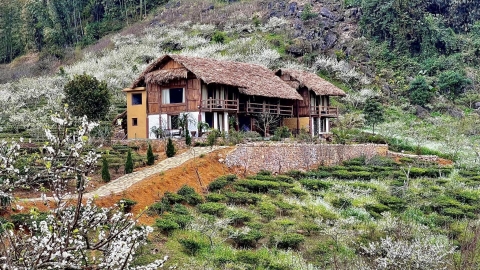
Nestled in Sung Trai village, Tuyen Quang (formerly Ha Giang), where the slow pace of life of the Dong Van karst plateau is still preserved, Ha Giang Aya Lodge by Local Vietnam does not appear as a resort in the conventional sense. It emerges like a melancholic ballad amidst the vast wilderness: unpretentious, not seeking to be different, simply existing quietly, intimately connected to the rocks, earth, water, and wind, just as the Mong people have lived on this land for generations.


Ha Giang Aya Lodge is located deep within Sung Trai village, Dong Van.
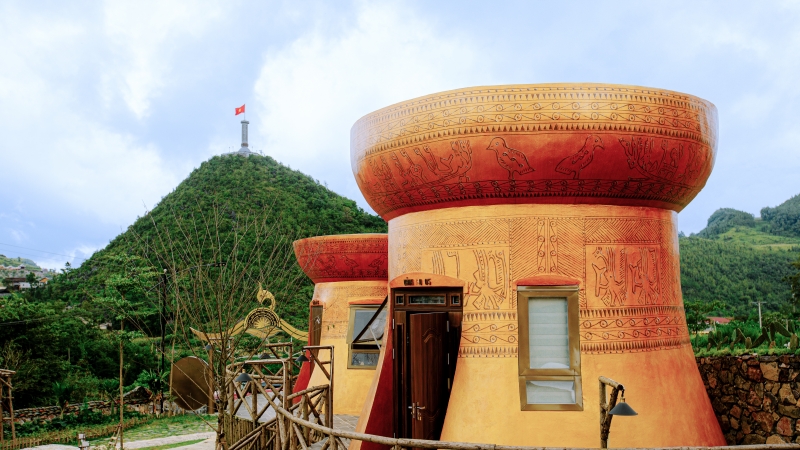
Separated from the crowded tourist routes, Ha Giang Aya Lodge offers a space where local life and contemporary amenities blend seamlessly, for those seeking peace, authenticity, and the pristine beauty of the northern mountains.
Ha Giang Aya Lodge was conceived from architect Tung Le's extensive travels and years of working with the highland communities. For him, this is not a purely commercial resort project, but a "living experiment": to see how far contemporary architecture can step back to make room for local memory, the landscape, and the rhythm of life that has existed here for so long.“A house is like a life, always flowing between two shores: old and new, memory and hope, hardship and gentleness. In this house, everything blends together through the breath of stone, wind, and hands accustomed to the harshness of the mountains and forests,” architect Tung Le shared with Travellive.
Instead of bringing preconceived notions of comfort or aesthetics to the mountain, the architect chose to stay, observe, and work alongside the local people: from how they arranged stones, built walls, set up kitchens, and opened verandas… so that the new house would not become an "outcast," but a natural continuation of Sung Trai village.

Ha Giang Aya Lodge was conceived from architect Tung Le's extensive travels and years of working with highland communities.


The rooms bear the names of the local people of Sung Trai village.
According to Tung Le, in Ha Giang, architecture has never been just a place to live. For the Hmong people, the house is a subconscious fortress accumulating memories of migrations, escapes, and journeys of survival across generations.

Ha Giang Aya Lodge emerges in this context like a new note, but written entirely with old materials. The low-lying yin-yang tiled roof softens the rigidity of the architecture. The wide veranda welcomes the morning mist, the afternoon breeze, and the stories of travelers who stop here. The thick stone walls leave gaps for light to penetrate. The thick rammed earth walls are like a vow binding people to the land. The small, low windows both let in light and evoke the self-preservation instincts of a people who once wandered amidst the mountains and forests.


The rooms at Ha Giang Aya Lodge are named after the surnames of the local people.

The guest rooms maintain a simple structure, using local materials.
According to Mr. Tung Le, the rooms at Ha Giang Aya Lodge are named after local people's surnames such as Mua, Chai, May, Pao, Sua, Lenh… Not to create a sense of novelty for tourists, but as a way to acknowledge the presence of the community who contributed to building this house with their own knowledge and experience. The rooms maintain a simple structure, using local materials, and offer views of the rocky mountains and misty valleys. Privacy is designed to be just right for guests, while still allowing the light, wind, and even the sounds of the village to become part of the experience.
Together with the local community, Aya Lodge is not just a place to stay, but a way to experience Ha Giang in its purest form. Guests here "live" in an authentic ethnic village, waking up to the sound of roosters crowing, going to the Tuesday morning market right next to the resort, where the colors of traditional dresses, the smell of corn wine, and the laughter create the original rhythm of highland life. The staff are all local friends from the surrounding villages. The warmth doesn't come from professionally trained service, but from the way they tell stories of the mountains, guide guests along less-traveled trails, or invite guests to sit by the fire when the mist descends.


From Ha Giang Aya Lodge, guests can begin their exploration of Ha Giang by motorbike or car, traversing some of the most majestic rocky roads in Southeast Asia. Or, more simply, they can hike along hidden trails, climbing the mountain slopes behind the lodge, places rarely visited by tourists. Cultural experiences such as visiting local markets, exploring nearby villages, and engaging in conversations with the elderly are not staged as a "tour" but unfold naturally, reflecting the daily lives of the local people.
The three treasures of the highlands: rocks, soil, and water.
To understand this house, one must understand the three treasures that have shaped life in the highlands of Ha Giang: stone, earth, and water. In a place where earth is so scarce that people have to carry it in small baskets to fill the crevices of rocks to create fields; where water is channeled drop by drop from distant streams to the village's communal reservoir; and where stone occupies most of the area but has become an absolute companion. Stone builds walls, stone forms the pillars, stone constructs water tanks, stone becomes a way of life. Just by watching how a Hmong person walks on stone, one understands: no stone is hard enough to make them falter.

To understand this house, one must understand the three treasures that have shaped life in the highlands of Ha Giang: stone, earth, and water.
Aya Lodge's house on the rocks was born from that very spirit: sturdy yet not harsh, enclosed yet open. The stone walls are thick, but always leave gaps for light to penetrate. The low-lying yin-yang tiled roof opens up soft patches of light, softening the rigidity of the architecture. The wide veranda is like outstretched arms welcoming the morning dew, the evening breeze, and the stories of travelers who stop by.
Under the eaves, an old wooden table, perhaps once found in a Hmong house many years ago, has been preserved by Tung Le in its rustic state, with only minor adjustments to blend into contemporary life. The hearth is placed in its proper position in highland life: the center of the house, the source of warmth and the anchor of stories.


Architect Tung Le further shared:“Ha Giang Aya Lodge is just a tiny dot amidst the vast forests of Ha Giang. But within that tiny dot, travelers can touch the land of rocks, the softness of light, the warmth of the hearth, and the resilience of the Hmong people… people who have transformed mountains into homes, hardship into strength, and wilderness into a living heritage. And if one day you stand on the porch, looking down into the misty valley, you may very well rediscover an ancient rocky land, where everything begins with simplicity, and is beautiful in the most enduring way.”

The low-lying yin-yang tiled roof creates soft, light-filled spaces, softening the rigidity of the architecture.