VI
VI


In the heart of Ho Chi Minh City, where major thoroughfares are constantly bustling around Notre Dame Cathedral, the Independence Palace, and Nguyen Hue pedestrian street, the Ho Chi Minh City Museum stands as a more subdued, discreet, yet complex layer of memory. Less noisy than iconic tourist destinations, this building, formerly known as Gia Long Palace, is not only a repository of the urban history of Saigon - Gia Dinh - Cholon, but also a space that reveals how power, architecture, culture, and even underground secrets have coexisted for over a century.

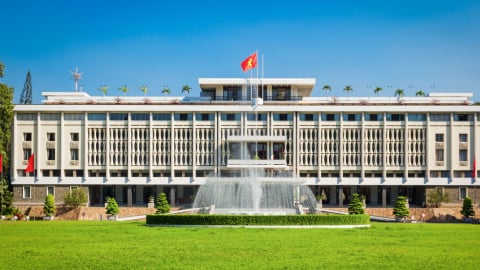
The Ho Chi Minh City Museum as seen from the main entrance on Ly Tu Trong Street.
From the opulent mansion of the colonial government to the museum of a multi-layered metropolis.
Located on Ly Tu Trong Street, this building was constructed in the late 19th century, during the period when the French were reshaping their administrative system in Southern Vietnam. Initially, it was designed as an important administrative building, serving the colonial administration rather than as a public cultural space. This is why Gia Long Palace, from its inception, has embodied the role of power: an architectural symbol of governance, control, and representing the new order that the French government wanted to impose on Saigon.


Initially, the building was designed as an important administrative residence, serving the colonial administration.
Related articles


Throughout various historical periods, the building has continuously changed its function and users. From the residence and workplace of French officials to successive governments in the 20th century, the building has witnessed major political shifts in the South. Each change in name and function has altered the power structure within it, but the building itself has remained a silent witness.
After 1975, as the city entered a new historical phase, it was transformed into the Ho Chi Minh City Museum. This decision held special significance: a space that once served administrative power became a place to recount the history of the very city it had helped govern. From then on, Gia Long Palace ceased to be merely an old building, becoming a place where the past was organized, interpreted, and opened to the public.
French architecture in Saigon, but more than just a European copy.
What makes the Ho Chi Minh City Museum stand out is not simply its age, but the way the building reflects the ambition to recreate a colonial Saigon according to Western standards, while still adapting to the local climate and context.

Overall, the building is in the French Neoclassical style with a symmetrical layout, a grand facade, large columns, wide corridors, and symbolic relief details. From the outside, the structure gives a sense of majesty, more like a declaration of power than a place to welcome the masses.


The building is in the French Neoclassical style with a symmetrical layout, a grand facade, and large columns.
However, upon closer inspection, it becomes clear that this is not a direct copy of a European design. The large windows, high ceilings, airy corridors, and spatial organization have all been adapted to suit the tropical climate. Natural light, ventilation, and the openness of the architecture help the building adapt to Saigon's hot and humid climate, while also creating a softer feel compared to the rigid appearance of many Western administrative buildings of the time.


The large windows, high ceilings, spacious corridors, and spatial organization are all adapted to suit Saigon's hot and humid climate.
Gia Long Palace Tunnel: A secret underground section beneath a building.
If the exterior architecture is what makes visitors stop, it is the secret tunnels beneath Gia Long Palace that truly set it apart.
Hidden beneath the structure is a system of strategic bunkers and passageways that served security, protection, and escape needs during periods of political instability. This area, little known for a long time, is what gives the museum its special appeal today.


Beneath the structure lies a little-known system of bunkers and strategic passageways.
In contrast to the luxurious, symmetrical, and somewhat ostentatious architecture above, the basement offers a complete opposite: enclosed, narrow, solid, and practical. The thick concrete walls, limited passageways, and defensive structures reveal a different logic of power—no longer about display, but about survival.


The artifacts are displayed in separate spaces within the tunnel.
The very existence of the tunnel makes Gia Long Palace a two-tiered symbol: the upper tier for image and administration, the lower tier for security and contingency planning. It clearly reflects how institutions of power always simultaneously possess two faces – a public and a backup.
For many visitors, the most memorable experience lies not in the exhibits in display cases, but in the moment of stepping down into this underground area to feel a different Saigon: where history is not only present in documents or architecture, but also in the silent defensive structures.

Descending into the tunnels, visitors can learn more about the defensive structures of old Saigon.
A destination for reading about Saigon in depth.
In the context of Ho Chi Minh City's constant transformation with new buildings, metro lines, shopping malls, and a fast-paced lifestyle, the Ho Chi Minh City Museum serves as a reminder that this metropolis is not only developing horizontally, but also accumulating depth.
More than just a museum, the building is a rare glimpse into Saigon from multiple perspectives: colonial, administrative, folk, community, and even strategic secrets.


This area displays war artifacts from the people of old Saigon.
While the Independence Palace often represents major moments in modern Vietnamese history, the Gia Long Palace is captivating in a different way: slower, more layered, and sometimes more mysterious. It's a place where viewers not only observe artifacts but also learn how a city was once built, controlled, transferred, and reinterpreted over time.
In the midst of a Saigon always moving forward, the Ho Chi Minh City Museum reminds us that to understand this city, sometimes we need to delve deeper, both into its history and underground.