VI
VI


Recreating the life of fishermen.
The exhibition areas are arranged chronologically, starting from the period when the Cham people lived along the coast, followed by the Nguyen Dynasty, the French colonial period, and the mid-20th century. The exhibition space uses images, artifacts, and models to depict the life of coastal residents and the development of the fish sauce industry.

The Old Fishing Village Museum is located on Nguyen Thong Street, about 7 km from the center of Phan Thiet.

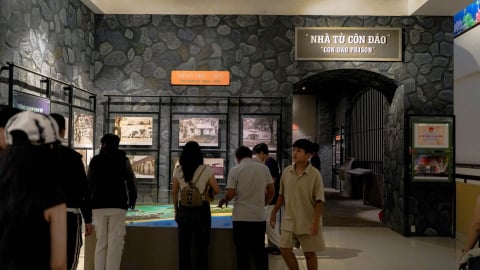
Tourists observe photographs depicting the lives of fishermen in the early 20th century.

Images of fishermen mending nets and preparing fishing gear on the beach.

These round, bulbous ceramic jars with narrow mouths are used to hold fish sauce.

The two royal decrees issued by Emperors Đồng Khánh and Khải Định to the fishing village demonstrate the court's recognition of the coastal community of Bình Thuận.

These are the owners of the fish sauce factories – the people who laid the foundation for the Phan Thiet fish sauce brand.

Traditional fish sauce labels often feature images of anchovies, traditional boats, and the names of famous fish sauce producers.
Several scenes of daily life are recreated, such as a tape recording shop, a grocery store, and the houses of wealthy families who made their fortune from fish sauce production. These models are placed in separate spaces, allowing viewers to easily follow the narrative. In addition to the artifacts, the museum also recreates fishing, salt production, and trading activities at sea. Viewers can visualize the formation of the craft village, linked to the abundant fish resources and natural conditions of the Binh Thuan coastal region.
The museum is open daily from 9 am to 6 pm. Admission is 100,000 VND per adult; children under 1 meter tall are admitted free of charge.


Traditional fish fermentation techniques
The barrel house is the central area of the museum. Here, large wooden barrels are arranged according to traditional production models, simulating the traditional fish sauce production process - an art form with a history of hundreds of years in the locality.


The space inside the fish sauce fermentation house features large wooden barrels used for traditional fish sauce making.
The main ingredients are anchovies and salt, mixed in a common ratio of 3 parts fish to 1 part salt. The mixture is then placed in wooden barrels, compressed, and left to ferment naturally for a long period. This process can last from 6 to 12 months, depending on conditions and production methods.

The salt field model simulates the important ingredient preparation stage in the fish sauce making process.
During the fermentation process, the fish and salt gradually decompose, forming fish sauce. The fish meat then breaks down into liquid. The product is subsequently extracted multiple times through a system of pipes. The first extraction, with its high protein content, is generally considered the highest quality in the traditional production process.

Anchovies - the main ingredient used in the production of fish sauce.

Ceramic jars are used to store and transport fish sauce.
Primitive tools such as bamboo baskets, ladles, and earthenware jars are placed alongside wooden vats and illustrative images. These familiar tools help to clarify the process of fish sauce production before the advent of modern technology. This process is linked to the centuries-old fermentation technique in Phan Thiet, formed from the fishing and fish preservation activities of coastal residents.
How to identify good fish sauce
The experience zone is located at the end of the tour. Visitors can sample fish sauce served in earthenware jars – a type of ceramic vessel once used to transport the product to other localities. The fish sauce is extracted directly from the fermentation vats using the traditional method, also known as "mam nhi." This is a pure, high-protein fish sauce that was widely used by the people of Phan Thiet in the past.
The finished product typically has a reddish-brown color, a distinctive fermented aroma, and a rich, sweet aftertaste. These characteristics are formed during the long fermentation process of fish with salt, without the use of additives. Here, visitors can be guided in identifying fish sauce through sensory evaluation and protein content, and compare different types of fish sauce to understand the differences between traditional and industrially produced products.
Besides the fish sauce making tradition, the museum also displays items related to the lives of fishermen, such as fishing tools, salt-making equipment, and trading tools. These spaces further complete the picture of the daily life and production of coastal fishing village residents over the centuries.