VI
VI


Upon his first visit to Wuzhen, Nguyen Tran Hieu was overwhelmed by the scene, which resembled a vibrant ink painting: the river winding through the streets, bridges connecting the two banks, wooden houses nestled close to the water's edge, and wooden boats gently gliding on the clear river.

Dubbed "the most beautiful scenic spot in Jiangnan," Wuzhen is like a watercolor painting in real life.
Step into the ink painting
Wuzhen is a town located north of Tongxiang City, Zhejiang Province, founded in the 4th century, approximately 1,300 years ago. The town lies within a triangle formed by Suzhou, Hangzhou, and Shanghai, three famous cities in China.
At the same time, Wuzhen is also one of the six famous ancient towns in the southern Yangtze River basin, including Jinzhou (Liaoning), Ciqikou (Chongqing), Lizhuang (Sichuan), Dachang (Wushan), and Jiang'an (Sichuan).

Wuzhen is one of the most popular ancient towns in China, attracting a large number of tourists.
The Grand Canal, connecting Beijing and Hangzhou, flows through Wuzhen, dividing it into four main areas: Donghe, Xihe, Nanhe, and Beihe.
Before the railways, the ancient Chinese could only travel by boat to reach populated areas along the Yangtze River. Therefore, boat travel became a deeply ingrained and distinctive cultural feature of this ancient town.


Boats were an ancient means of transportation in Wuzhen, and today they have become a distinctive cultural feature of the Gingnan river region.
Despite historical upheavals, Wuzhen has retained its feudal-era wards: traditional craft villages, ancient villages, cultural villages, food villages, beverage villages, and riverside markets. With its intact form, Wuzhen has become a "living fossil of ancient Eastern civilization." The Donghe and Xihe areas have been developed for tourism, attracting many visitors.
Wuzhen is 86 km from Hangzhou, 70 km from Suzhou, and 126 km from Shanghai; visitors need to take a bus from one of these three cities. Hieu bought his ticket at Suzhou Station North, stopping right at the West Gate of Wuzhen, making it convenient for exploration. The entrance fee to the West Gate is 150 yuan, and to the East Gate is 110 yuan; visiting both for a day costs only 190 yuan.


Nowadays, not only domestic tourists, but also a large number of foreign visitors come to Wuzhen to admire its earthly beauty.
Enjoy a boat trip through the heart of the ancient town.
Influenced by Confucian philosophy and the aesthetics of ancient China, with its "small bridges, flowing water, and houses," the ancient town features small bridges over flowing water symbolizing prosperity, and houses lining both sides, offering views of the river and the changing scenery with the four seasons. Naturally, Hieu couldn't miss the experience of taking a leisurely boat ride on the river, immersing himself in the lush greenery of the ancient town.
From the entrance gate to the moment he stepped onto the boat, Hieu still didn't have a clear picture of Wuzhen. "As the boatman's oars stirred the water, slowly propelling the wooden boat forward, through the lush green willow branches casting shadows on both banks, it lifted the veil of an ancient town that has remained unchanged for a thousand years," he said.


Wooden boats, wooden houses, a green river, and weeping willows create a picture of "harmony and beauty," according to the ancient Chinese concept.
The boat ticket counter is located next to the ticket area for entering Wuzhen, with a fare of 60 yuan per person for a shared boat seating 8 people. The boat dock is right next to it. After buying tickets, Hieu boarded a boat to enjoy the beautiful scenery on both sides of the river before exploring the town's cobblestone streets.
The emerald-green water nurtures schools of colorful koi fish, some larger than an adult's thigh. The fatigue and hardships of the journey seem to vanish, blending into the water where schools of fish, big and small, swim freely and playfully.


The koi fish gathered around the edge of the bridge spanning the river, waiting for tourists to feed them.
As the boat turned left to enter the center of the ancient town, traditional houses made of wooden planks joined together, with tiled roofs, gradually appeared on both banks. The wooden boat glided under the bridge, taking Hieu to the central area of western Wuzhen, where a wooden bridge spanned the water, connecting the two banks, allowing visitors to cross and feed the fish or watch the plump fish gathering around the bridge's edge.
Wuzhen is also famous for its picturesque bridges, most notably the Renji Bridge and the Tongji Bridge, where you can see the arches of the other bridge from one. After a tour, Hieu realized with admiration that the experience of cruising on the river allows visitors to truly appreciate the beauty and harmony of the ancient town.


The bridges spanning the river, illuminated by lights and transforming into the shapes of the full moon and crescent moon, have become one of the symbols of Wuzhen.
Strolling through the old streets
The boat docked at the end of the town, and Hieu began walking back towards the gate to explore the cobblestone streets inside, nestled between rows of ancient houses. The houses were exquisitely carved, decorated with elegant traditional wood and stone sculptures, harmonizing with the modern pace of life.


Old wooden houses and cobblestone streets still blend harmoniously with modern life.
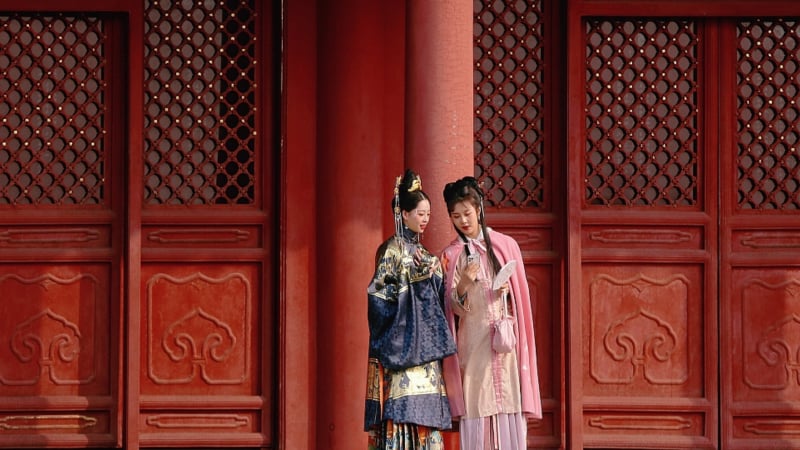
The traditional architecture of Wuzhen remains perfectly preserved, blending seamlessly with the bustling crowds, reflecting the inherent lifestyle of an ancient town. Shops and restaurants are built in an antique style. Young men and women in traditional attire stand on the verandas of shops, by the riverbank, beside willow trees, or stroll among the crowds, creating a scene straight out of a Chinese martial arts film.


Hieu visited the food village and witnessed long queues in front of snack stalls. He tried a 6-yuan cheese sandwich, Chinese beef noodles, and braised eggs for 49 yuan, then sat down for a 42-yuan coffee, watching the boats drift by and the people passing by. On his way back to the bus station, Hieu passed a wooden boat-building workshop and saw the craftsmen carefully performing each step in creating wooden boats. These will probably be the boats used to transport passengers on the river in the future.

The boatyard is located in Wuzhen, where local craftsmen work diligently.
The day they arrived in Wuzhen was cool, with a gentle breeze and bright sunshine. There were moments when Hieu felt like he had traveled through time, witnessing scenes from another dimension of the past. "I still hope that one day I can return to this ancient town with my loved one, to watch the maple leaves change color, the snow fall on the willow branches, and observe the four seasons passing by in this most beautiful place in Jiangnan," he said.

After more than a millennium, Wuzhen still vividly portrays the classical Chinese architectural style of "harmony and beauty," meaning the harmony between the overall architectural space and the inherent beauty of nature, while allowing travelers to appreciate the ancientness and cultural and historical importance of this ancient town to future generations.