VI
VI


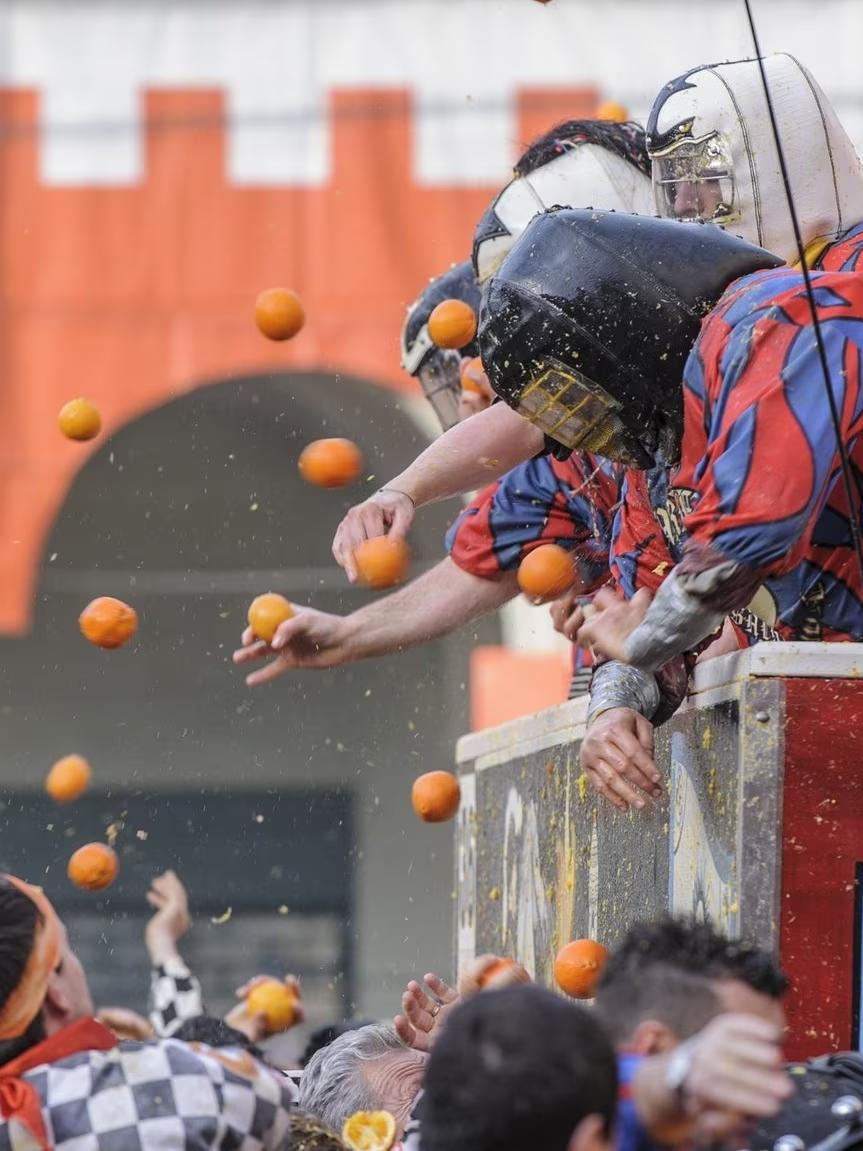
During the Carnevale di Ivrea festival, the charming village of Ivrea nestled at the foot of the Italian Alps transforms into a battleground. Locals and people from all over the world flock to participate in the annual "Orange Throwing Battle." Carnevale di Ivrea is a traditional event blending history and legend, lasting four days. Taking place in February or March, depending on when Lent begins, Carnevale di Ivrea is an unforgettable combination of parades, ceremonial fires, and distinctive regional cuisine.

Held annually before Lent, Carnevale di Ivrea is one of Italy's most anticipated events.
The folklore origins of Carnevale di Ivrea
The origins of the Carnevale di Ivrea festival are a somewhat ambiguous blend of legend and history. According to the organizers, local legend tells that in the Middle Ages, there was a legal right in Europe called prima nocta that allowed feudal lords to have sexual relations with any female citizen, even on their wedding night. A notorious tyrant exploited this right to try to rape Violetta, the daughter of a miller. But instead of succumbing to the tyrant's cruel act, Violetta drugged him and beheaded him while he slept, then presented her victory to the people, sparking an uprising for freedom.
The Battle of the Oranges
Professor Daniel Bornstein, an expert on medieval Italian religious culture at Washington University in Saint Louis, said: “The medieval origins attributed to festivals like this are generally legendary and undocumented; many festivals are later creations.” While the story of Violetta may be mythical, Bornstein reinforces: “There were certainly riots and factional fighting in the streets of medieval cities, with whatever they had at hand being used as weapons.”
Whether the story of the medieval heroine and her rebellion against the tyrant is true or fictional, the people of Ivrea celebrate their "day of liberation" every year. Each year, they elect a "new Violetta" and introduce her to the public on Carnival Saturday. She appears throughout the festivities, throwing candy in parades and observing the entire event. However, over the centuries, the customs have changed considerably, with many historical elements and traditions of the festival added later, including the orange-throwing tradition which only emerged after World War II.


Each year, the people elect a girl to play the heroine Violetta (la Mugnaia).
The Battle of the Oranges
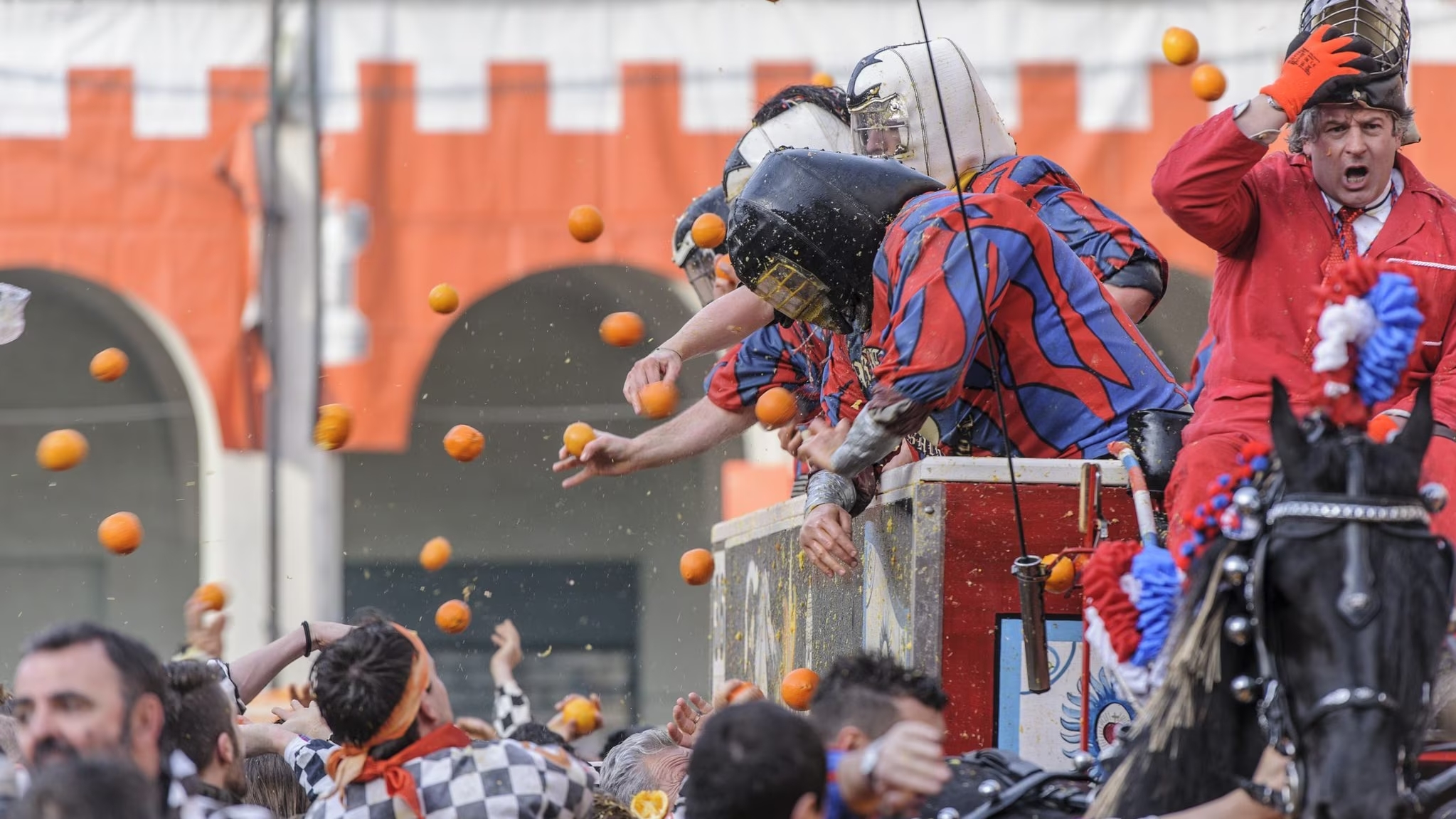
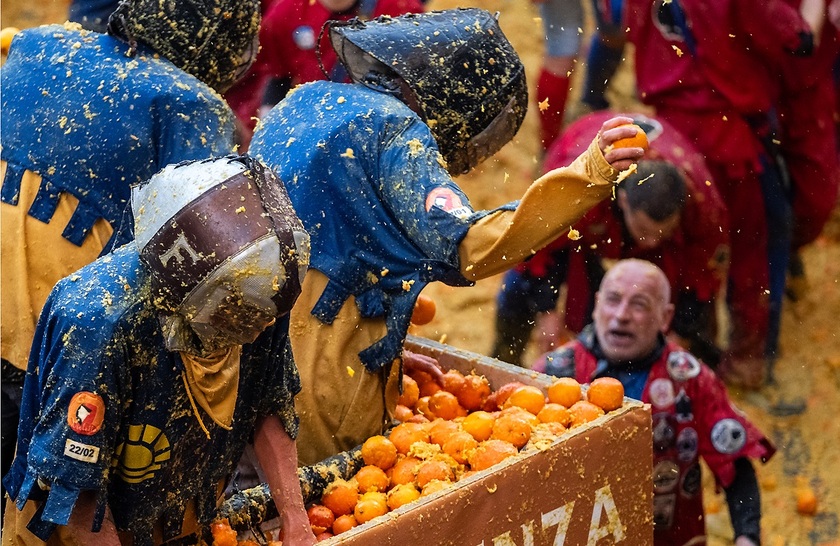
Officially known as the Battaglio delle Arance, meaning "Battle of the Oranges," this "friendly conflict" takes place in designated squares and streets throughout the city. For three days, from Carnival Sunday to Shrove Tuesday (the last day of the festival before Lent), nine groups of aranceri – representing the class of people rising up against the autocratic regime – walk and throw oranges at horse-drawn carriages carrying armored figures representing the lords and their retainers. Imported from Sicily and other parts of Southern Italy, an estimated 900 tons of oranges are used each year throughout the event.

The streets of Ivrea are covered in a paste made from orange peels and pulp, and the scent of oranges lingers in the air and on people's bodies for days, even weeks.
Unlike the tomato-throwing festival La Tomatina in Spain, the "lethal" impact of the oranges at Carnevale di Ivrea is far greater. Most participants will leave with bloody noses, or worse, but for them, it's part of the fun. If you don't want to join the melee, spectators can still observe the event from safe locations such as building balconies or behind fences. Additionally, wearing a crimson Phrygian hat, symbolizing Ivrea's freedom from authoritarian rule, lets the aranceri know you're not their target.

The participants' faces were bruised from being hit by oranges, but they were full of joy.
The symbolic traditional ceremony of Carnevale di Ivrea
Recognized by the Italian Prime Minister as an “Italian event of international importance,” Carnevale di Ivrea would be nothing without its enduring traditions and symbolic celebrations. While all eyes are on the Battle of Oranges, many other events take place, from Calzata del Beretto, where visitors are invited to wear ceremonial Phrygian hats on Fat Thursday, to enjoying cod and polenta (a traditional cornmeal dish) in Marmora Square on Ash Wednesday.
As the festival draws to a close, festival-goers and aranceri gather in Ivrea's squares to burn scarli, a tall pole covered in heather and juniper, topped with an Italian flag. Children representing Ivrea's parishes burn individual scarlo (singular of scarli) in three separate squares, inviting people to put down their oranges and shake hands in peace. Local photographer Alessio Ferreri, who has attended Carnevale di Ivrea since he was three, describes the burning of scarli as the most important tradition of the festival. “People gather together, the atmosphere is filled with a spirit of community, all sharing the warmth of the fire on the chilly night… Depending on how the scarlo burns and falls, it will be considered a sign of good or bad luck for the coming year. A beautiful moment to gather, warming ourselves by the vibrant fire in the middle of Ivrea's square on a cold night.”

The ritual of burning scarli - the most important tradition of the festival.
Carnevale di Ivrea is not just a festival honoring a medieval heroine; it has become an integral part of Ivreian identity, to the point that one can see in their eyes the longing to fully enjoy it and pass this passion on to future generations. In the final steps of the Funeral Procession – the closing ceremony of Carnevale di Ivrea – people whisper to each other, "Arvedse a giobia a 'n bot," meaning "We will meet again on Thursday at one o'clock," a confirmation of their participation in the festival the following year.