VI
VI


As cultural tourism expands, Pao's House takes on a new layer of meaning, acting as a gateway leading visitors deeper into the lives of the Hmong people.
The century-old house tells its story.
The road leading to Lung Cam village is lined with stone walls, moss-covered yin-yang tiled roofs, and faint light filtering down from the high mountains. Amidst this setting, Mr. Mua Sua Pao's traditional earthen house stands still, as if it has been waiting for someone for a hundred years.

The road from the entrance to Lung Cam village leads to the house that served as the setting for the film "Pao's House".

The yin-yang tiled roofs lean against the mountainside.


Layer upon layer of earth, sun-dried and compacted, these dark yellow walls not only keep the H'Mông family warm but also preserve the resilient work ethic of the mountainous region. Every stone slab around the courtyard, every wooden beam in the house frame, seems to bear the imprint of generations.
When the film crew of "Pao's Story" arrived, the house suddenly took on a different life. From then on, the name "Pao's House" stepped out of the screen, into real life, and then into the memories of visitors from afar.

The yellow earthen walls bear the mottled marks of time.
The moment the plateau became a cinematic landscape.
If you only watch the film, you might think "Pao's House" is romantic thanks to the camera lens. But when you stand at the doorstep, look at the neatly paved courtyard, and listen to the wind rustling through the tiled roof, you'll understand that cinema only captures a very small part of the truth.


The life of Mr. Mua Sua Pao's family continues in this house.
The light in Lung Cam changes hour by hour. In the early morning, the sun peeks through the mountain ridge, filtering through the wooden pillars and creating thin streaks of light. By noon, the entire courtyard is brightly lit, highlighting the colors of the brocade dresses drying on the veranda. As evening falls, the scent of wood smoke permeates the air, making the house even warmer.


The interior space is simple with only basic furnishings.
What makes this place iconic is not just its beauty, but the fact that it preserves a way of life. The earthen walls, fireplaces, mills, water jars… are all pieces of authentic life that cinema was fortunate enough to capture while they were still intact.
New tourism flows and expanded routes towards Tuyen Quang.
For many years, "Pao's House" was one of the first stops to enter the world of Hmong culture. But recently, as tourism routes in the Northeast region have been reconnected, tourists often combine their journey from Ha Giang to Tuyen Quang to find a softer, more peaceful experience.


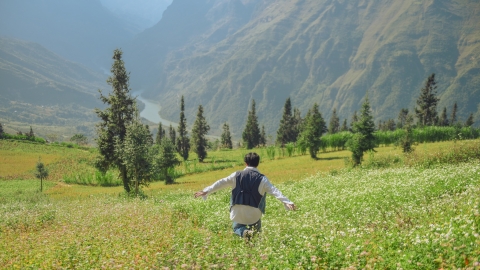
This gives "Pao's House" a new meaning: not just a place to tell stories of the past, but also a starting point for exploring a broader cultural landscape. From the harsh rocky plateau, people follow gentle paths to the streams and forests of Tuyen Quang. From the vibrant colors of the H'Mong people's clothing, they encounter the simpler way of life of other ethnic groups.
A house doesn't change its location, but it changes how people see it.


The breath was silent, and the lingering echoes remained.
What visitors will remember most about "Pao's House" is not the ancient wooden gate, not the century-old tiled roof, and certainly not the fame of the film. It's the indescribable feeling of standing in the courtyard, looking at the blue sky divided by towering mountain peaks, hearing the laughter of children, the crowing of roosters, and people calling out to each other in a unique language.


Compared to scenery in movies, real-life scenery offers a more authentic and emotionally resonant experience.
These little things make people leave, yet still feel like they've left something behind. Perhaps it's a rare moment of peace, perhaps it's the simplicity that's increasingly difficult to maintain in life in the lowlands. Or maybe it's just a vague memory of a place that once appeared in a film, but which, upon actually visiting, feels far more profound.
"Pao's House" has never been just a cinematic setting, but also a part of life, history, and the pristine beauty of the H'Mông people. Even though today's travel routes have expanded, connecting Ha Giang with Tuyen Quang or any other mountainous region, that century-old house still stands quietly in the valley, preserving the flame that generations have nurtured.