VI
VI


A research team led by Professor Monica Montefalcone, a 51-year-old experienced scientist, headed to Vaavu Atoll in the Maldives. The goal of the trip was to dive into the underwater cave system to search for and study a rare, previously undisclosed coral species.
Among the deceased was 22-year-old student Giorgia Sommaca, who was Montefalcone's own daughter.


The noble scientific mission quickly turned into utter tragedy when the diving team completely lost contact with the surface at around 1:45 PM on May 14th, after failing to surface as scheduled.
Italian media confirmed that the research team holds a permit to dive to depths of up to 50 meters for scientific purposes. This is a limit far exceeding the usual 30-meter standard for recreational scuba diving.
However, a noteworthy detail recently discovered by authorities concerns the legality of the personnel list. This special permit actually only registered the names of Professor Montefalcone and two other members. The other two members of the group who perished, including her daughter, were not listed in the official registration with the bay management.

Vaavu Atoll (Maldives), a place with rugged terrain and extremely strong Indian Ocean currents.
Vaavu Atoll is renowned as a pristine diving spot, boasting a high density of marine life thanks to the characteristic monsoon currents of the Indian Ocean. However, this majestic beauty hides extremely harsh geological hazards. The underwater cave system where the accident occurred is located at a depth of about 50 meters within the coral reef, but the actual depth inside extends down to over 60 meters, comprising three large chambers connected by narrow passageways, protruding sharp rocks, and tunnels xuyên through the coral reef structure.

On the day of the tragedy, the local meteorological agency issued a yellow alert to all passenger ships and fishermen due to deteriorating weather and rough seas. This dangerous weather not only stirred up the fine mud at the bottom of the cave, reducing visibility to a minimum, but also triggered extremely strong underwater currents.
Unlike the relatively calm waters of the Mediterranean Sea that the Italian divers were familiar with, the Indian Ocean possesses very strong currents, leading to the hypothesis of the "Venturi effect".
When strong ocean currents are forced through narrow passageways and cave entrances, the water velocity increases abruptly to maintain a constant flow, causing a severe pressure drop and creating a massive mechanical suction force directly into the cave.
Previously, the team had attempted to send a remotely operated vehicle (ROV) down for exploration, but the strong currents rendered the device inoperable, forcing the scientists to dive down themselves.

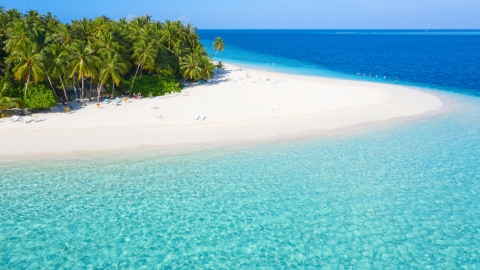
The Maldives is an island nation with low-lying terrain, featuring long stretches of white sandy beaches and coral reefs teeming with marine life.
Based on the Venturi effect hypothesis, two terrifying scenarios were reconstructed. Either the entire group of five was simultaneously sucked deep into the cave by the raging current, or one member was swept in first, and the others, in their attempt to rescue their teammate, were completely isolated by the water.
In cramped, dark spaces with zero visibility, extreme psychological panic acts as a catalyst, accelerating oxygen consumption and causing them to lose control of the situation.
Besides the unpredictable external factors from nature, underwater medical experts also have serious doubts about the hypothesis of oxygen poisoning in high-pressure environments: At great depths, the use of conventional compressed air tanks (containing 21% oxygen and 79% nitrogen) or specialized Nitrox gas mixtures (oxygen-rich air to reduce decompression time) requires strict control. When humans breathe oxygen at extremely high concentrations and pressures at depths exceeding 50 meters, this life-sustaining gas reverses course and becomes a highly toxic substance to the central nervous system.
Oxygen toxicity syndrome, or hyperoxygenation, attacks victims with symptoms such as muscle spasms, severe dizziness, physical pain, and a rapid decline in consciousness and complete disorientation. In a dark underground cave, when a diver loses consciousness, they are completely helpless in finding their way to the surface, and death is inevitable.
Immediately after receiving reports of the missing person, Maldivian rescue forces, in coordination with a team of professional Finnish divers, launched a large-scale salvage operation. However, the complex nature of the cave's terrain and harsh weather conditions continuously hampered progress.
To date, the rescue team has found the bodies of all five victims, but unfortunately, one diver died while searching, bringing the total number of victims to six.