VI
VI




With Valentine's Day approaching, many young men and women are frantically searching for a beautiful and meaningful gift for their loved ones. This could include cards decorated with pretty hearts, sweet boxes of chocolates, fragrant bouquets of roses, or teddy bears with cute messages printed on their shirts.
Although Valentine's Day has been commercialized and celebrated almost everywhere in the world, many people might be surprised to learn that this holiday originated centuries ago and stems from the legend of Saint Valentine.

Who is Saint Valentine?
There are many different biographies surrounding Saint Valentine, and no one can be certain which is the true story of Saint Valentine, as there may have been one or more imprisoned saints with the same name. However, according to the most widely circulated legend, Saint Valentine was a priest from Rome. He was arrested after secretly arranging marriages for Christian couples – who at the time (3rd century AD) were being persecuted by Emperor Claudius II for their religion.
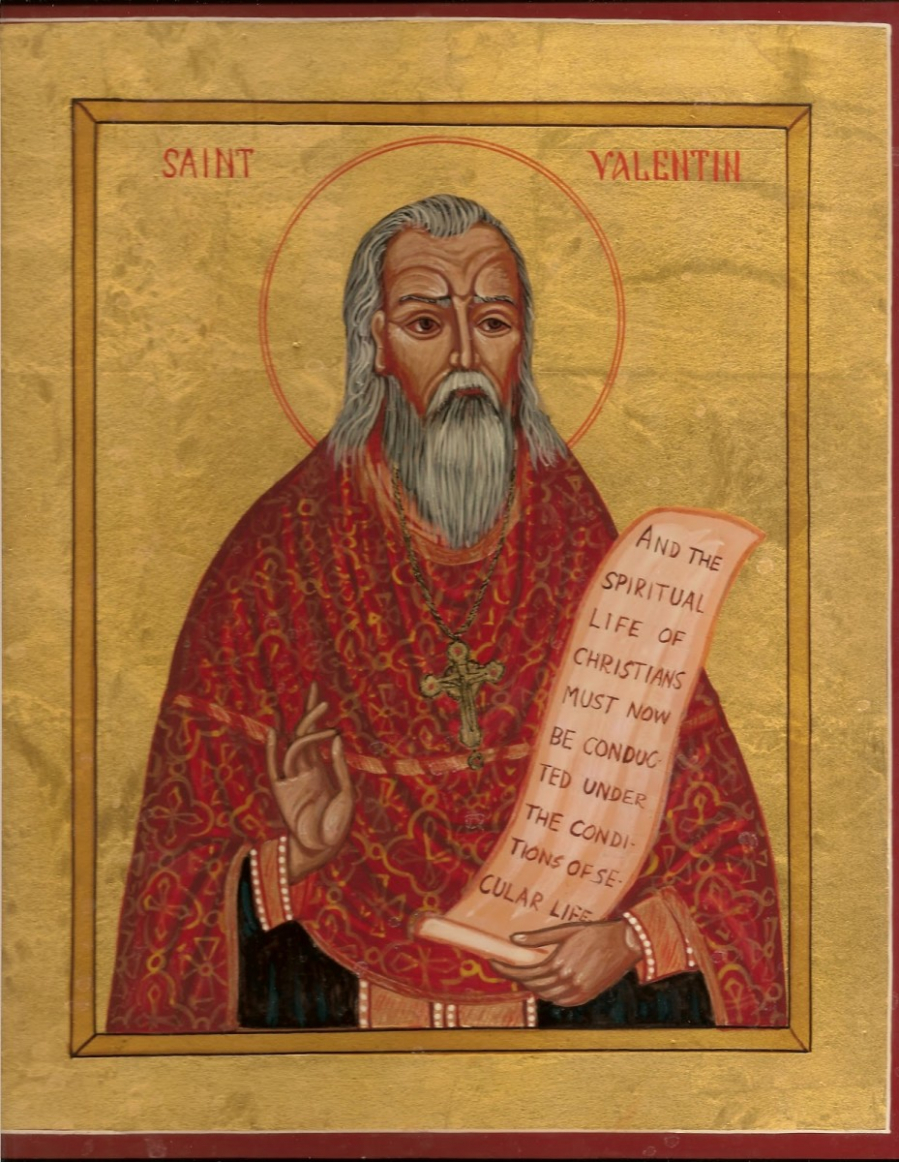
Illustration of Saint Valentine
Because he helped them get married, Saint Valentine was imprisoned and eventually sentenced to death. According to many sources, during his time in prison, he fell in love with the jailer's daughter. Then, on February 14th, the very day Saint Valentine was to be executed, he wrote a love letter to the girl he loved.
Today, the skull is kept at the Chiesa di Santa Maria in Cosmedin, Rome's beautiful Piazza Bocca della Verità; while the coffin containing some bone fragments and a vial of blood is kept at Whitefriar Street Church in Dublin, Ireland. Interestingly, many couples regularly visit this church to pray for the blessing of their relationship, and even many couples preparing for marriage come to this church on February 14th to pray and receive blessings.

Cupid and the Arrows of Love
Cupid is known as the god of love, desire, and passion. Often depicted as the son of the goddess of love, Venus, and the god of war, Mars, Cupid is known as Amor (“Love”) in Latin and Eros in Greek. Along with the heart, the image of a dove, and the colors red and pink, Cupid is frequently mentioned as an ancient symbol associated with Valentine's Day.

Cupid is often depicted as a boy with small wings and a bow and arrows, which he uses to shoot people's hearts. Therefore, those in love are said to have been "struck by Cupid's arrow of love."
Why is the heart associated with love?
The Egyptians believed that the heart was the source of both memory and human emotions. It was so important that while all other body parts, including the brain, were removed during mummification, the heart was the only one left intact. The renowned ancient Greek scholar Aristotle also believed that the heart was an organ of intellect.
The connection between the heart and love was widely known until Galen, a Roman physician, stated that the heart influences human emotions more than reason, yet love is an exception because the main factors governing it are found in the liver.

During the Middle Ages, as Christianity gained increasing influence in society, the concept of the heart—love—gradually gained more acceptance. This concept became particularly prevalent in the 11th century, when it was associated with many spiritual achievements and became a familiar image in the courtship rituals of knights towards the women they loved.
Around the 1180s, members of European families began expressing a strong desire that, upon their death, their hearts be buried separately from the rest of their bodies, in places special to them. For example, in 1199, when King Richard I of England died, his heart was buried in Rouen in Normandy while his body was interred in Anjou, where his father rested.
Since when has Valentine's Day become so "commercialized"?
Around the mid-18th century, Valentine's Day began to arrive in England, and couples exchanged beautifully decorated cards with flowers, ribbons, images of Cupid and doves to convey sweet messages of love. In 1913, Hallmark Cards of Kansas City began mass-producing Valentine's cards, and thus, handwritten cards were replaced by printed ones.

Today, while the legends of Saint Valentine and the true historical meanings behind this special holiday are no longer frequently mentioned, the most important thing is that it remains a special day of love, a time for us to express our most sincere feelings to our loved ones, just as Saint Valentine did in his final moments on earth.






_result.jpg.jpg)