VI
VI


On the world map, few countries possess a position as unique as Türkiye. Just looking at the Bosphorus, which divides Istanbul into two parts on two different continents, one can understand why this land has consistently appeared at major turning points in history. From the Byzantine and Ottoman eras to the trade routes that once connected Europe, Asia, and the Mediterranean, Türkiye has long been a place where geography and history are so inseparable.


That's what made me want to come here. Not to hunt for beautiful photos or add another country to my travel map, but to see with my own eyes a land that once stood at the crossroads of empires, religions, and great cultures of the world.
Perhaps that's why this is one of the destinations I often mention when friends ask where to start if they want to take a trip that's both culturally rich and distinctly different from the usual choices for Vietnamese people.
Interestingly, the gap between many people's perceptions of Türkiye and reality is often larger. Obtaining an eVisa is now relatively easy, flight options to Istanbul are increasingly diverse, and the cost of living in many locations is significantly more affordable than one might imagine for a country situated between Europe and the Middle East. This is also why I'm often surprised to see many people view Türkiye as a distant destination, when in reality it's much closer and more accessible than we imagine.

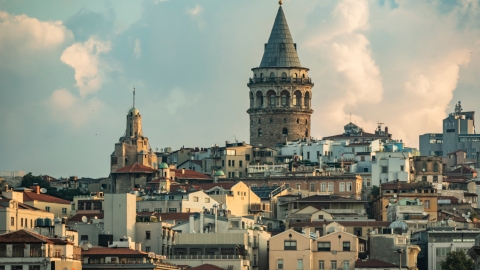
Sunset over the Bosphorus Strait, the lifeline that divides Istanbul and forms the natural border between Europe and Asia.
Bosphorus, where geography becomes history
On my first afternoon in Istanbul, I took a ferry across the Bosphorus. The city emerged from the water, its domes, spires, and layers of architecture stretching along the hillsides. Cargo ships slowly made their way towards the Black Sea while ferries continued their regular service, carrying people back and forth between the two sides of the city as they had done for generations.
Standing in the middle of the Bosphorus, I felt like I was in a place where geography was no longer simply geography. This narrow body of water connecting two vast seas played a decisive role in the prosperity of the empires that once ruled the region, creating the unique status of Constantinople in the past and Istanbul today. Not many places in the world allow you to understand, simply by looking at a map, why history unfolded the way it did.
But the most fascinating thing about Istanbul isn't seeing the traces of history, but feeling that history is still present in everyday life. Centuries-old buildings stand amidst the bustling crowds, ancient markets continue to welcome visitors as they once did with merchant caravans on the Silk Road, and seemingly ordinary dishes carry stories that have spanned generations.

The famous Galata Bridge in Istanbul holds many stories about the culture and people.
One afternoon at the foot of the Galata Bridge, I stopped at a famous fish sandwich stall right by the water's edge. While preparing the food, the vendor told me about the fishermen on the Bosphorus, about the boats returning from the sea, and about how fish sandwiches have gradually become a part of the city's memory.
That story might sound insignificant compared to the empires that once ruled this land, but the more I listened, the more I realized that history isn't just written by kings or battles. Sometimes it's also preserved in a dish, a market, or a custom that has existed long enough to become part of a community's identity.
Perhaps that's why I particularly love Turkish cuisine. Many people only remember kebabs, but in reality, each region brings its own distinct flavors, reflecting the country's unique crossroads. From seafood dishes along the Bosphorus to hearty Central Asian barbecues, from Turkish black tea and coffee to Balkan and Mediterranean-influenced pastries, everything suggests that this is a place where cultures have met for centuries.


Spices are characteristic commodities from the Silk Road era.
When prejudices begin to fade away
Before arriving in Türkiye, I had many concerns, just like many other Vietnamese tourists. Would a country with a majority Muslim population be too different? Would getting around be complicated? Would cultural norms make tourists feel restricted? After many days of traveling, I realized that the biggest gap between me and Türkiye before the trip wasn't geography or religion, but rather things I had never had the chance to experience before.
In a mosque in Istanbul, I met a group of schoolgirls who proactively approached me when they learned I was from Vietnam. They asked about my country, about life in Southeast Asia, and excitedly asked to take a few photos with me. The conversation lasted only a few minutes, but it was enough to dispel the feeling of alienation that is often associated with the Islamic world in the imagination of many people.

The friendly demeanor of young Muslim girls in front of a mosque in Istanbul breaks down religious barriers for tourists.
That feeling was repeated at the Grand Bazaar. Amidst the labyrinth of stalls selling carpets, spices, pottery, and souvenirs, what I remember most isn't the items on display, but the willingness of the vendors to offer tea and conversation to a foreign visitor. Some asked about Vietnam, some told me about their families, and some simply wanted to know what brought me to this market. This hospitality wasn't anything grand, but it made cultural barriers seem much smaller.
Another pleasant surprise was the feeling of safety throughout the journey. Of course, as with any destination in the world, caution is always necessary. But from Istanbul to Cappadocia and then Antalya, I rarely felt stressed or insecure. This very feeling of ease allowed me to walk more, spend more time observing, and be more willing to engage in casual conversations.

The friendly smiles of the vendors at the Grand Bazaar.
Warmth amidst the cold snow and the blue sea.
If Istanbul helped me understand why Türkiye holds such a special place in human history, Cappadocia helped me understand something much simpler about humanity. The weather changed faster than expected on my arrival. In the afternoon, snow began to fall on the rocky valleys, famous for their bizarre landforms created over millions of years. While searching for shelter from the cold, an old woman living in a nearby cave house offered me her room.
We barely spoke any language, yet she poured hot tea, pulled a chair closer to the fireplace, and smiled continuously as if opening the door to a stranger was perfectly natural. Even now, when I think of Cappadocia, I don't think much of the famous scenes that appear on postcards or social media, but rather of the warmth of that little room on a cold, snowy afternoon.

Cappadocia is beautiful because of its millions-of-years-old geology, but it's memorable because of the people I met along the way.
A few days later, I arrived in Antalya on the Mediterranean coast after a rather tiring overnight journey. The city was still not fully awake when I dragged my luggage to the guesthouse early in the morning. According to regulations, check-in time was still quite far off, but the landlady, seeing that I had just finished a long trip, proactively arranged for me to rest in my room right away.
While waiting for my room to be prepared, she brought out a slice of breakfast pastry and a cup of hot tea, even though breakfast wasn't included in my accommodation cost. Afterward, she carefully marked on a map the street corners, eateries, and stretches of beach that she considered must-see in Antalya. Outside the window, the first rays of Mediterranean sunlight were beginning to illuminate the city's low rooftops.

Antalya, a seaside city on the Mediterranean coast.
Looking back, these were all very small details. There were no grand structures, no pivotal moments. Yet it is these small things that linger the longest in memory. The more I travel, the more I realize that while structures help us understand the history of a place, it is the way people treat each other that makes that place truly memorable.
After the empires
Before the trip, I thought I would return with stories of Byzantine, Ottoman, the Bosphorus, or the Silk Road. And I did bring back all of that. But once the photos were saved on my computer and the tickets were sitting quietly in my drawer, the first thing that came to mind when someone mentioned Türkiye wasn't the famous landmarks or historical sites.
I remember the fish sandwich vendor at the foot of the Galata Bridge, the group of schoolgirls in the mosque in Istanbul, the brief conversations in the Grand Bazaar, the old woman in the cave house in Cappadocia, and the landlady on the Mediterranean coast who brought me an unexpected breakfast very early one day.

The stalls in the Grand Bazaar stretched endlessly like a labyrinth, but what captivated me the most was the openness of the people there.
Empires leave their mark on maps and in history books. But it is ordinary people who remain longest in the traveler's memory. Perhaps that's why I often advise my friends to visit Turkey at least once. Not only to see where two continents meet or to step into one of the world's most unique historical spaces, but also to understand that behind the grand concepts of civilization, religion, and geopolitics, there are always very ordinary people living, working, and opening their doors to visitors from afar.
In Türkiye, I discovered stories of empires that had changed world history. But years later, the first thing that will likely come to mind is probably the smile of the fish sandwich vendor at the foot of the Galata Bridge, a hot cup of tea in a cave house in Cappadocia, or that very early morning on the Mediterranean coast when a stranger treated me like a regular customer.

A moment captured by the author in Cappadocia - A very distinctive symbol of Sufi Islam is transformed into unique souvenirs.
Years later, as the details of the journey fade, perhaps what remains is not the domes of Istanbul, the rocky valleys of Cappadocia, or the blue of the Mediterranean, but the feeling of having been treated kindly by strangers in a faraway land. And perhaps that is how a country emerges from the map to become a part of each traveler's memory.