VI
VI


A journey to the waters of Trang Kenh
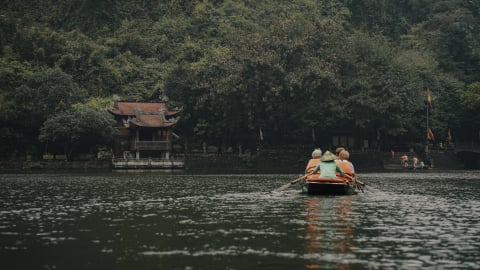
Nestled amidst the scenic Trang Kenh area of Hai Phong city, the Bach Dang Giang historical site emerges as a harmonious blend of history and spirituality. About twenty kilometers north of the city center, the road leading to the site unfolds before your eyes, revealing a vast expanse of sky where towering limestone mountains cast their shadows upon the tranquil Bach Dang River.


Entrance gate to the Bach Dang Giang historical site.
The first impression upon arriving here is one of solemnity and spaciousness. The wide open square, the rows of straight trees, and the stone steps leading up to the temples create a symmetrical spatial axis, reminiscent of traditional Vietnamese architecture.


The entire complex is harmoniously planned, blending natural landscapes with spiritual architecture. The soaring, curved temple roofs, covered in red tiles, stand out against the green backdrop of the mountains and forests. In the distance lies the Trang Kenh mountain range – a place that has witnessed countless historical events. It is this strategic location, offering both offensive and defensive advantages, that gave rise to the legend of Bach Dang and today serves as a majestic backdrop for a memorial space.


Spanning a vast area and situated at the confluence of mountains and rivers, the historical site offers a sense of tranquility amidst nature and scenic beauty.
Three times the waves rose up in rebellion.
Delving deeper into the temple complex, each space is a slice of history. The Ngo Quyen Temple commemorates the naval battle of 938 – the moment that ended more than a millennium of Chinese rule. His statue is placed solemnly, his eyes gazing straight out towards the river as if still watching the ebb and flow of the tide. It was here that the tactic of planting wooden stakes underwater proved decisively effective, defeating the Southern Han army and ushering in an era of independence and self-governance.


The temple dedicated to Ngo Quyen in the historical site.
Not far from there is the temple dedicated to Le Dai Hanh, who continued the tradition of defending the country and defeated the invading Song army in 981. The simple yet solemn space of the temple emphasizes the spirit of continuity: history is not a single moment but a continuous flow of national will.


Temple of King Le Dai Hanh
Perhaps the most prominent and attractive to tourists is the temple dedicated to Tran Hung Dao – the hero associated with the 1288 victory against the Yuan-Mongol army. The majestic bronze statue, holding a proclamation, stands proudly amidst the vast landscape of Trang Kenh. The Battle of Bach Dang that year was not only a military triumph but also a symbol of wisdom and courage. While still employing the tactics of wooden stakes and utilizing the tides, these were elevated to a new level in terms of organization, coordination, and strategic vision.


Temple dedicated to King Tran Hung Dao
In the exhibition area, reconstructed wooden stake models help viewers visualize more clearly how our ancestors arranged their battlefields. Standing before these rough, sharpened wooden stakes, one suddenly realizes that victory did not come from advanced weapons, but from understanding the terrain, the laws of nature, and belief in justice. The waves of the Bạch Đằng River, therefore, rose not only from the tides, but also from the will of the people.


The Bạch Đằng River wooden stake monument
The courtyard opens up between the mountains and the river.
The spacious square, paved with gray stone, is situated directly on the main axis facing the Bach Dang River. In the center of the square is a large stone incense burner, in front of which stands a tall flagpole. Three bronze cauldrons are carved with images of the three national heroes Ngo Quyen, Le Dai Hanh, and Tran Hung Dao. On either side of the square are stone statues depicting the process of manufacturing, transporting, and planting wooden stakes in the Bach Dang River.


The square where the bronze statues and golden bowls of the three kings are erected.
Immediately beyond the square is the central lake. The lake isn't large, but it's surrounded by sturdy stone embankments and low railings. In the middle of the lake, steps lead down to the water's edge, where many people stop to admire the view and take pictures. The lake reflects the temple roofs and the sky, softening the entire architectural structure behind it like a natural screen. The entire layout is arranged along a straight axis, creating a sense of coherence and purpose.

The lake behind the square reflects the image of Bach Dang Ho Quoc Temple.
The upper levels of the complex – a place of tranquility after the story of water conservation.
Following the stone steps upwards leads to Truc Lam Trang Kenh Pagoda. The pagoda is situated separately from the main memorial axis, on a raised platform overlooking the entire square and the river in the distance. The spacious courtyard houses a large Buddha statue in the main hall, with a bronze incense burner and a pair of stone dragons flanking the steps in front.

The statue of Avalokiteshvara Bodhisattva sits atop the Truc Lam Trang Kenh tree.
From this vantage point, the entire structure of the historical site is clearly visible: below is an open courtyard, in the middle is a cluster of temples and a lake, and in the distance, the Bach Dang River winds its way through the foothills. The feeling at this elevated level is quite different from below; it's quieter and more detached from the hustle and bustle of sightseeing.

From the temple, one can observe the entire architecture of the historical site.
It is this layering that makes Bach Dang Giang not only a place recounting three naval battles, but also a space organized so that visitors can pass through layers of emotion: from solemnity, to visual historical insight, and finally settling into spiritual depth.
When the present reflects the past
Today, the Bạch Đằng River is devoid of the sounds of war and the smoke of battle; only the wind rustles through the trees and the silent footsteps of travelers on the rocky surface remain. In this space, the past is not distant, but present like a layer of sediment beneath our feet.


The image depicts three kings standing proudly facing the gently flowing river that has witnessed the passage of centuries.
The water still flows peacefully, and the silt continues to build up the riverbanks. But it is precisely this tranquility that highlights the value of past victories, reminding us of the resilience of the ancient Vietnamese people who knew how to rely on nature, how to unite, and how to put the national interest above all else.
As the sunset casts its light upon Trang Kenh, the crimson roofs of the temples gradually fade in the late afternoon sun. The river sparkles like a mirror reflecting the past and present, reminding us that history does not lie dormant in books but flows alongside the waters of our homeland, nurturing the pride and responsibility of every Vietnamese person today.


The current landscape at the Bach Dang Giang historical site is lush and peaceful.