VI
VI



Enough sophisticated tricks
Most recently, a representative from Vietnam Tourism Media Joint Stock Company stated that in recent times, unscrupulous individuals have been using various forms of advertising on social media, creating fan pages and imitating brand names to offer tours to Japan at incredibly low prices of 6.999 million VND per person for a 6-day trip. Some customers have had their deposits stolen, lured into accepting these cheap promotions. According to the company, in one particular case, a customer contacted them to inquire about registering for a Japan tour and was then invited to a café by these individuals to collect a deposit.
In addition, another scam targeting high demand during peak season involves groups impersonating businesses to contact people and invite them to join social media and Telegram chat groups to complete tasks, such as liking ads for rewards starting from 50,000 VND and gradually increasing to hundreds of millions of VND depending on the number of consecutive ad likes completed.
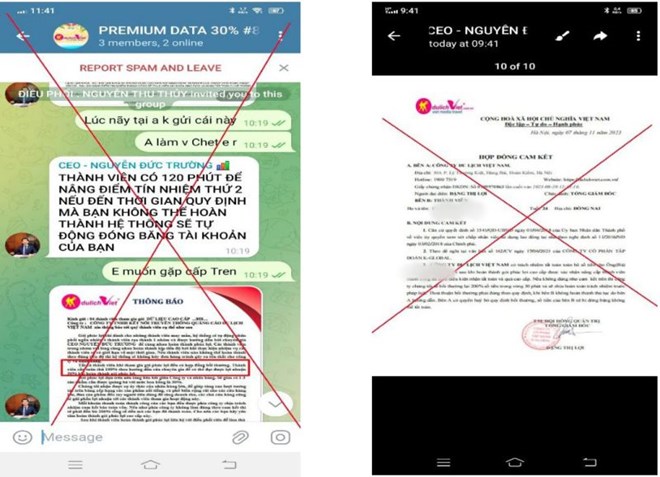
Impersonating a tourism business, they tricked people into liking advertisements in exchange for money. (Photo: Provided by the business)
Ms. M, a victim residing in Dong Nai, recounted in shock: “The perpetrators added me to a group tasked with liking advertisements for a business. Initially, they paid me into my account to build trust. Later, citing operational errors, they required me to deposit all the money they had transferred to me, plus an additional amount equivalent to the commission. The total was 129 million VND, to verify that I was the legitimate recipient before they would allow me to withdraw the money. They presented a commitment contract but used the logo of Viet Travel Company. And when I deposited nearly 300 million VND, the group stopped responding.”
People need to be more vigilant.
According to a warning from the Ministry of Public Security, there are several common scams during the tourist season that people are easily tricked into falling for.
The scammers will post advertisements on the internet and social media offering cheap tour packages and hotel rooms with many included benefits, then ask victims to transfer a deposit of 30-50% before stealing the money.

Another tactic involves the scammer posting advertisements for overseas tourist visa services, promising a high success rate and a 100% refund if the visa is not obtained.
Using more sophisticated tactics, the scam group will create fake websites/fan pages of reputable travel companies, forge photos of receipts and payment invoices, and ask victims to transfer money to pay for the tour. After the customer transfers the money to pay for the travel services, the suspects will block communication and erase all traces.
Notably, a new form of fraud has emerged: criminals are using Deepfake technology (a technology that uses artificial intelligence to create videos with images and faces that are identical to those of the person being impersonated) to gain the trust of victims.
Using this tactic, criminals will create fake accounts or hijack social media accounts, contacting relatives on the victim's friend list, claiming to be stranded while traveling abroad and needing money immediately. The scam group may use Deepfake technology and video calls to make the victim believe they are speaking with a relative and that the need for money is genuine, thus prompting the victim to transfer money to the scammers.
Another method involves scam groups impersonating airline ticket agents, creating websites and social media pages with addresses and designs similar to those of official airlines or agents, and then advertising very attractive prices compared to the general market to attract customers.
Speaking to the press, a representative of a travel agency emphasized that: "When searching for or booking travel products, tourists should carefully research the program and what services are included or excluded in the tour, then choose to book tours, accommodations, and airline tickets with reputable companies; they can request to see the company's business license and other relevant documents."
In particular, be cautious of requests for deposit payments to reserve a spot. If possible, make payments directly at the company's office and be especially wary of offers to collect payments at restaurants or cafes. In such cases, tourists can contact the companies directly through official channels to verify the information.