
 VI
VI


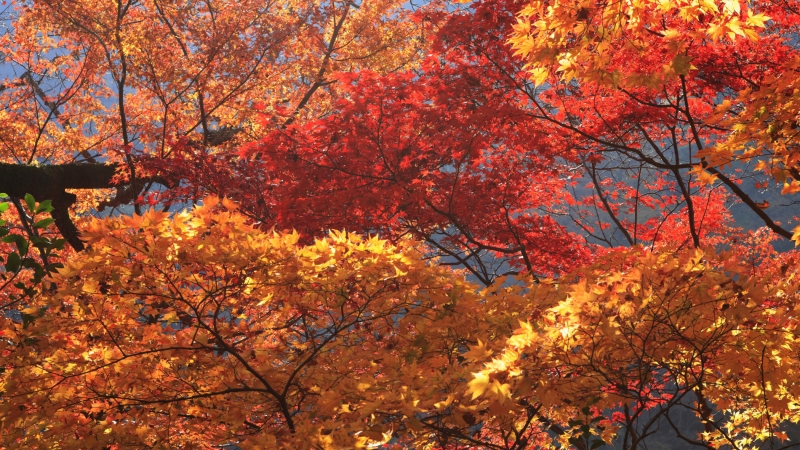
In the final days of the year, as the North begins to embrace winter, the biting cold air helps to adorn the slopes of Thanh Mai mountain with a "new coat" as the maple forest in front of Thanh Mai pagoda silently changes color. Each leaf gradually shifts from green to yellow, then to deep red, stretching along the mountainside.

The leaves of the fragrant maple tree change color in winter when the weather in northern Vietnam turns cold.
A tranquil hillside and a temple over seven centuries old.
Thanh Mai Pagoda is located on the slopes of Thanh Mai Mountain, also known as Tam Ban Mountain, in Chi Linh district, formerly Hai Duong province, now part of Hai Phong city. Built in 1329, this ancient temple is over 700 years old and is one of the important spiritual sites in the Northeast region. The pagoda was renovated and rebuilt in 2005, but it still retains its serene atmosphere, completely separate from the hustle and bustle of urban life.

Thanh Mai Pagoda sits peacefully amidst the greenery on the slopes of Thanh Mai Mountain.

The pagoda is situated at an altitude of 200 meters on the summit of Thanh Mai Mountain – a mountain range spanning three provinces: Bac Ninh (formerly Bac Giang), Hai Phong (formerly Hai Duong), and Quang Ninh. Thanks to this location, the area around the pagoda remains cool and peaceful year-round, especially pleasant during the end of the year when mist and cold winds add to the tranquil atmosphere.
The fragrant maple forest and the changing colors of the leaves.
The fragrant maple, also known as the Sau Sau tree or Bach Giao tree, is a large woody tree that typically grows in the cold climates of northern Vietnam, such as Cao Bang, Lao Cai (formerly Yen Bai), and Quang Ninh. This tree has the characteristic of changing leaf color with the seasons, and this color shift creates its distinctive beauty in late winter.


At Thanh Mai Pagoda, the fragrant trees grow densely, forming a forest that spans approximately 15 hectares. Tall trees, tens of meters high, stand side-by-side, their canopies intertwining to create a sheltered space, just large enough for sunlight to filter through the leaves. Within this forest are many ancient trees, their trunks so large that it would take two or three people to encircle them, silently enduring many seasons of wind and rain.
The approximately 1-kilometer-long concrete path from the parking lot to the temple grounds is where the most fragrant trees gather. During the autumn foliage season, this path seems to be covered in a new layer of color. Yellow and red leaves fall scattered on the road, on the stone steps, and under the trees, creating a poetic scene in a tranquil atmosphere. People slow down, their footsteps lighter, as if afraid to disturb the inherent serenity of the forest.


The leaves of the fragrant maple trees change color against the green backdrop of Qingmei Mountain.
An afternoon on a maple leaf-lined road.
Visiting Thanh Mai Pagoda during the season when the maple trees change their leaves, photographer Nguyen Trong Cung from Hung Yen (formerly Thai Binh) couldn't hide his impression of the scenery. For him, the yellow and red hues of the maple forest reminded him of scenes from Korean films he had seen, but because it was present in a Vietnamese setting, it felt very familiar.
According to Mr. Cung, the maple trees at Thanh Mai Pagoda are different from those in Cao Bang. The leaves have fewer lobes, and the color is more subdued and paler compared to the maple forests on the high mountains. However, the special feature lies in the age of the forest and the way the trees grow in succession on the mountainside.


Although the leaves of the fragrant maple tree are lighter in color compared to those in Cao Bang, they are more numerous, creating vast swathes of color.
"The maple trees here are all perennials, growing continuously in long stretches, so when they change color in the autumn, they create large patches of color that are very pleasing to the eye. When placed in the ancient setting of the temple, that beauty becomes even more apparent, giving a feeling of time accumulating," he shared.
With a paved path from the parking lot to the temple that only has a few gentle slopes, strolling under the fragrant maple trees becomes a pleasant experience, suitable for even short day trips.

When combined with the serene atmosphere of the ancient temple, the scene resembles a painting imbued with the colors of time.
According to Mr. Cung's experience, the afternoon is the best time to take photos in the maple forest near Thanh Mai Pagoda. Around 3 PM - 4 PM, the gentle sunlight shines down the path leading to the pagoda, highlighting the layers of yellow and red leaves, creating depth in the frame. In the morning, the sun is often obscured by mountains and trees, resulting in flatter and less vibrant light.
To blend in with the scenery, he suggests that visitors choose outfits in bright colors such as white, red, or neutral tones. Amidst the changing colors of the maple forest, these colors are enough to stand out without disrupting the overall peaceful atmosphere.

Visitors should come here at sunset, wearing light-colored, simple clothing to blend in with the atmosphere.
Stopping points around the maple forest
Besides the fragrant osmanthus trees, along the path leading up to Thanh Mai Pagoda, there are also ancient chestnut and Terminalia trees growing interspersed. Towards the end of the year, white chestnut blossoms bloom scattered among the green foliage of the Terminalia trees and the yellow-red osmanthus trees, creating interwoven patches of color that make the scenery more vibrant while still maintaining its natural beauty.
Besides visiting the temple, tourists can combine their trip with a visit to the pink grass hill on the slopes of Ho Giang, about 2 km from Con Son tourist area. Further afield, about 20 km away, the lily fields along the Kinh Thay River dike, in Le Dai Hanh ward, Hai Phong city (formerly Dong Lac ward, Chi Linh city, Hai Duong province), are also a popular destination. When the flowers are in full bloom, stretches of white, yellow, and pink lilies line the dike, adding a unique charm to a trip before Tet (Lunar New Year).


The lily fields along the Kinh Thầy river embankment are in full bloom.
Amidst the hustle and bustle of the year-end, the maple forest surrounding Thanh Mai Pagoda emerges as a tranquil haven. There, nature transforms slowly, the ancient pagoda sits peacefully on the mountainside, and the maple-lined path becomes a place for people to slow down, breathe deeply, before the old year draws to a close.












