VI
VI


.jpg.jpg)
Text and photos: Son Nguyen
On National Highway 14, traversing the Central Highlands, the early morning was colder than usual. The rains of the rainy season had just passed, bringing with them a chilly atmosphere that made you need to wrap yourself in a warm coat while riding. I thought that the Central Highlands, with its year-round clear blue skies, would only be pleasantly cool, but surprisingly, I still had to bring out a warm jacket and scarf before continuing my journey.
.jpg_1.jpg)
The sky remained a deep blue with golden sunlight pouring down, but the first rubber forest I passed left me astonished, prompting me to quickly pull over to the side of the road. The same dense forests with their straight rows of trees remained, but the green of the leaves had given way to a golden hue interspersed with red. A rubber forest in the midst of its beautiful leaf-changing season made you feel as if you were walking through autumn. With a mix of emotions stirring within me, I turned into the forest.
.jpg_2.jpg)

There were no workers lurking behind the trees, tapping latex; only the silent rubber forest, filled with the joyful rustling of the wind, the dancing sunlight, and the murmur of falling yellow leaves underfoot. I trod on the yellow leaves, walking alongside the motorbike rolling ahead, swept up in the red earth and the dancing leaves. The motorbike stopped, and the space fell silent, the trees still in the early morning sunlight.
Spring is the season when all things sprout and burst forth with green shoots, but it is also the season when rubber trees shed their old leaves. After nine months of stretching and producing white sap, this is the time for these hardworking trees to rest and recharge.
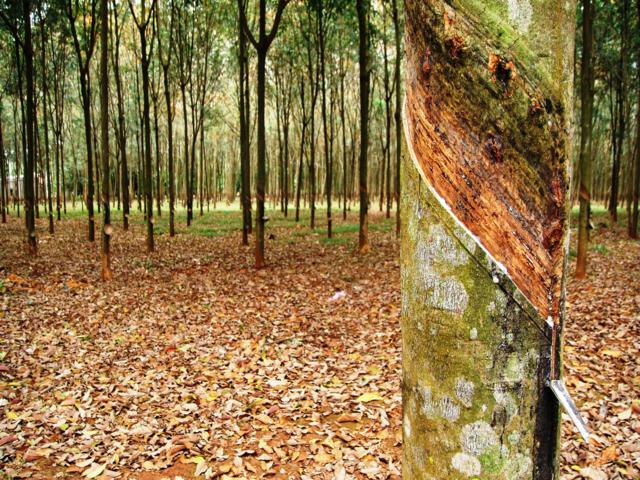
The rubber tree season is devoid of latex, with no fresh cuts on the trunk, no streams of hot, white sap flowing around the trunk. The latex collection bowl lies still on the trunk, and the sap flows in a thick, brown stream. The rubber tree sheds its leaves, shaking off its weariness one last time in the year, burning its remaining remnants into a vibrant red-yellow hue on the branches before falling to the red earth. These final remnants create a breathtaking picture of the arid Central Highlands, where the rubber tree, with its tenacious vitality, even in its final moments of shedding its leaves, leaves passersby stunned by the spectacle it creates.
.jpg_3.jpg)
The rubber trees shed their leaves, which fall onto the red soil, decompose naturally with the rain, and fertilize the soil and the rubber trees themselves. One leaf-falling season follows another, creating fertile ground for the trees to thrive.
I've traveled through many rubber tree seasons before, but rarely have I stayed this long. Walking through a rubber forest can easily make you feel short of oxygen because the trees are very toxic; their sap is poisonous, and even the gas-exchanging leaves on their trunks are toxic. Passing through the vast, straight rubber forests on the Central Highlands road, the wind howls relentlessly. As the rubber trees shed their leaves, the entire forest shudders, donning a new coat, creating a mesmerizing beauty. Another season of rubber trees shedding their branches is approaching.