VI
VI


In the Vietnamese Buddhist system, where Mahayana Buddhism holds a dominant position, Theravada Buddhism is present in limited numbers, mainly associated with the Khmer community in Southern Vietnam. Buu Long Pagoda is one of the few Theravada pagodas founded by Kinh people in a large urban area like Ho Chi Minh City. The rare combination of Theravada Buddhism, Theravada architecture, and the modern city setting makes Buu Long Pagoda a unique case in contemporary Buddhist life.

Buu Long Pagoda follows the Theravada school of Buddhism: it has few rituals and emphasizes personal practice and meditation.
Buu Long Pagoda is located on a low hill in Long Binh Ward, Thu Duc City, separated from the residential area by a large green space. Although within the city limits, the pagoda grounds create a sense of isolation thanks to the elevated terrain, surrounding lake, and restrained building density. From the entrance gate to the center of the grounds is a sufficiently long walk for visitors to adjust their pace and observe the overall space before approaching the main structures.

A panoramic view of Buu Long Pagoda from above, isolated from the urban landscape in the distance.


Spatial organization and overall architecture
The overall architecture of Buu Long Pagoda is organized along a clear axis, with the Gotama Cetiya stupa at its center. This is the largest structure and also the visual highlight of the entire complex. The stupa has a tall, tiered structure that tapers towards the top, reflecting the Theravada Buddhist architectural style common in Thailand, Sri Lanka, and Myanmar.

The Gotama Cetiya stupa is located in the center of the temple grounds.
Unlike many Mahayana Buddhist temples in Vietnam, Buu Long Pagoda does not arrange its structures close together. The various elements are separated by open spaces, ponds, and green areas, creating transitional layers of space. This arrangement reduces the feeling of heaviness in terms of volume while emphasizing the independence of each architectural structure.


The various sections are separated by open spaces, lakes, and green areas.
The dominant color of the temple is white, combined with gold-plated details at the top of the spire and some decorative elements. The restrained color palette ensures the overall structure maintains a sense of lightness, avoiding ostentation. Under varying lighting conditions throughout the day, the building's surfaces reflect light in a gentle way, without creating harsh contrasts.


Some gilded details help the temple stand out against the sky and surrounding landscape.
Patterns and decorative language
The decorative patterns at Buu Long Pagoda are selectively used, consistent with the spirit of Theravada Buddhism. The main decorative motifs are lotus flowers, Dharma wheels, geometric patterns, and some traditional symbols of Southern Buddhism. These details appear on the base of columns, pagoda pedestals, railings, and decorative borders, in moderate sizes, creating a relatively "open" visual space, allowing visitors to observe the structure as a whole rather than being drawn into disjointed details.


Patterns at the base of the column

Pattern at the base of the railing
Compared to typical Vietnamese temples, Buu Long Pagoda does not use many narrative reliefs or densely packed decorative statues, but rather places them in a few fixed positions. Right at the approach to the Gotama Cetiya stupa, a system of four large dragon statues is arranged along the main staircase, creating a clear visual axis leading towards the central structure. The large dragon statues, with their bodies curving in rhythm with the steps, serve both as decoration and to define the approach space.

Four winding stone dragon statues lead up to the Gotama Cetiya stupa.
Surrounding the four sides and entrances of the pagoda, statues of mythical creatures are arranged symmetrically, serving to guard the main directions and entrances. Placing these creatures in key positions aligns with traditional East Asian architectural and spiritual beliefs, where protective figures are often used to establish boundaries and the sacredness of a structure.


The dragon and phoenix imagery at the temple is characterized by its clean form, emphasizing volume and curves, and minimizing ornate details. The colors are restrained, often white, stone gray, or accented with gold, allowing the mythical creatures to blend into the overall architecture, becoming an intermediate visual language connecting Theravada Buddhist architecture with familiar East Asian art.
The presence of large mythical creatures at Buu Long Pagoda does not deviate from the original Buddhist school but reflects the process of harmonizing the original Buddhist thought with the local cultural context. This is one of the elements that creates the pagoda's unique identity: a Theravada Buddhist structure that is not detached from Vietnamese aesthetic traditions.


Buddhist schools and approaches to practice
Buu Long Pagoda belongs to the Theravada Buddhist tradition, also known as original Buddhism. This school focuses on the practice and study of doctrines based on the Pali Canon, emphasizing the path of personal practice, meditation, and mindfulness.
Venerable Thich Vien Minh is the abbot whose teachings are closely linked to the temple's ideological direction. He is known for his writings and sharing of original Buddhist teachings, emphasizing understanding and practicing the doctrines in daily life, rather than focusing on ritualistic forms. At certain times, visitors to the temple can meet the abbot directly and discuss Buddhist teachings, depending on the temple's schedule.

Venerable Thich Vien Minh - Abbot of Buu Long Pagoda
The spirit of Theravada Buddhism is not only manifested in its practice but also clearly reflected in its spatial organization and architecture. The limited ornamentation, restrained use of color, and emphasis on open spaces in the layout demonstrate a preference for quiet experience and introspection, consistent with the Theravada school's approach to practice.

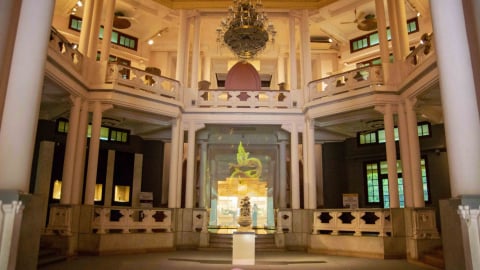
The interior space of the pagoda is organized simply and modestly, aiming at fostering inner spiritual practice for each individual.
Amidst Ho Chi Minh City's rapid development, Buu Long Pagoda holds a special place as a unique religious space. Not only is its architecture different from many familiar Vietnamese pagodas, but it also represents a less common approach to Buddhism in urban life.
Maintaining a low building density and prioritizing landscaping and open spaces helps the temple avoid the overcrowding often seen at crowded spiritual sites. This also contributes to preserving the temple's core function as a place of meditation and contemplation, rather than becoming a purely tourist attraction.


Therefore, Buu Long Pagoda doesn't impress with its grandeur or the abundance of festival activities. Its value lies in the consistent organization of its architecture, patterns, and ideological orientation, creating a rare Theravada Buddhist space in the heart of the city.