VI
VI


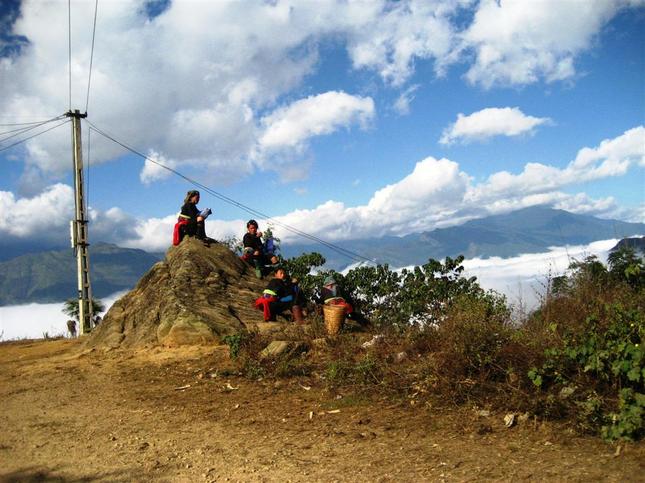

Photographers, hearing rumors of the golden rice harvest season in the highlands, would grab their cameras and rush over 300km to Mu Son to catch the Hmong people harvesting their crops.
The only way to reach Mu Cang Chai is via National Highway 32. From Hanoi, cross the Khe Pass to enter Yen Bai province, then follow this road through Nghia Lo straight to Mu Cang Chai. Before reaching the endless terraced rice fields, stop in Tu Le and enjoy the famous sticky rice with free-range chicken. Here, people harvest rice to make green rice flakes (com). Surprisingly, this region also produces these emerald green grains, just like in the lowlands. Although the com isn't as chewy as the com from Lang Vong village, it's still incredibly appealing with its fragrant, chewy flavor in the autumn. The rice fields in this valley have begun to turn a deep yellow, and the air is filled with the fragrant scent of ripening rice throughout the vast valley. This is the land of the Thai ethnic group, where the prosperous Khau Co village nestles at the foot of the Khau Pha Pass, beside a stream that babbles day and night. Tu Le is also one of the must-see destinations when you plan to visit Yen Bai province during the harvest season. Then, after crossing the winding Khau Pha Pass, surrounded by mountains and hills with little traffic, for nearly 20km, we arrived in Mu Son. Khau Pha Pass, also known as Cao Pha, meaning "Heaven's Horn," is an extension of National Highway 32. From atop Khau Pha Pass, the Tu Le valley stretches out before our eyes, showcasing the most beautiful golden autumn scenery of the year in the remote Northwest region.

In the early morning, while the mist still lingered in the valley, the Hmong people, carrying baskets and hoes, led their buffaloes to the fields. As the first rays of sunlight shone, bare feet moved swiftly across the rice paddies. The silhouettes of Hmong girls in brightly colored dresses peeked out from the golden fields, their diligent husbands following behind. A simple hut was erected beside a dry field. Inside, a few odds and ends were kept, a water bottle still full, a simple meal wrapped in banana leaves, and a baby boy, only a few months old, sleeping soundly.


The terraced rice fields, meticulously cultivated for generations by the Hmong people, are now ready for harvest. The ethnic minorities of Yen Bai province cultivate their rice on the high mountain slopes. After spring, they wait until the rains come, when the terraced fields are flooded (a phenomenon known as the "water pouring season"), before planting their only rice crop of the year. The Hmong are skilled climbers, transforming the treacherous mountain slopes into stunning terraced rice fields. The skillful and diligent hands of the Dao, Hmong, Ha Nhi, Giay, Tay, Xa Pho, Nung, and Pa Di people, generation after generation, have created these masterpieces.
The road through La Pán Tẩn and Chế Cu Nha, two communes with the most beautiful rice terraces in all of Mù Cang Chải, is so captivating that no one can pass through without stopping to admire the masterpieces of the H'Mông people, brilliantly awaiting harvest. Young boys and girls herd buffalo along the highway, playing near the fences. In the distance, a few huts are erected to guard the rice fields. The H'Mông people live high up in the mountains; they only come down to tend the rice before returning to their homes high above. The Yên Bái region, with its easily eroded soil, boasts such sturdy and breathtaking terraced rice paddies.

The entire Mu Cang Chai district has 2,200 hectares of terraced rice fields, of which 500 hectares are located in the three communes of La Pan Tan, Che Cu Nha, and De Xu Phinh. These 500 hectares of terraced fields are a heritage site of the Mong people, recognized by the Ministry of Culture, Sports and Tourism on October 18, 2007, and are perhaps one of the most unique and special scenic spots in Vietnam. Within a radius of 20km, the rice paddies are arranged between the mountainsides, gradually descending to the emerald green river below.
During the rice harvest season, the entire highway is bathed in a shimmering golden hue from the terraced rice paddies stretching all the way to the stream in the valley below, from the radiant faces of the harvesters, and from the honey-like golden sunlight. Late in the afternoon, a sudden shower passes by, and the sky brightens again with sunshine. A rainbow of five colors adorns the beauty of Mu Cang Chai, sparkling against the backdrop of a sea of gold and blue sky. It's a romantic and breathtaking scene that captivates passersby.

This region is at its most beautiful during two periods of the year. In May and June, when the rice paddies are flooded with water, the shimmering sunlight reflects the colors of the clouds and sky; this is also the time when the wild apple blossoms bloom profusely throughout the forests of Yen Bai. And in September and October, when a golden hue stretches across the fertile fields. These are also the two times when Yen Bai, Sapa, and Y Ti – Bat Xat in the Northwest region welcome a large number of tourists and photographers eager to capture stunning images.

The harvest season is bustling with activity. Girls in their finest clothes head to the fields, celebrating a new harvest. From distant villages, families pour into the fields. Everyone lends a hand, harvesting, threshing, and carrying the rice back to fill the granaries. The air is filled with laughter, chatter, calls to one another, and the joyful shouts of children as they eagerly head to the fields to harvest.
On your way back, remember to stop by Giang Stream, buy some delicious San Tuyet tea as souvenirs, and soak in the hot springs to relax after a long day's journey. And don't forget to buy a few kilograms of fragrant Tu Le sticky rice to make a delicious pot of sticky rice with the aroma of the new harvest.
During the rice harvest season, Mu Cang Chai beckons countless travel enthusiasts to visit and capture beautiful images of this land in their cameras and memories.

Additional information
From Hanoi to Mu Cang Chai, follow National Highway 32, passing through Thanh Son - Thu Cuc, crossing Khe Pass to Nghia Lo, Van Chan to Tu Le, then over Khau Pha Pass to reach Mu Cang Chai.
The guesthouses here cost 150,000 VND per room for 3 people. You can travel up to this land of famous terraced rice fields by motorbike or car.
The most beautiful scenery along this route is found in Tu Le commune, Khau Pha pass, and Mu Cang Chai district, with terraced rice fields that yield only one harvest per year. Tu Le sticky rice is famous for its fragrant and chewy texture; you can buy a few kilograms as souvenirs, priced at around 25,000 VND/kg. Guesthouses in Mu Cang Chai and Tu Le cost 150,000 VND per room with two beds.
Article by: Lam Linh
Photos: Lam Linh, Thanh Cong