VI
VI


.jpg.jpg)
Located in western Spain on the sunny and breezy Mediterranean coast, Barcelona is an ideal destination for those who appreciate nostalgia, with its beautiful nature and unique architectural landmarks such as La Sagrada Familia church, the old town of Barri Gotic, the Arc de Triomf, Casa Batllo, and Guell Park. This second-largest city in Spain (after Madrid) boasts a vast amount of cultural and artistic heritage, a world of villas, castles, and churches steeped in Renaissance architecture.
.jpg_0.jpg)
A busy yet relaxing day at Barca.
What could be more delightful than starting an autumn day in Barca with a cup of latte and some pastries in the city center along the Rambla boulevard? After a stroll in the early morning sun, my boyfriend and I arrived at Plaza Catalunya to participate in the program.Free walking tourWith a young guide and passengers eager to explore the city, we traveled to the Barri Gotic old town, passing by the Palau de la Música Catalana, a UNESCO World Heritage site. Next was an extremely famous location: the Picasso Museum, home to the largest collection of works by the renowned painter Pablo Picasso. Barcelona has many museums, but the most special is the Barcelona History Museum, which houses important underground archaeological layers dating back 2000 years.
.jpg_11.jpg)
.jpg_5.jpg)
Although we only stayed at the Poliorama Theatre for a few minutes, we had a brief experience of the characteristic Spanish Flamenco dance, swept away by the lively melodies and the exhilarating steps of the instructor. That afternoon, we tried authentic Spanish tapas, appetizers made from various ingredients such as cheese mixed with olives, bacon, sausages, etc. You'll find tapas served at almost every meal here. Of course, Cava, a sparkling wine made from grapes using traditional methods and mostly produced in the Penedes region in the northeast of the country, was also a must.
.jpg_7.jpg)
Our busy day continued on the narrow streets near La Rambla before heading to La Boqueria Market (Mercat de la Boqueria). This is Barcelona's largest food market, famous throughout Europe and once voted the best market in the world by Time Out magazine. Operating since the 13th century and still thriving today with over 200 food stalls of all sizes, it has been an important part of local life for centuries and a cultural icon of the city. The market's roof, restored in the 16th century, is made of colorful ceramic and curved glass, contributing to the market's unique character. In addition, La Boqueria Market offers a culinary class introducing visitors to the origins and history of traditional Spanish dishes and how to prepare local specialties.
.jpg_8.jpg)
In the evening, we took a cable car to the top of Mount Tibidabo to enjoy a panoramic view of the city at night. Barcelona's vibrant nightlife is what attracts so many tourists, second only to Madrid.
.jpg_9.jpg)

Colorful avenues and sunsets on the beach.
Exploring Barcelona is incomplete without visiting the unique classical architecture of the two legendary architects Antoni Gaudí and Lluis Domènech i Montaner. Their first masterpiece is Guell Park, built in 1900, located on a hill west of the city. Sculptures and crooked columns, colorful mosaics, strangely shaped buildings contrast with the charming gardens surrounding them. We went from surprise to delight, as it is the largest architectural work in southern Europe. The undulating, colorful stone benches, the brown stone columns carved into bizarre shapes, and the two giant chocolate houses, Hansel and Gretel, which seem like something out of a fairy tale or used to decorate Christmas cakes.
.jpg_8.jpg)
.jpg_3.jpg)
Afterward, we used buses and the subway to travel to Passeig de Gràcia, admiring two more architectural works by Gaudí. The Casa Milà (La Pedrera) high-rise apartment complex appeared with its exquisite architecture, sandstone walls, and ornate railings. We went inside to see the exhibition and climbed to the rooftop, where colorful chimneys rose high as if to touch the sky. Next was Casa Batllo, a building that resembled a work of contemporary Spanish architecture, a sophisticated departure from tradition with its undulating facade, decorative mosaics, curved roof, and peculiar balconies that resembled masks jutting out from the windows.
.jpg_6.jpg)
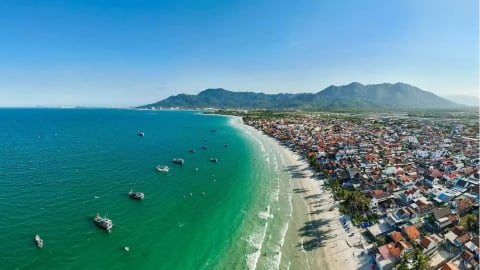
After admiring the unique architectural masterpieces, we decided to relax on La Barceloneta beach. The Barraca restaurant in Passeig Maritim along the coast is a great choice for romantic days in this place. We didn't miss the opportunity to enjoy "Paella," a typical Spanish seafood rice dish dating back to the 19th century, or "Huevos flamencos" - fried eggs with smoked meat, tomatoes, and vegetables, a traditional Seville dish. To beat the summer heat, we tried Sangria, a drink that first appeared in 1600, a perfect combination of red wine and fresh fruit including apples, cherries, grapes, oranges, and lemons...
.jpg_5.jpg)
Time seemed to stand still with every step as we strolled along the beautiful beach, admiring the glorious and romantic sunset as the fiery red ball cast its last rays of light on the horizon. Thus, our journey of love in Barcelona began amidst the dense atmosphere of ancient architecture and ended with the majestic symphony of sky and sea.
Additional information:
+Trip:From Vietnam, there are direct flights to Spain (Barcelona) with Vietnam Airlines or other airlines such as Turkish Airlines and Qatar Airways, with a layover of about 2 or 3 hours. There is a bus from the airport to the city center (A1-A2 route) costing 12 Euros, with a travel time of about 10-20 minutes.
+Transportation:
-Rent a bicycle or motorbike: You can find them along the city center, Plaza Catalunya, Via Laietana… for prices starting from 25 Euros/day.
- Buses & Metro: €1.50 per metro ride or €1 per bus ride. You can also buy a ticket from €7.40 for 10 metro or bus rides. In Barcelona, getting around by metro and bus is quite convenient. Finding directions is also easy as each bus and metro station has a map.
+ Sightseeing:In addition to the destinations mentioned in this article, you can also visit:
- FC Barcelona Museum and Camp Nou Stadium: for football lovers, near Les Corts metro station and along Travessera de les Corts street.
- Arc de Triomf (Triumphal Arch): near the city center.
- Encants Barcelona (flea market): Located near Gloriès metro station, this is the largest antique market in the city, where you can find everything from old records, books, stamps, and postcards from the past to modern items like tables, chairs, and cabinets at incredibly low prices.
- Tibidabo Hill: near Lesseps metro station, this is a huge amusement park with a fair, open on weekends in spring and fall, and from Wednesday to Sunday throughout the summer, closed in winter.
+ Language:In Barcelona, people speak both Catalan and Spanish. Additionally, as it's a tourist city, you can safely use English. However, it's still a good idea to familiarize yourself with some Spanish vocabulary beforehand to communicate with the locals.
Text and photos: Le Chau