VI
VI


A Hollywood of the East in the past.
The creator of Hengdian Film Studios is Xu Wenying. Originally a poor farmer, Mr. Xu started his career and became wealthy selling silk. In 1993, he founded the Hengdian Group, a diversified business conglomerate.

In 1990, China began a period of cinematic revitalization. The film and television industry was on the verge of a boom, but it suffered from a severe shortage of large-scale sets for historical dramas – one of the five main film genres that the Central Broadcasting and Television Administration of China had prioritized for investment.
In 1996, Chinese director Xie Jin needed a historical setting for his film *The Opium Wars*. Xu Wenying seized the opportunity and persuaded Director Xie to collaborate. In just a few months, Mr. Xu completed the site clearing and perfectly recreated a 19th-century Guangzhou neighborhood. This marked the beginning of what would later become the Hengdian Film Studios.
In 1997, director Chen Kaige began working on the film *Jing Ke Assassinates Qin*. Xu Wenrong continued to take on the contract and build the 110,000 square meter Qin Dynasty Palace. This setting was reused by director Zhang Yimou to film *Hero* in 2001.
The blockbuster films that achieved success both domestically and internationally have propelled Hengdian Film Studios into a new brand.

These structures are accurate replicas of original historical monuments at a 1:1 scale.
Hengdian's groundbreaking development isn't simply based on its scale of construction, but rather on its unconventional business model. Since 2000, the management has completely waived the cost of using the film sets. The studio's profits come from a self-contained service chain including accommodation, film logistics, and recruitment of extras.
Hengdian achieved National Scenic Spot Level 5A status in 2010. Each year, the film studio welcomes over 12 million visitors and serves as the number one revenue-generating hub for the entertainment industry in China.
In 2003, Mr. Tu Van Vinh transferred management to his son, Tu Vinh An. Tu Vinh An now has the final say in the group, especially in the tourism and film studio sectors.
Hengdian currently has a total planned area of 30 square kilometers and an actual construction area of nearly 500,000 square meters. The film studio boasts a massive system of structures that accurately recreate original historical sites at a 1:1 scale. For example, the Qin Dynasty Palace is the first magnificent section, simulating the Xianyang Palace with its 18-meter-high city walls.
The Ming Dynasty Palace Garden is a 1:1 scale replica of the Forbidden City, serving as the setting for two popular palace dramas, *Story of Yanxi Palace* and *The Legend of Zhen Huan*. The *Qingming Shanghe Tu* area meticulously recreates the painting of the same name by artist Zhang Zeduan.


In September 2024, the Hengdian High-Speed Railway Station, located on the Hangzhou-Wenzhou high-speed railway line with a design speed of up to 350 km/h, was officially inaugurated. The subsequent addition of the Jinyi East urban railway line, connecting Jinhua City to Mingqing Palace station via Yiwu and Dongyang, makes travel between tourist attractions in Hengdian more convenient than ever.
In Hengdian, besides experiencing the feeling of traveling through time from the Song, Ming, and Qing dynasties to the Republic of China and modern times, visitors can also enjoy many spectacular shows. Hengdian's existing scenery makes these live performances even more realistic. For example, the Dream Tai Chi show combines the Eastern philosophy of the five elements, traditional martial arts, and modern multimedia performance technology in a visually stunning way. The outdoor stage of Dream Tai Chi can realistically recreate the scene of a volcanic eruption with towering columns of fire.
At the Qingming Shanghe Tu area, the "Dream of Flowers and the Battle of the Imperial Court" show recreates the opulent life of the Song Dynasty capital. For tourists who enjoy dramatic action, the "Heroic Swordsmanship" show at Qinwang Palace is the perfect choice.

A dream on screen comes to life.
Entering the 2025-2026 period, Hengdian is witnessing a remarkable growth in the trend of cinematic tourism combined with interactive experiential services - an inevitable trend accompanying the explosion of short films and the habit of browsing TikTok to watch vertical screen videos.
In March 2026, the historical drama "The Jade" directed by Zeng Qingjie, starring Zhang Linghe (as Xie Zheng) and Tian Xiwei (as Fan Changyu), was broadcast, achieving a popularity rating exceeding 31,000 on Tencent and ranking among the top 10 most-watched non-English language films on Netflix. 95% of the scenes in the film were shot in Hengdian.
The film's impact led to Hengdian receiving over 80,000 visitors daily during the May Day holiday in 2026. At that time, tourists had to wait up to 40 minutes to queue for photos in the style of the historical drama "Jade Axis."

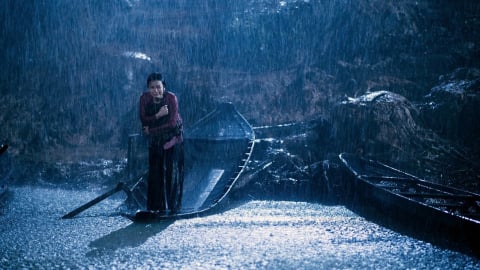
Hero – one of China's classic films – was filmed in Hengdian.

The Jade Axis - the latest film creating a film set tourism craze in Hengdian.
Besides admiring the architecture and film settings, visitors can also rent costumes modeled after the characters played by Zhang Linghe and Tian Xiwei to take photos at the riverbanks of Qingming Shanghe Tu or the corridors of Qin Wang Palace.
While previously most tourists visited for a day trip, now more and more people are choosing to stay in Hengdian for 2-3 days. Combo packages including professional photography, period makeup, and entrance tickets to film studios have become best-selling products on online travel apps.
To meet the immersive needs of tourists, the Hengdian Film Studios management, along with travel agencies, has developed a professional and well-structured film experience service system, often referred to as the "All People's Film Studio." After "Jade Axis," this service has become the most popular tourist product in Hengdian.
Instead of simply strolling around in traditional costumes and taking photos, visitors will get to participate in a professional film production from start to finish. From a filming commencement ceremony with rituals such as removing the red cloth covering the camera lens and offering incense to the patron saint of the craft, to a grand wrap-up ceremony, visitors will receive direct script explanations from the director, guidance on posture, expression, and role assignments based on their physical characteristics or preferences.

The Qingming Shanghe Tu area - the filming location for the Jade Axis movie.
Actors and tourists can also experience a specialized dressing room, transforming into characters from the film. There are even extras assisting during filming to increase realism.
The entire process will be filmed using professional cameras, sometimes even employing green screen technology for the flying, fantasy scenes. The studio will then handle post-production editing, voiceovers, and special effects to produce a complete 10-15 minute short film for tourists. Depending on the service package, the film delivery time can be extremely fast; some packages allow tourists to have their finished product ready to share on social media just 30 minutes after filming is complete.
If visitors don't want to follow a fixed script, they can participate in free role-playing activities. Upon passing through the entrance gate, visitors will receive tasks from NPC characters dressed as street performers. By engaging in poetry exchanges, completing martial arts challenges, or deciphering secret messages, visitors will accumulate virtual points, which can be directly redeemed for souvenirs and local specialties at the historical-themed stalls within the complex.
Participation packages come in various price ranges. Short clip packages can cost as little as a few hundred yuan (over 1 million VND), while full short film packages can cost several thousand yuan.

Interestingly, behind the glitz and glamour of the film sets and the throngs of tourists in Hengdian, there is a unique social phenomenon called the "Hengdian Wanderers"—a term referring to a community of acting enthusiasts who settle there in search of screen opportunities.
Some have succeeded, breaking free from the label of extras to rise to the ranks of Best Actor and Best Actress, like Wang Baoqiang and Zhao Liying. Others have spent their entire lives struggling. But the "Wandering Life" still holds a magical quality amidst reality, where everyone has the right to dream of a bright future.