VI
VI


The plane departed Athens on a bright summer morning. The city receded behind, its small white buildings nestled against the dry Mediterranean landscape, and then, in just a few minutes, the view outside the window changed completely. A deep blue unfolded beneath the plane's wings, stretching to the horizon and dotted with countless islands of varying sizes, like brushstrokes on the sea.

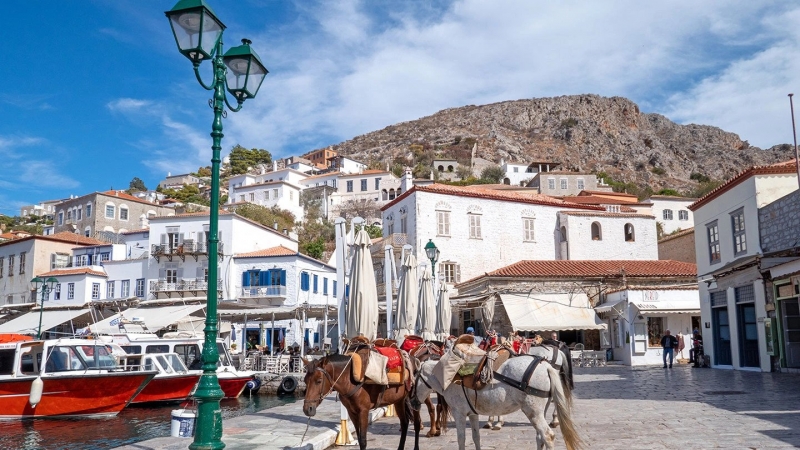
My destination was Santorini, an island still considered an icon of Greek tourism. Most visitors come here to watch the sunset over the volcanic crater, to stroll among the white houses with blue domed roofs, or to enjoy a few peaceful days in the Mediterranean.
I also carried with me the excitement of someone visiting the island for the first time. However, many years later, when I recall Santorini, the first thing that comes to mind is not the cobblestone streets, the small cafes, or the orange hues of the setting sun, but the endless blue of the Aegean Sea.

I vividly remember that afternoon standing on the cliffs in Oia. The wind from the sea carried the salty scent of the ocean, boats silently cut across the water, and in the distance, the horizon almost merged with the sky. It was in that very moment that a long-dormant memory suddenly resurfaced. It was Troy. The movie I saw nearly twenty years ago, starring Brad Pitt as Achilles.
Back then, I was captivated by the fierce battles at the foot of Troy, the duels that shaped the fates of the heroes, and the epic atmosphere that permeated the entire film. As time passed, many details faded, but one image remained etched in my memory: the sails of the Greek fleet billowing in the wind on a vast, deep blue sea.
I wondered where the sea behind those sails lay, how far Troy truly was from the Greek kingdoms, and what seas those ancient ships had traversed.

Years later, my trip to Santorini didn't immediately answer those questions. It did something very simple: it placed me in the very space where those stories were born. Before me was still the same sea, the same Aegean winds blowing across the rocky slopes, the same ships sailing between the islands as they had for thousands of years. Time had changed almost everything, but the sea seemed to remain a silent witness to history.
When all the ships were heading toward Troy
Three thousand years ago, the name Greece as we know it today did not yet exist. Around the Aegean Sea were independent kingdoms such as Mycenae, Sparta, Pylos, Argos, and Ithaca, each with its own king, fleet, and territory. Across the sea, on the western shores of Asia Minor, Troy rose as a wealthy city thanks to its control of the trade route connecting the Aegean Sea with the Black Sea. This very location made Troy the focal point of a war that has been remembered for over three millennia.
According to Greek mythology, the war began when Prince Paris brought Helen, the queen of Sparta, to Troy. But behind this famous love story lay a rivalry for power and trade between the kingdoms around the Aegean Sea. Although history and legend are so intertwined that they are difficult to separate, the Trojan War became the material for Homer's Iliad, the epic poem that laid the foundation for Western literature.


Within the League of Greek kingdoms, two individuals later became symbols of two vastly different destinies. Achilles boarded the warship with the aspiration of being remembered as the greatest warrior, while Odysseus, king of the small island of Ithaca, left his homeland because of a vow and the duty of a ruler, always carrying the hope of one day returning to his family. One became the soul of the Iliad. The other opened the Odyssey, where the war had ended but the journey of humanity truly began.
When Troy fell, the sails of victory set sail en masse. Most of the Greek kings returned to their kingdoms. Odysseus, however, spent another ten years at sea before finally seeing Ithaca on the horizon. Those ten years shaped one of humanity's greatest epics and transformed the return of a king to a small island into a story that continues to be told to this day.

The journey of a person returning home.
The Iliad concludes with the smoke and flames of Troy. The Odyssey opens as sails leave the harbor, carrying a warrior on a journey even longer than the war that just ended: the journey home.
That is also what makes Homer's two epics stand side by side without repetition. One work is written for the glory of warriors on the battlefield, the other for a man who has gone through war and only carries with him the longing to return to his home.
During his ten years of wandering, Odysseus crossed countless islands, faced storms, unfamiliar seas, capricious gods, and challenges beyond human imagination.

Reading The Odyssey today, many mythological details remain captivating: the one-eyed Cyclops, the enchanting songs of the Sirens, the goddess Circe with her ability to transform humans into beasts, or the two monsters Scylla and Charybdis guarding the narrow strait. But the slower I read, the more I feel that Homer never intended readers to remember only these monsters.
Each challenge is more like a slice of life than a magical performance. There are forces that seem invincible by force, only overcome by intellect. Sometimes, what hinders people are temptations that make them forget their original purpose. Then, at every crossroads, people are forced to accept loss because there is no perfect choice. Amidst all of this is the never-ending longing for home in the heart of the man named Odysseus.
That's what sets him apart from many other heroic figures in mythology. Odysseus wasn't the strongest, nor was he the most favored by the gods. He made mistakes, was sometimes impulsive, sometimes arrogant, and often paid the price for his decisions. Homer didn't portray the character as a perfect human being. On the contrary, it is precisely these limitations that make Odysseus so relatable after more than three thousand years, because each person can see a part of themselves in that journey.

The Odyssey has never belonged solely to ancient Greece. This epic has transcended the boundaries of time to become the story of every person who has left their homeland, who has endured turbulent times, and who has always longed to return to a place. Ithaca in Homer's work is no longer just a small island in the Ionian Sea. It has become a symbol of the destination that each person cherishes in their heart.
I recall that afternoon standing on the cliffs of Oia, as the sun slowly sank below the horizon and the Aegean Sea gradually turned a deep blue. Around me were many tourists from all over the world, each silently lost in their own thoughts before the end of the day. I gazed at the sea for a long time, and then suddenly wondered if perhaps more than three thousand years ago, on this very sea, ships had carried soldiers leaving their homeland, and many years later another ship carried Odysseus on his arduous journey back to Ithaca.

Of course, no one knows exactly which seas the voyage in The Odyssey traversed. Legend and history have long been intertwined. What remains is not an accurate nautical chart, but the collective memory of an entire civilization. The Aegean Sea, the Ionian Sea, and the Mediterranean Sea today still stretch endlessly under the same sky, with summer breezes still blowing across rocky islands and ships silently departing from harbors each day. Time has changed the world, but it cannot erase the stories humanity has left behind on the sea.
The Aegean Sea is still there.
My flight from Santorini took off very early. Public buses weren't running yet, and taxis were almost impossible to hail. I slung my backpack over my shoulder and quietly walked more than five kilometers from the hotel to the airport. The island was still asleep. The last rays of the moon hung in the sky, the sea breeze blew across the rocky slopes, and only the sound of my footsteps and the rolling of my suitcase on the road broke the early morning silence.

The five kilometers under the moonlight wasn't the longest distance I'd ever traveled, but it was the one I remember most vividly. After the fall of Troy, the victorious sails gradually departed. Some quickly returned to their homelands. Odysseus, however, had to endure another ten years at sea before he saw Ithaca appear on the horizon. That return was so significant that it transcended the fate of one individual to become a shared memory of Western civilization.
The plane slowly taxied onto the runway as dawn broke in the east. Santorini, with its white-roofed houses clinging to the sheer cliffs, gradually shrank out the window, then dissolved into the vast blue expanse of the Aegean Sea.
It was then that I realized what I was bringing back wasn't just photos or a list of places I'd visited, but the feeling of standing for the first time in the space that had nurtured one of humanity's greatest epics.