VI
VI


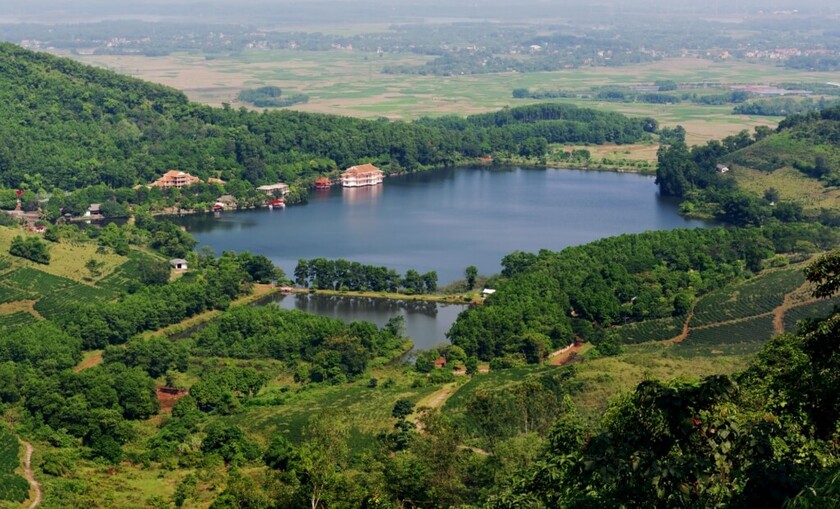
Hanoi has great potential for developing green tourism.
Hanoi is a city with great potential and advantages, possessing both natural and human factors to develop sustainable green tourism. Nature has endowed the capital with a rich system of natural tourism resources. From a climate with four distinct seasons; abundant surface and groundwater resources year-round, to diverse topography including fertile plains in Hanoi's inner city, rice paddies in Thuong Tin, Phu Xuyen, Ung Hoa... or undulating mountain ranges in the Soc Son and Ba Vi areas.
At the same time, ecological landscape systems such as Ba Vi National Park, Huong Son scenic area, Vien Nam mountain landscape... along with some agricultural spaces such as the specialized crop belt in Thanh Tri, Gia Lam, Dong Anh, Hoai Duc districts...; the ornamental flower and plant belt in Bac Tu Liem, Dong Anh, Me Linh... have a long tradition, producing agricultural products to serve urban areas while also serving as natural and human landscapes for tourism development, especially rural tourism and farm tourism.
Many tourist destinations in the outskirts of Hanoi are undergoing significant changes in creating green spaces and using environmentally friendly materials in tourism activities. A prime example is Co Loa commune (Dong Anh district), which is highly praised by many tourists for its unique experiences at the Co Loa National Special Historical Site. One of the key highlights for visitors is the clean, beautiful, and friendly environment.
Tourist destinations in Ba Vi, Son Tay, My Duc, Thach That, etc., have also developed many green tourism products. Notable examples include ecotourism, health care, and herbal baths offered by the Dao people in Ba Vi district; experiential activities at Duong Lam Ancient Village (Son Tay town); and community-based tourism in Thach That district.

In the inner city area, for many years, tourist attractions, services, and accommodations have made a strong impression on visitors with their green, smoke-free tourism model. According to the Hanoi Department of Tourism, since 2019, Hanoi has implemented a smoke-free tourism model at 30 tourist sites and historical and cultural relics in Hoan Kiem district, such as: Ngoc Son Temple, Ba Kieu Temple, Quan Su Pagoda, Ba Da Pagoda, the National Historical Museum, the Women's Museum, the National Library, the Grand Opera House, the Grand Cathedral, Ham Long Church, Hoa Lo Prison, Thang Long Water Puppet Theatre, and the Workers' Theatre… These sites attract many tourists, thus quickly creating an impression of a green, clean, beautiful, friendly, and civilized Hanoi.
However, the development of green tourism still faces many obstacles due to the low awareness of tourism businesses and the community regarding the protection of the environment, landscape, and nature.
Furthermore, the infrastructure and supporting facilities at many agricultural and rural ecotourism destinations are not yet fully developed and their quality is not high. Many agricultural and rural tourism destinations in Hanoi face difficulties in connecting with travel agencies to improve and develop products as well as attract tourists…
"Locals in tourist areas and destinations need regular training in hospitality skills, community-based tourism, building eco-friendly and nature-friendly experiential products, and providing accommodation services that meet standards," emphasized Associate Professor Pham Hong Long, Head of the Tourism Department - Faculty of Social Sciences and Humanities (Vietnam National University, Hanoi).
According to Dang Huong Giang, Director of the Hanoi Department of Tourism, since 2019, the department has organized numerous training courses on community tourism and civilized tourism conduct in districts, towns, and cities. The department also requires travel agencies and destinations to pay attention to environmental factors, ensure health and safety, and promote sustainable development in the process of building tourism products. These training courses contribute to spreading many green tourism models, helping local people promote their cultural identity and participate with the government in building unique experiential tourism products for the capital city.