VI
VI


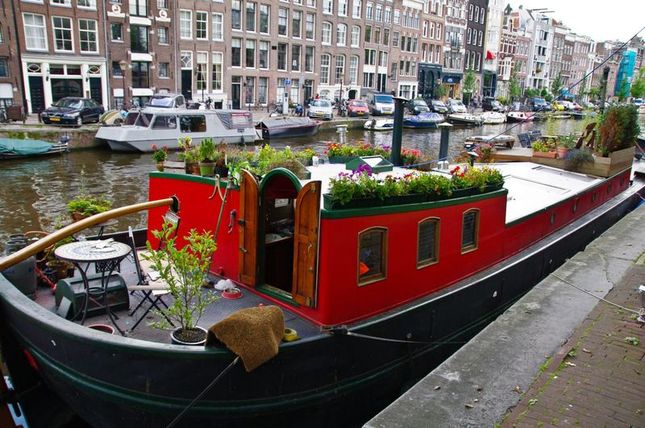

Stepping into these houses, it seemed as if all the hustle and bustle of the street outside suddenly vanished. Instead, there was the scent of wood, the sea, and the vast expanse of waves. The low ceilings didn't detract from the feeling of freedom and coziness. Waking up each morning to the sound of the water brought back memories of youthful adventures conquering the land. I was freely enjoying complete privacy, in these houses that didn't sit on land, these floating houses, the houseboats of the Dutch lowlands.
Past and present
The Netherlands is a country famous for its bustling seaports. For centuries, shipowners have brought their families on their long voyages, living in cramped cabins below deck. Upon retirement, they traditionally remained on board with their families. The ships and barges were modernized to better suit their new purpose. They called these "homes" from that time onward. Their ships no longer moved but were anchored in one place, usually in the main canals of cities. Living conditions in these early homes were very basic. The spaces were damp, small, and lacked electricity; they had to generate their own power using gas or burning charcoal on the ships themselves.


After World War II, when housing was insufficient for the population while river and sea transport was abundant and outdated, converting old ships into houses became an effective solution for densely populated cities. Furthermore, such houses were inexpensive and offered privacy, making them very popular among the poor at the time. However, due to the lack of adequate amenities and sewage systems, these houses created a nightmare for the canals with their wastewater.
During the 1960s and 70s, cities implemented policies to improve the quality of life on houseboats and encouraged residents to preserve these old vessels as a way of preserving their riverine culture. As a result, the number of houseboats increased significantly, and their architecture and colors became more diverse, creating very distinctive features on the canals within Dutch cities.
Amenities on houseboats have gradually improved, becoming comparable to living in regular houses on land, especially the electricity system. From 2005 onwards, garbage and wastewater from the houseboats have been fully integrated into the city's sewage system. The canals are cleaned, and many young people can jump into the cool water on hot summer days without worrying about pollution.
Over the years, houseboats have become a symbol of luxurious living for the wealthy. Locals call this lifestyle the "yuppie trend" of the upper class. Many other names have emerged instead of the simple name houseboat, such as "castles on the water" or "dream houses." Many of these "castles" have now been converted into floating restaurants, mini-hotels, or cultural museums, primarily catering to tourists who want to explore this unique lifestyle.
| Over the years, houseboats have become a symbol of luxurious living for the wealthy. Locals call this lifestyle the "yuppie trend" of the upper class. Many other names have emerged instead of the simple name houseboat, such as "castle on the water" or "dream house". |
Houseboats in Amsterdam

The Netherlands currently has over 10,000 houseboats of all sizes. Within the capital city of Amsterdam alone, the number of houseboats on the water accounts for a quarter of the total number nationwide. Besides houseboats made from the original metal boats, Amsterdam also has floating houses built on sturdy concrete structures that remain stationary on the water. Furthermore, in the new Amsterdam urban area of Ijburg, a new type of floating house is gaining popularity. These houses, at first glance, resemble the raft houses in Vietnam but are more robust because they are built on reinforced concrete and, of course, float on water.


Known as the "city of bridges" with its dense network of canals, houseboats have become an indispensable part of the capital. Perhaps that's why, when visiting the Netherlands, and especially Amsterdam, adventurous travelers often choose these floating hotels as their accommodation. The unique thing about these houses is that no two are alike. Each house has its own distinct characteristics that can only be truly appreciated when you step inside and explore.
| What makes these floating houses unique is that no two are alike. Each house has its own distinct characteristics that can only be truly appreciated when you step inside and explore. |
For travelers who don't prefer that type of hotel but are interested in history, the floating "Houseboat Museum" on the Prinsengracht canal is a must-see. Those interested in ships and boats in general can visit the "Het Scheepvaartmuseum" docked in Kattenburgerplein square to explore the history of Dutch shipping and admire a recreated version of the once-famous 18th-century VOC (Verenigde Oost-Indische Compagnie) ship.
When tired and weary from strolling through the city, the restaurants and cafes on the water are a must-see. Personally, I prefer watching people go by rather than being stared at. But sitting in a small cafe on an old boat in the heart of the bustling city, I felt a sense of tranquility as the curious and amused eyes of passersby watched me savor the traditional local flavors. The feeling of being a part of something traditional was truly charming.


Remembering the Mekong River
Writing this brings back strange memories of the Mekong River! I was just a tourist exploring the southwestern part of Vietnam on the Mekong River, and I was fortunate enough to experience the feeling of floating on the water in the houseboats there. The houseboats in the Netherlands, though vastly different in architecture and sturdiness, still evoke a poignant feeling of nostalgia for home, where there are houseboats, rafts, and floating houses. The Dutch often joke, "Our country will eventually be submerged by the sea, so it's best to acquire a house like that that's safe." They laugh. I laugh, and I remember some project in the Mekong Delta and Central Vietnam to combat the recurring floods that occur every year in a natural cycle.


---------------------------------------------
Additional information
When visiting any city in the Netherlands, tourists can simply stroll along the canals in the city center to admire the houseboats and floating houses.
+ A few addresses in Amsterdam:
- Houseboat Museum: Prinsengracht, opposite house number 296. Phone: +31 (20) 4270750
- Home for homeless cats "the cat house": De Poezenboot, Singel 38, 1015 AB, Amsterdam. Phone: +31 (20) 6258794
- Museum "Het Scheepvaartmuseum": Kattenburgerplein 1, 1018 KK, Amsterdam. Phone: +31 (20) 5232222.
Text and photos:Minh Trang (from the Netherlands)