VI
VI


Passing through the autumn foliage season on familiar roads.
At the end of January, we left Ho Chi Minh City as the morning sun was just rising. The city quickly receded behind us, giving way to long, straight stretches of road, flanked by endless rubber plantations. I felt distinctly that I was traveling through a very different season. It wasn't the rainy season, nor was it the scorching dry season, but rather the season when rubber trees shed their leaves—a brief period, yet enough to transform the landscape of the Eastern region.
Along the road to Vung Tau, rubber plantations stretch as far as the eye can see: from Cu Bi commune (Chau Duc district), through Chau Thanh, Xa Bang, and Cam Duong. Each forest seems to have its own rhythm of change. In some places, the leaves are still green, with only a few scattered trees turning yellow. In other places, entire forests are dyed a deep red or yellow, forming a thick, dry carpet underfoot. Still other patches of forest, the trees have shed almost all their leaves, their branches bare and gaunt, as if they have fallen asleep during the changing seasons.


The different shades of the rubber forest during the leaf-changing season, as seen from above.


What's special about the rubber tree leaf-shedding season is its non-uniformity. Along the same road, just past a bend, the scenery changes. This interweaving makes the journey more interesting: the eyes are constantly captivated by the changing colors, and the mind slows down, becoming quieter amidst the steady rhythm of the vehicle.


The tranquil colors of the rubber forest
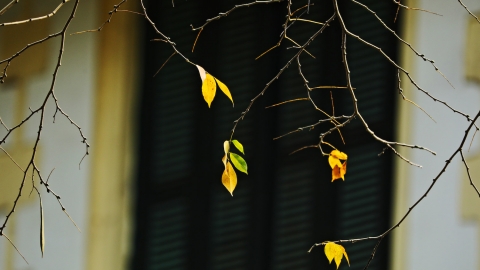
Not a vibrant, explosive display, the rubber tree's leaf-shedding season possesses a quiet, serene beauty. The leaves don't just change color in one shade; it's a process of transformation from dark green to light green, then turning yellow, orange, and reddish-brown before falling to the ground. Under the late January sun, the multicolored foliage standing side by side creates the feeling of an unfinished painting, where the colors are still finding their place.


The leaves change color from dark green to yellow-orange to deep red before falling off.
In the orchards where the leaves have fallen heavily, the ground is covered with a layer of dry leaves. Every step creates a very faint rustling sound. Occasionally, a gentle breeze blows through, the branches and leaves tremble as if shivering, and then the dark brown leaves fall to the ground like a harbinger of the season's rain. The air is dry and light, carrying the pungent smell of decaying leaves and red basalt soil – a familiar scent of the Southeast region, but even more pronounced during this season.

In some sections of the forest, the rubber trees are almost completely bare. The trunks are arranged in straight, regular rows, reaching towards the pale blue sky, forming parallel lines as if pre-arranged. Seen from afar, the slender branches resemble thin arms reaching towards the sky, both strong and fragile. This scene evokes a very different feeling: no longer the familiar lush green of rubber trees in the rainy season, but a rustic, tranquil beauty.


The dry tree trunks, arranged in straight rows, their grayish-brown color creating the feeling of stepping into an eerie forest.
In that moment, the rubber forest was no longer simply an agricultural production space. It became an emotionally rich backdrop, where passersby could easily feel a sense of contemplation, as if witnessing the slow breath of nature.
Silent movements in the rubber forest during the leaf-changing season.
The rubber tree leaf-shedding season usually takes place from the end of December to around February or March, coinciding with the transitional period between seasons and the peak of the dry season in the Southeast region of Vietnam. For locals, this is a familiar cycle for rubber trees – the time when the trees shed their old leaves to prepare for a new growth cycle. But for those who just happen to pass by, it's a pleasant surprise.


Amidst this seemingly tranquil setting, the rhythm of labor in the rubber forest never ceases. On the red dirt roads winding through the forest, the figures of people tapping rubber from early morning can still be seen, silently among the bare trees. The blades glide swiftly across the rubber tree trunks, the freshly tapped lines appearing a pale white, the latex slowly flowing into the prepared collecting cups. When most of the leaves have fallen, the space in the forest becomes more open, the sunlight falling directly on the tree trunks, illuminating every movement.
By midday or late afternoon, the rubber latex containers are loaded onto motorbikes and tractors, following small paths winding through the rubber forest to the collection point. The road suddenly seems longer between the slender trees, but this also makes the image of the people even more prominent: small but resilient in the vast space. The rubber forest may shed its leaves, but life does not stop; the rhythm of daily life continues as regularly as in any other season.


Even during the leaf-shedding season, the rhythm of work in the rubber forest continues without interruption.
The interplay between nature's transformation and humanity's tireless labor gives another layer of meaning to the rubber tree's leaf-shedding season. It's not just about the beauty of the landscape; it's also a picture of the quiet life of the Southeast region, where people are accustomed to living alongside the forest, remaining connected to those rows of straight trees through every season.
The rubber tree's leaf-shedding season doesn't last long. After only a few weeks, new shoots appear, covering the forests in green again. People may travel along these roads many times a year, but only at this time does the scenery take on such a wild and gentle appearance.






.jpg.jpg)