VI
VI


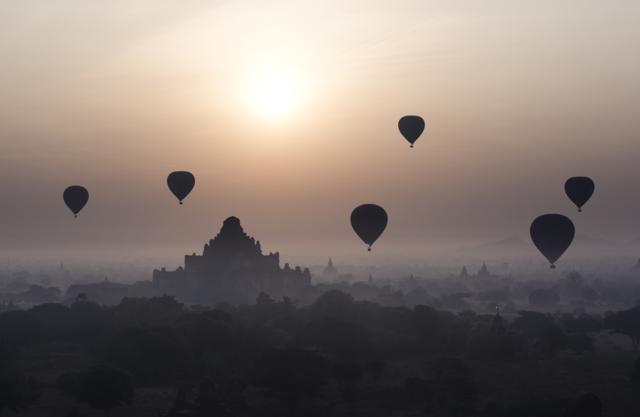
Text and photos:Le Thang
So it takes about 6 hours by early morning bus from Mandalay, with so many peaceful and tranquil sights along the way. The weather in Myanmar generally has large temperature fluctuations, cold at night and hottest in the mid-afternoon, then gradually getting colder as the sun sets behind the mountains on the horizon.
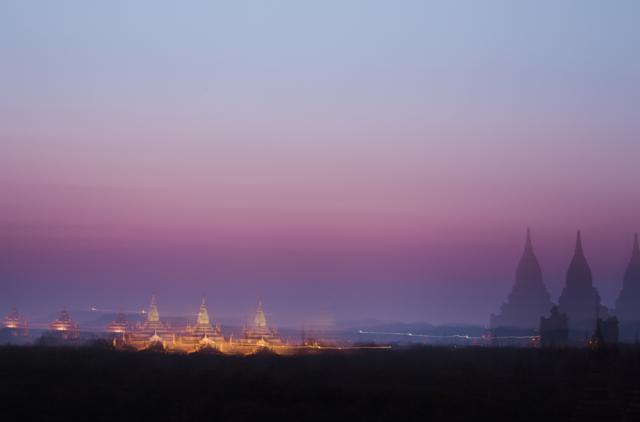
I woke up very early, around 5 a.m., the sky was still sparkling with stars and quite cold. Of course, I had already surveyed everything I needed the previous afternoon, as soon as I arrived. Wrapping a scarf around myself to keep warm, I made my way to the meeting point, with the fiery sunrise illuminating the layers upon layers of sacred towers.
 Bagan is located about 150km southwest of Mandalay, on a dry land on the eastern bank of the Ayeyarwady River. Formerly known as Pagan, Bagan was the capital of the Pagan Kingdom, which existed from the 9th to the 13th centuries AD. Covering an area of approximately 25 square miles, it boasts around 13,000 temples, pagodas, and stupas, built between the mid-11th and late 13th centuries. These temples and pagodas, constructed during this golden age, marked the beginning of a new Buddhist tradition in Myanmar. Today, about 2,500 such temples and pagodas remain. An earthquake in 1975 and, further back, the Mongol invasions of the 13th century destroyed many of these magnificent structures.
I read about Bagan in that way. Actually, I didn't intend to delve too deeply into such details. I came to Bagan to explore and take photos, to capture as many images as possible of this mysterious land, and I'm beginning to fulfill those desires.
I climbed breathlessly to reach the top level of the temple, chosen as the best spot to watch the sunrise in Bagan. I arrived before dawn, but was surprised to find it packed with people and countless photographers. Although I knew it was a popular spot for photographers, I was still truly surprised and had great difficulty finding a decent spot to wait for the sun to rise.
I remember the wait was quite long, the space was completely silent. Perhaps I was too focused, or maybe everyone around me was, and I rarely heard anyone talking. It seemed as if all eyes were fixed on the horizon.

I arrived in Bagan in a strangely excited mood. Bagan was the place I was most looking forward to on this trip. This excitement probably stemmed from the allure of what I had read, and even more so from the photos I had seen. Lost in my thoughts, flocks of birds flew across the sky, which was gradually turning red. I was almost speechless when the round sun emerged from behind the ancient Dahmmayan Gyi Phaya temple. Somewhere, there was a murmur of admiration in various languages. And then another sound replaced that murmur: the frantic clicking of camera shutters.
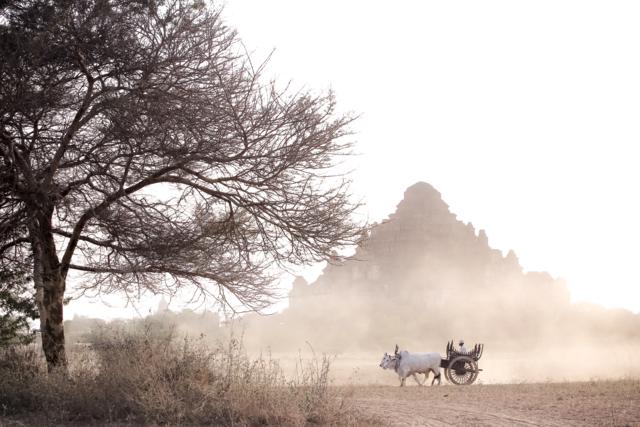
The sunrise over the fiery land is truly extraordinary. Mysterious, magnificent, and wild. Its captivating allure lies in the celestial fire, its brilliant light spreading through the morning mist, across fields and pagodas, gradually enveloping the entirety of Bagan in a golden glow. The morning mist then rises with the sunlight, obscuring everything in its path. In an instant, the entire territory of Bagan is reduced to mere treetops and pagodas of varying sizes rising from the mist. Everything seems to unfold in layers, drawing the viewer's gaze far into the horizon.
The sunrise over the fiery land is truly extraordinary. Mysterious, magnificent, and wild. The captivating allure is reserved for the celestial fire, radiating a brilliant light that gradually spreads through the morning mist, across fields and pagodas, and slowly blankets the entire city of Bagan in a golden glow.
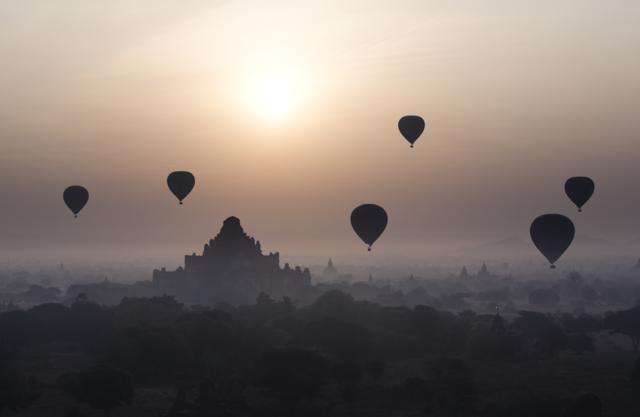
I had seen pictures of Bagan, heard stories from those who had been there about hot air balloons soaring across the fiery sky. It seems not everyone who visits Bagan gets to see them, even if it's simply a service offered by a Western tour company. I hadn't thought about the balloons; all the enchantment was focused on the sunrise and the mysterious towers. But I was lucky, perhaps, as the sun was just beginning to cast its light. Far to the north of Bagan, amidst the bluish mist, faint, round spheres appeared. One, two, then three, and more—I realized they were balloons, and it was wonderful to see them for the first time in my life, in such a wondrous place. It took me a long time to count them all; there were thirteen of them, gradually drifting towards the center of the field of towers. Looking at them, it felt like an invasion, an invasion of wonders.
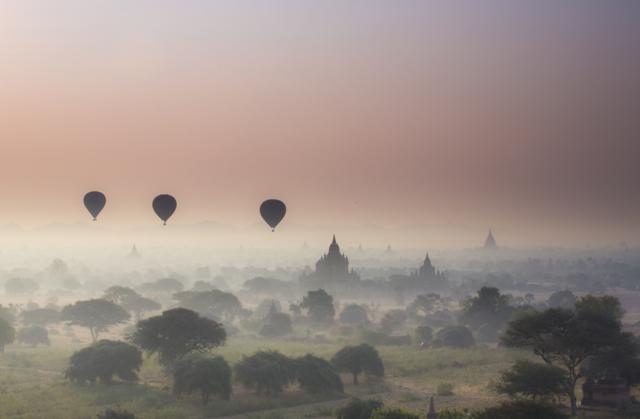
The hot air balloons began to spread across the sky, drawing gasps of admiration from those around me. The atmosphere became lively, no longer as quiet as when we waited for the sunrise. Some soared high to observe the panoramic view, while others descended close to the ground, flying past the towers. Those on board were either thinking or seeing something, but it was probably very interesting. And perhaps they didn't realize that they were discovering a wonder and inadvertently creating another, equally fascinating wonder.
Mesmerized by the balloons' flight paths, I, and probably everyone else, forgot where the sun was. By the time the balloons reached the center of the ancient tower field, the sun was already high in the sky. The entire area was bathed in sunlight, mist hung over the field, and dust from the cars driving on the red dirt roads mingled with it.
I saw a solar eclipse when I was a child, and even now, more than twenty years later, I haven't seen one again. And miraculously, I got to experience it again, in a hot air balloon, in Bagan. It was incredibly lucky; a hot air balloon flew across the sun, perfectly covering it and creating a solar eclipse for about ten seconds – a short but spectacular sight.
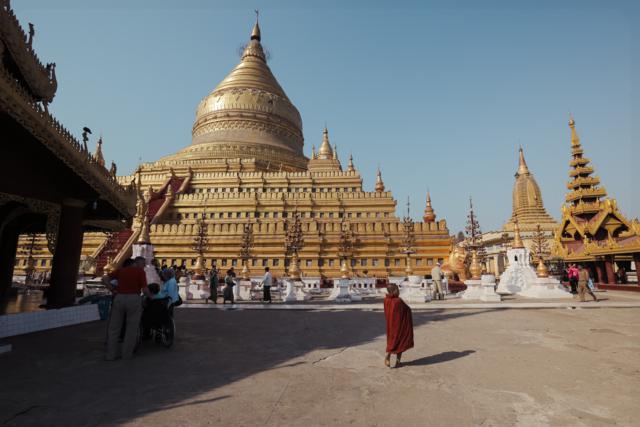
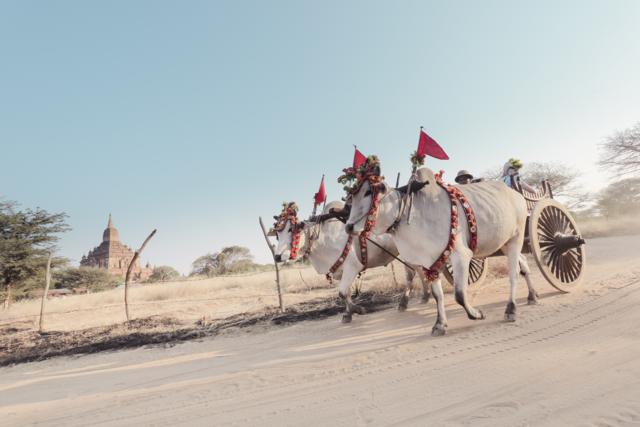
I left the tower and wandered all day across the fields, along dusty roads leading to various temples. I stood before colossal temples and encountered uniquely shaped tourist carts pulled by horses and oxen. As twilight began to fall over the Ayeyarwady River, I sought out the sunset viewing tower marked on the tourist map. A local girl led me up the tower along tiny paths. I stayed there, watching the sun set behind the mountains in the west. Bagan sunsets are unlike sunrises; they are solemn and tranquil. It's easy to see the regret in everyone present as the sun sets, due to the enchanting beauty the sunlight brings to this fiery land of sacred towers.
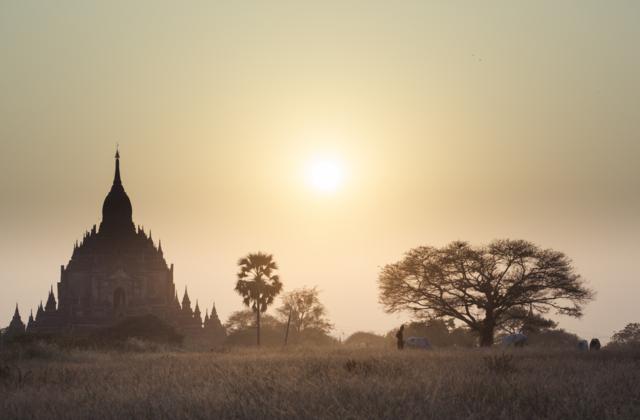
Unlike sunrise, the sunset in Bagan is very solemn and tranquil. It's easy to notice the sense of regret in everyone present as the sun sets, because of the enchanting beauty that the sunlight brings to this fiery land of sacred pagodas.
I left the pagoda as night had fallen. Bagan still holds so many wonders. The colossal and ancient temples, the clear blue Ayeyarwady River with its simple Myanmar life, the famous traditional lacquerware handicraft villages, and countless people and monks of this strangely peaceful land.
And I still have one more day to go to Bagan.
Additional information:
+ Means of transport:
- Bagan can be reached from Yangon and Mandalay by domestic airlines. Alternatively, there are trains and buses available, costing between 8 and 10 USD, equivalent to 8,000 and 10,000 Kyats.
- The waterway route from Mandalay to Bagan on the Ayeyarwady River has two types of boats, with travel times of 9 hours and 17 hours, costing approximately 40 USD and 10 USD respectively.
Getting around in Bagan:
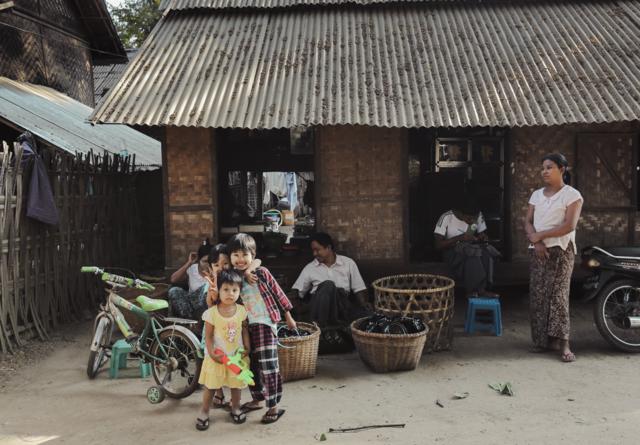
You have many transportation options in Bagan, including bicycles, electric bikes, ox carts, horse-drawn carriages, etc. Experience everything if you can, but the most convenient is probably an electric bike. Rentals here cost around $10 per bike per day. The cheapest option is a bicycle, at about $3 per bike per day.
+ Cuisine:In Myanmar, the food is basically traditional. There are some restaurants that serve Western European and Chinese-style food that are quite good.
+ Hotel:There are resorts and budget hotels, with a wide range of prices. The cheapest are around $35 per night for a room that can accommodate 2 to 3 people. Alternatively, you can rent a bed on the patio for $7 per night.
+ Places worth visiting:
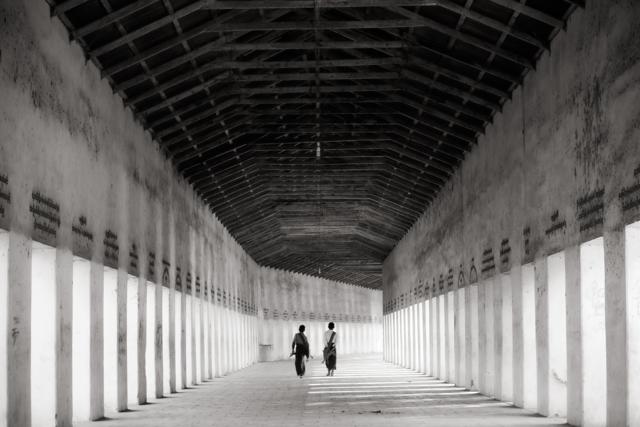
- There are approximately 4,000 temples in Bagan. Famous ones include the Shwezigon Temple (built in the 11th century) in Nyang U, Ananda (11th century), Thatbyinnyu (12th century), Shwegugyi (11th century), and Shwesandaw (11th century) – a great place to watch the sunset in Old Bagan.
Other activities you shouldn't miss in Bagan include: visiting lacquer workshops; going to the local market; having dinner at Nanda restaurant (7-10 USD) to watch a puppet show; and climbing Mount Popa, an ancient volcano 40km from the center of Bagan – the birthplace of the Nat spirits who bless the people of Myanmar.
- Enjoy a scenic hot air balloon ride. The cost is approximately $350 per person for a 2-hour flight. It's quite expensive, but if you can afford it, you should consider it.
+FewOther notes:
- Remove your shoes, sandals, and socks when visiting temples, pagodas, and areas where footwear is not permitted.
- When giving money, gifts, or anything else to someone, you should do so with your right hand or with both hands to show politeness.
- When visiting temples and pagodas, you should wear trousers that cover your knees and a shirt with sleeves, avoiding revealing your chest, stomach, or back.
There are some places where filming and photography are prohibited, so you should be aware of this to avoid any trouble.