VI
VI


Some dishes, like sushi and tempura, are born from tradition, nurtured within a structured framework, and preserved as a heritage of Japan. But there are also dishes, like ramen, that don't begin with tradition but with a shift in culture. Not inherently "original," ramen has become the most vivid testament to a profound truth in cuisine: that not only indigenous cuisine, but also the values of foreign cultures can sometimes represent a stronger identity than any native dish.


In every strand of ramen noodle, every spoonful of broth, one can sense not only the flavor, but also the history, geography, and people.
On the Japanese culinary map, sushi is celebrated as a global icon, tempura as the embodiment of skill, and kaiseki as the pinnacle of Japanese cuisine, while ramen emerges as a fascinating counterpoint. It's unpretentious, unceremonious, and distinctly Japanese. It's hot, served quickly, flavorful, and the restaurant atmosphere is vibrant, much like the rhythm of postmodern Japanese urban life.
But behind that unassuming exterior lies a complex story, spanning history, geography, and ever-changing cultural currents.
Born elsewhere, raised in Japan.
Ramen, by its very nature, is not an original Japanese dish. According to George Solt's research in "The Untold History of Ramen," the dish originated in China, where bowls of pork noodle soup existed long before Japan knew about them.
In the late 19th century, as Japan opened up to trade after a period of isolation, Chinese communities began to emerge in port cities such as Yokohama, Kobe, and Nagasaki. Along with them came culinary memories of steaming bowls of noodles, rich broth, chewy noodles, and familiar spices from their homeland.
Initially, this dish was called Shina soba or Chūka soba – “Chinese noodles”. The name “ramen” only truly became popular after World War II, when Japan entered a period of profound social and cultural upheaval. Furthermore, what is noteworthy is not its origin but how ramen was received.

Ramen, by its very nature, is not an original Japanese dish.
From an unfamiliar dish to a national symbol of Japan.
There's an interesting paradox: in the past, the Japanese weren't accustomed to eating pork—the core ingredient of many ramen dishes today. Therefore, bowls of noodles with broth simmered from pork bones were once a strange, even unacceptable, experience. But history, with all its harsh upheavals, has changed that.

After the war, amidst food shortages, wheat became a vital food source. Small noodle shops began to spring up throughout the cities, serving hot, inexpensive yet nutritious bowls of ramen. Ramen, once an imported dish, gradually became a staple for the masses. No longer a symbol of foreign noodles, it became a part of life, a familiar after-work option, a simple comfort on cold days, an almost instinctive habit. And it was this popularity that laid the foundation for ramen's profound influence on Japanese cuisine.

The broth is made from a foundation of top-notch culinary techniques.
If you had to choose one element that defines the soul of ramen, it would undoubtedly be the broth. Unlike udon or soba, where the light broth plays a supporting role, ramen places its entire focus and appeal on the structure of the broth.

If you had to choose one element that gives ramen its soul, it would definitely be the broth.
From shoyu ramen with its fragrant, smooth soy sauce, miso ramen with its rich, fermented bean paste, to tonkotsu ramen with its creamy, milky white broth... each variation is a world of its own, a philosophy of balance. In particular, tonkotsu, with its technique of simmering bones for hours to extract collagen, is a distinctly Japanese innovation. It demonstrates how the Japanese not only embrace techniques but also push them to their limits, transforming them into a new standard. In each bowl of ramen, the broth is not just an ordinary base; it holds a cultural depth that we are still gradually discovering today.
Influence from China
The influence of China on ramen goes beyond just the noodles or the cooking technique. It lies on a deeper level, in the mindset and the depth of cultural exchange.
A complete bowl of ramen is a combination of many elements: noodles, broth, oil, and toppings. But more importantly, it's about the balance of salty, sweet, fatty, and umami flavors, and the harmony of temperatures ranging from hot to warm. A quality bowl of ramen is hot; even when you finish the bowl, the noodles and broth are still warm. This embodies the philosophy of "five flavors" and "yin and yang" in classical Chinese cuisine.
However, what defines ramen is not its adherence to that philosophy, but rather its flexible adaptation to a more minimalist, refined, and sometimes, more extreme Japanese style in its pursuit of perfection.
Ramen and the rhythm of Japanese urban life
If kaiseki represents stillness, then ramen represents movement. Ramen is associated with bustling streets, train stations, and office areas. It's served quickly, eaten quickly, and often enjoyed in a hurry. The slurping sound, which might be considered impolite in many cultures, is accepted, even encouraged, in a ramen setting. It's part of the experience, an expression of direct and uninhibited enjoyment.
In a way, ramen is a reflection of modern Japan with its fast-paced lifestyle, intense work ethic, and direct approach, yet still retaining a sense of enjoyment in personal life.

Ramen is a reflection of modern Japan: a fast-paced, efficient, and direct lifestyle, yet still retaining enjoyment in personal life.
It's impossible to discuss the influence of ramen without mentioning a revolutionary invention: instant noodles. Originating in Japan, the "industrialized" version of ramen has spread worldwide, becoming one of the most popular foods. Despite its simplification, instant noodles retain core elements like noodles, broth, and convenience. They bring the spirit of ramen to places where the traditional version couldn't reach. And from there, ramen is no longer just a Japanese dish; it has become part of global culture. In every country, the consumption of instant noodles seems to reach staggering figures, especially in South Korea and Vietnam.
Today, the story of ramen is not just a one-way street. In China, ramen chains like Ichiran and Ajisen Ramen attract a large number of diners. In high-end restaurants, ramen is even served in a contemporary style. This is an interesting cycle where a dish migrates, is transformed, and then returns to its origin with a distinctly new identity. This shows that cuisine in each country has no clear beginning or end, but rather adapts to changing times. Cuisine, like fashion, is always in motion, always changing, and always most clearly reflects the cultural exchange between different regions.

In each bowl of ramen, there is more than what we see and feel. It bears the traces of the journeys of exploration undertaken by each migrant community, along with the upheavals of history. Ramen is not a "perfect" dish in the classical sense, nor does it truly capture the tranquil spirit of Japanese culinary culture. But it is precisely this imperfection, this blend, this flexibility, this spectacular transformation, that makes it more vibrant than ever, transcending its original version from the distant 19th century, transcending Japan to become acquainted with the world.
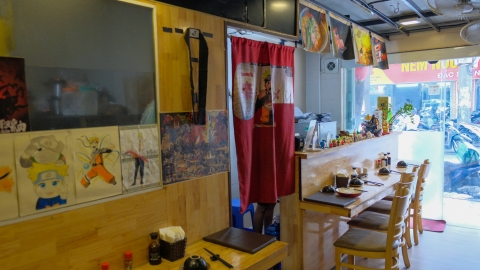
In Vietnam, ramen shops are just as popular and crowded as noodle shops selling vermicelli, pho, porridge, and other similar dishes. Ramen shops can be found everywhere, from budget-friendly to mid-range and even more expensive, lining the streets and alleys of Saigon, Da Nang, and Hanoi. Young Vietnamese people enthusiastically and comfortably slurp up ramen and "check in" with their bowls as a trendy culinary habit.
And perhaps this is why a small bowl of ramen can have such a profound impact on Japanese cuisine and, more broadly, on the world. Now that ramen has become so popular, it's being celebrated as a new kind of contemporary culinary icon.