VI
VI


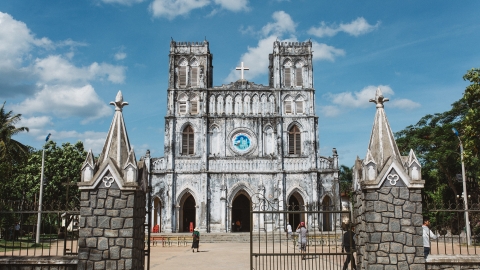
Ninh Binh (formerly Nam Dinh) has long been known as the "holy land" of Vietnamese Catholicism – a place where the sound of church bells blends with the rhythm of daily life, and the majestic Gothic domes standing tall in the Northern Delta have become a familiar part of the local people's memories. More than just a place of worship, the hundreds of churches here are also works of art, embodying the fusion of Western and Vietnamese influences, attracting pilgrims, photographers, and architecture enthusiasts alike.
Land of cathedrals
According to the "Imperial-commissioned Comprehensive History of Vietnam" by the National History Institute of the Nguyen Dynasty, the former Nam Dinh province was the first place to welcome Catholic missionaries to spread the faith in the North in 1533. From then on, Catholicism took root, spread, and gradually became a part of the cultural life there. Over the centuries, churches have sprung up one after another, creating a unique and rare religious space.

Today, Ninh Binh boasts over 700 churches of all sizes – a number sufficient to earn the region the title of "kingdom of cathedrals." Each structure possesses its own unique architectural style, largely influenced by classical European Gothic architecture with soaring domes and bell towers reaching towards the sky, yet skillfully blending with the local spirit through the use of wood, tiles, and exquisitely carved details.

Formerly Nam Dinh (now part of Ninh Binh province), it was known as the land of the most magnificent Catholic churches in Northern Vietnam.
Amidst the rice paddies, bell towers rise like landmarks of faith, bearing witness to centuries of missionary history, and also serving as a highlight that makes Ninh Binh a unique region on the architectural map of Vietnam.
The ruined Hai Ly church - a witness to the sea.
On the beach of Hai Hau commune, amidst the waves and salty sand, still stand the ruins of an ancient church – the ruined Hai Ly Church, also known as the Church of the Sacred Heart. Built in 1877, the structure features a blend of French and Spanish architecture and was once one of the most beautiful churches in the coastal region of Ninh Binh.

The ruined Hai Ly church at dawn.
Initially, the church was only about 98 m² in size, with a simple thatched roof. By 1927, the structure had been expanded to over 9,000 m², including a 27-meter-high bell tower, a cruciform dome, and many Gothic-style decorative motifs. But the sea continued to encroach further inland. Typhoon No. 7 in 2005 destroyed the dike, devastating the Xương Điền - Văn Lý fishing village (the old place name) and many coastal churches, leaving only bare ruins.
Amidst the ruins, only the bell tower and the northern wall of the Church of the Sacred Heart remain standing, bearing the marks of time. Today, the ruined Hai Ly church is not only a famous tourist destination but also considered a living testament to climate change and the erosive power of the sea. As the sun sets, golden sunlight streams through the broken windows, reflecting on the shimmering water. This scene makes the place both melancholic and majestic, like a surreal painting in nature.


Hung Nghia Temple - a grey castle in the middle of the plain
From a small wooden church built in 1894, the Hung Nghia Holy Temple in Hai Hung commune, Hai Hau district, has been restored and rebuilt, completed in 2012, becoming one of the largest and most magnificent churches in Ninh Binh.


The main hall is 76 meters long, approximately 24 meters wide, and about 23 meters high; the two bell towers are about 57 meters high, creating an overall structure strongly influenced by classical Gothic style. The dominant muted gray color scheme makes the cathedral reminiscent of tranquil European castles. From afar, the curved arches, pointed roofs, and slender columns remind many people of Hogwarts School of Witchcraft and Wizardry in the Harry Potter film series.
As visitors get closer, they are increasingly overwhelmed by the intricate details, from the carved reliefs to the rose windows modeled after Western churches. In the evening, when the golden lights spread, the entire church resembles a magnificent palace in the countryside.

Hung Nghia Church, with its predominantly ash-gray color and magnificent Gothic architecture, resembles a wizarding school.
Kien Lao Temple - a fairytale castle
Not far from there, in Xuan Truong commune, Kien Lao Sanctuary offers a completely different feeling. The church, measuring 75 meters long, 26 meters wide, and 28 meters high, with a bell tower 46 meters high, was rebuilt from the original wooden church completed in 1889.

Front view of Kien Lao Temple
While Hung Nghia exudes a solemn, classic charm, Kien Lao resembles a castle straight out of a fairy tale. Sculptures adorning its four walls, intricate patterns, and towering spires reaching towards the sky make it a favorite destination for those who appreciate European style. Beside the church lies a tranquil lake, its streets illuminated at night, adding to the dreamy atmosphere.


For many couples, Kien Lao is not only an ideal place for wedding photos, but also holds sacred significance as a testament to their love under God's protection.
Opposite the Kien Lao Shrine is the Notre Dame Church, smaller but striking with its vibrant yellow paint. While the Shrine exudes an air of solemnity and reverence, the Notre Dame Church evokes a warm, bright feeling, like a radiant highlight amidst a classical setting.

Our Lady of the Immaculate Conception Church is located opposite the Kien Lao Shrine.
Xương Điền Church - a place where East and West meet.
In Hamlet 6, Hai Ly Commune, Hai Hau District, Nam Dinh Province, Xuong Dien Church is a vivid testament to the fusion of European architecture and Eastern spirit. The Xuong Dien parish was established in 1696, but due to the effects of coastal erosion and the passage of time, the current structure is a rebuilt version, completed around the end of 2022.

Front view of Xương Điền Church
The modern cathedral, measuring 62 meters long and 20 meters wide, with two bell towers nearly 40 meters high, retains the familiar Gothic style with its high domes, large windows, and upright bell towers, while also showcasing East Asian influences through its ceilings made of ironwood and mahogany, and its layered roof design similar to traditional Vietnamese temple architecture.
On the outside, the fish-scale roof tiles combined with the wooden ceiling frame create an overall look that is both solemn and familiar, reminiscent of a Northern Vietnamese village. Inside, the church blends Eastern materials and Western forms, creating a feeling that is both classic and modern, sacred yet deeply Vietnamese. Thanks to this unique combination, Xương Điền Church quickly became a new highlight, attracting those who love religious architecture, tourists, and those seeking a peaceful space in the old Thành Nam area.
The beauty of faith in the heart of ancient land.
In the ancient land of Thanh Nam, the churches are not only architectural structures but also testaments to the flow of culture, history, and faith. They tell the story of centuries of East-West interaction and the enduring faith of the Catholic community through countless changes.
Today, with increasing interest in cultural and religious tourism, Nam Dinh is gradually becoming a special destination on the Vietnamese tourism map. Amidst the resonant evening bells from the church tower, one not only sees a land deeply rooted in Catholicism, but also feels the breath of time, of faith, and of enduring beauty.