VI
VI


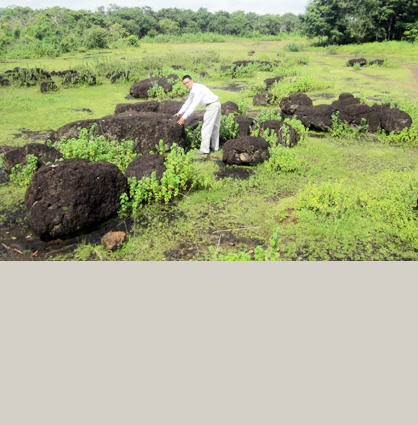
The eerie concentric stone circles
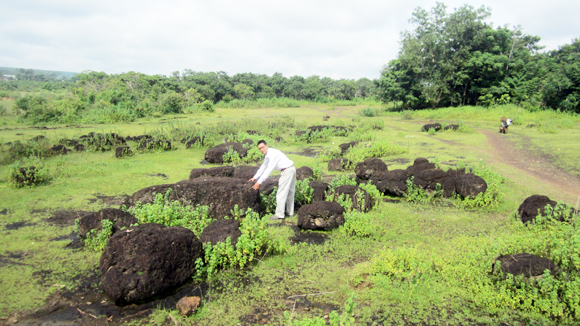
The author is studying the laterite rock formations here.

After navigating dozens of kilometers of forest roads and wading through fast-flowing streams at the beginning of the rainy season, we finally reached the ancient stone tombs of the S'tieng people, nestled amidst the vast forests and mountains of the Loc Ninh border region. Our guide, Dieu Thoai, a cheerful young man, told us as we walked: "This ancient tomb complex is located near a local quarry. It's a vast, open area sloping gently on a hillside, known locally as the Bai Tien stone area."
At first glance, the burial site gives a feeling of surprise and desolation because there are no inhabitants around, yet it is filled with rocks. All the rocks are laterite stones lying on a green grassy ground, even though there are no mountains or hills nearby. From our observation, this burial site contains thousands of rocks of various sizes, scattered around. In the center of the site is a tomb constructed of a circular stone structure with a radius of about 6 meters, surrounded by about 30 pointed pyramid-shaped laterite stone slabs, rising about 0.5-0.6 meters above the surrounding surface. This can be considered the center of this ancient burial site and is believed to be the final resting place of the site's owner, the village elder Rlem, who was the first to bring the S'tieng people to settle here.
Recounting this story, village elder Dieu Vinh, 69 years old, who lives near the burial site, said: "When I was young, I heard the village elders say that the stone burial site is the resting place of Elder Rlem and more than 100 other S'tieng people. It was a strange event that no one can explain to this day, but everyone believes it to be true. During Elder Rlem's funeral, 100 people came here to bid him farewell. While they were burying the village elder, it suddenly started raining heavily, submerging everything. Then, suddenly, amidst a thunderous, earth-shattering lightning strike, the body of the village elder and all those who came with him turned to stone. From then on, the laterite stone burial site was formed and has become a sacred place for the S'tieng community in the area." For them, the turning of the village elder and 100 people into stone represents a wish for immortality and eternity in the universe, a wish from the time of creation, hoping that future generations of the S'tieng people will settle down and prosper, using this ancient burial ground as a center for living and development, abandoning their nomadic life through the forests and rivers. Indeed, listening to the elder's story and touching the ancient laterite stones with my own hands, although I didn't believe it, I still felt a sense of sacredness, as if the presence of our ancestors, the millennia-old owners of this desolate land, was somewhere nearby.
According to our research, besides the central tomb, there are also large surrounding stones in a circular shape. Specifically, in addition to the circle containing the ancient tomb of Rlem, there are two outer circles of stones, quite large, composed of scattered blocks of stone arranged in a fixed but concentric order. Currently, these two outer circles have been significantly disturbed due to the passage of time and human activity. Specifically, the second circle of stones has an estimated diameter of 20 meters, surrounded by hundreds of laterite stones. Today, only about half of the laterite stones remain, as many have been moved elsewhere, but traces of it still remain, albeit faintly. Finally, the third circle of stones, believed to be concentric with the other two, has a radius of about one hundred meters, making it very large. It's safe to say that the strangely and remarkably precise arrangement of these concentric stone circles has aroused considerable skepticism, as achieving such accuracy was extremely difficult many years ago. Although excavation hasn't been permitted to determine the exact location beneath these unusual laterite stones, we can imagine that they undoubtedly hold many fascinating mysteries of the S'tieng community's culture.
Risk of disappearing
As mentioned above, this ancient laterite stone tomb complex is located near a local quarry, making it vulnerable to being crushed and loaded onto trucks at any time. According to Mr. Dieu Thoai, a few years ago, a local quarry owner planned to blast the tomb complex to extract the stone, but the local authorities discovered and prevented the plan in time. Mr. Thoai also stated that there are currently many such quarrying operations in the area, and the ancient stone site could be exploited at any time by trucks and explosives operating day and night. Without timely intervention, in a short time, bulldozers could completely encroach upon this stone tomb complex. Therefore, recently, several scientific teams from Binh Phuoc province have conducted surveys of this stone tomb complex. Although no official conclusion has been reached, the survey team asserts that the stone tomb complex may be the burial place of S'tieng chieftains or possibly a stone altar for rain-making rituals. Conversely, many other opinions regarding this stone tomb complex suggest that the complex, with its thousands of laterite stones and concentric stone circles, is a masterpiece of nature, formed randomly without human intervention. It can be considered a strange phenomenon, like other stone formations discovered by humans.
Although science has not yet reached a definitive conclusion about the origin of the stone tombs, according to the locals, many strange things have happened around this area. During the war, the border region of Loc Ninh, the cradle of the Southern liberation movement and the headquarters of the revolution, suffered heavy bombing from the enemy. While other mountainous areas, forests, and streams were ravaged by bombs and shelling, this ancient tomb remained intact, completely undisturbed. People also recount that, for some inexplicable reason, enemy bombs and shells seemed to "avoid" this tomb, despite its open and isolated location. Therefore, the S'tieng people consider this ancient tomb a sacred and inviolable treasure of their ethnic group.
According to Mr. Tran Thanh Tung, director of the Binh Phuoc Provincial Museum, the Bai Tien archaeological site is certainly a valuable archaeological site because the arrangement of the stone circles must have been done by human hands, not simply a natural formation. Ignoring the mysterious oral traditions of the local people, this place holds significant research value regarding the ancient S'tieng people, the first inhabitants of what is now Loc Ninh and Binh Long. Therefore, the museum will soon conduct research to accurately determine the age and age of the stone artifacts at Bai Tien to clarify any doubts and provide accurate explanations for the mystical stories of the local people.
It can be said that Mr. Tung's explanation is somewhat consistent with the cultural beliefs and practices of the S'tieng people regarding the use of stone in their daily lives. According to the village elders in the Loc An area, stone has long played a crucial role in their religious beliefs. From funeral rites and new rice harvest ceremonies to weddings and other ceremonies, the villagers worship stone. Therefore, the area around the stone tombs has gradually become sacred to the people without them even realizing it.