VI
VI



Following a trend, ornamental palm trees are now being planted more frequently in government offices and resorts. This is probably because of their straight trunks, lack of overgrown branches requiring pruning, and their beautiful leaves that don't shed or become messy like other trees. However, ornamental palm trees lack a canopy, and their fibrous, long, succulent roots absorb a lot of nutrients, so the soil where they are planted often becomes barren, making it difficult for other plants to thrive nearby.
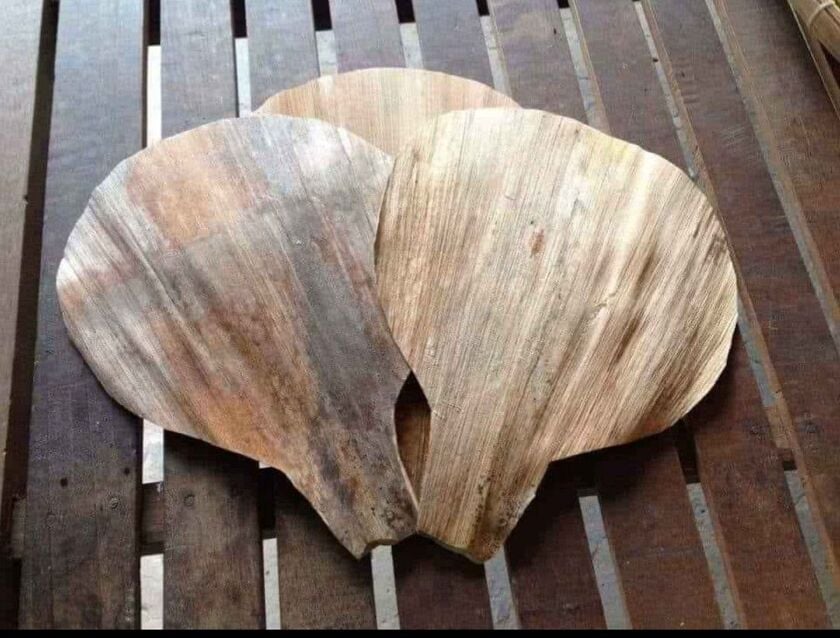
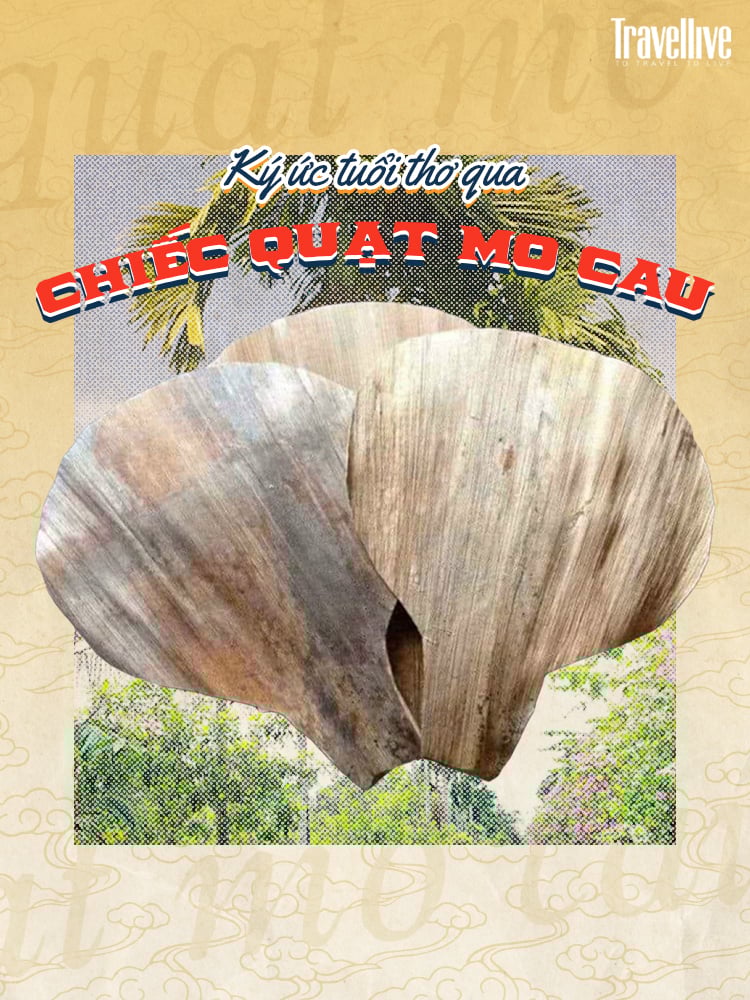
The palm leaf fan evokes childhood stories for the 60s and 70s generations.
Ornamental betel palms only produce flowers, usually white, and do not bear fruit. The native betel palm has a smaller but sturdy trunk, growing tall and straight. Its flowers, when in bloom, emit a fragrant aroma. The fruit, as everyone knows, is used for chewing with betel leaves and white lime paste during weddings, funerals, and housewarming ceremonies. The custom of chewing betel with lime paste is gradually disappearing; very few places still maintain it. When I was a child, the women and mothers, "those women selling goods with black teeth," had teeth that were black and aching like betel nuts. The betel juice seeping from the corners of their mouths and spreading along the wrinkles was quite distinctive. Because of betel chewing, even without toothpaste, the women and mothers of that era had very strong and durable teeth.
When the palm sheath fell, I remember my grandmother picking it up, cleaning it, and tying it to the largest round pillar in the house to keep it in place, prevent it from curling, and ensure it was dry enough to hold its shape. Then she would use it to make fans. The thickest and hardest part, the stem attached to the palm trunk, is like the fan's ribs, where you hold it to create wind. The thin, soft sides are folded in, and holes are punched to secure them with bamboo strips, making them neat, sturdy, and in the shape of a fan: tapering at the bottom and spreading out at the top. The widest part of the fan is slightly curved to create wind. The palm sheath fan in the famous folk song "Bờm has a palm sheath fan" is made from this very palm sheath.


The palm-leaf fan in the famous folk rhyme "Thang Bom has a palm-leaf fan" is actually a fan made from palm leaf sheaths.

A palm sheath fell down.
Those sweltering summer nights of yesteryear, the image of a palm-leaf fan being fanned all night to cool the air and ward off mosquitoes, is surely deeply etched in the memories of many people from the 60s and 70s generations like myself, who were "born in the village." Back then, mosquito nets were scarce, and the sound of the palm-leaf fan swatting mosquitoes in the late night was a part of our humble, simple, yet endearing memories.
Besides its primary function of providing coolness, the palm-leaf fan has countless other uses, no less impressive than a Coca-Cola bottle falling from the sky onto a village in the classic film "Even the High Gods Must Laugh." Palm-leaf fans are used to cover drinks and food to protect them from flies, mosquitoes, and dust. They become a farming tool during harvest season when drying rice and scooping it into baskets to pour into the granary. The fan acts like a paperweight on the desk of a rural teacher (my father) when he has to leave grading papers mid-morning, preventing the students' test papers from being blown away by the wind. The fan is even used for exercise. I remember during the summer, my older sister found two shuttlecocks for my brother and me. Before we knew how to kick them, we used the palm-leaf fan to toss them up, catch them, and toss them up again. We'd do dozens of laps around the front yard the next morning, leaving us drenched in sweat and panting.

The betel palm trees are perfectly straight.
If the palm sheath isn't dried enough before being used to make fans, in the hot and humid weather characteristic of Northern Vietnam, it's prone to mold. If it's dried too much, the fan becomes brittle and easily cracks. But I've never seen a hand fan that's as soft, durable, sturdy, and airtight as the palm sheath fan that holds so many memories of the past. On the fan's body, which is the inside of the palm sheath, there are sometimes fascinating stories that are truly unprecedented. Some people write all sorts of interesting things on it with a ballpoint pen, others draw pictures of flowers, birds, animals, rivers, and mountains. I remember my father's palm sheath fan had a local official, after drafting a document, casually write the words: Socialist Republic of Vietnam… and below it, “On behalf of the Chairman of the People's Committee of the commune…” My sisters and I would look at the fan and ask each other what “TM” meant, and we couldn't figure out what it stood for.
The beauty of the palm-leaf fan is that once you've finished writing or drawing on it, if it gets old or boring, you can peel off the old layer and "create" new designs. It's not as monotonous as the bamboo fans sold in the town, which are always the same design of peach blossoms or chrysanthemums, green or yellow, from the time you buy them until they break. Bamboo fans are also prone to breaking, becoming rickety after a few uses, and most importantly, they are far less useful than palm-leaf fans. Their primary function of creating wind is much weaker and less effective because the bamboo is thin and has gaps everywhere.

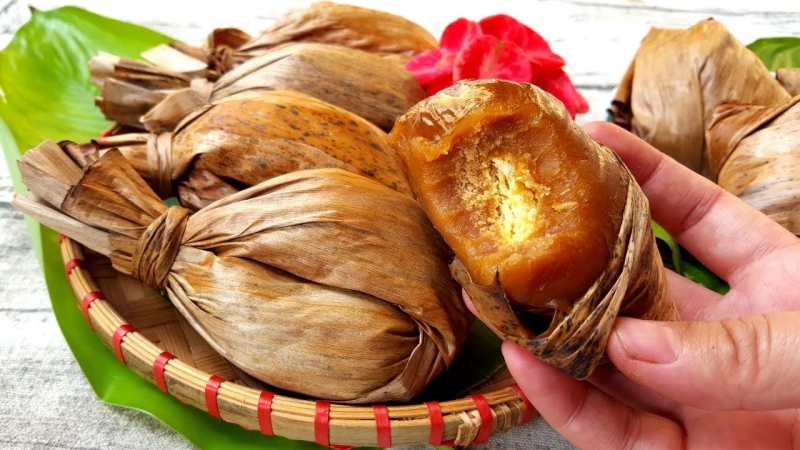
Besides making palm leaf fans, palm sheaths have countless other uses, including crafting everyday items like bowls and plates.
Just seeing a fallen palm leaf fan by the roadside brought back countless childhood memories, seemingly as distant as fairy tales. Generations like GenX, GenY, and GenZ probably never even see or imagine what a palm leaf fan looks like or what it's made of. But deeply ingrained in the minds of those who have been away from their homeland for a long time, simply glancing at rows of tall, straight palm trees with their drooping fronds and clusters of palm fruit evokes a poignant, yearning longing for home…